

Have DEXs replaced centralized exchanges in 2026?
No. Decentralized exchanges have gained substantial market share since the FTX collapse, but centralized exchanges still process most crypto trading volume. CoinGecko's 2026 CEX and DEX report put DEXs at 13.6% of spot volume in January 2026, up from 6.9% in January 2024. Perpetual DEXs reached 10.2% of perpetual volume in January 2026, up from 2% two years earlier.
| Measure | January 2024 | January 2026 | What it means |
|---|---|---|---|
| DEX share of spot volume | 6.9% | 13.6% | DEX share doubled, but CEXs still handled about 86% in the study |
| DEX share of perpetual volume | 2.0% | 10.2% | Onchain derivatives grew quickly, but CEXs retained about 90% |
| DEX spot volume | US$95.86 billion | US$231.29 billion | Absolute DEX activity more than doubled |
| DEX perpetual volume | US$81.74 billion | US$739.48 billion | Perpetual DEX volume increased about eightfold |
These figures compare the exchanges included in CoinGecko's methodology and should not be treated as a complete census of every venue. DEX spot share briefly reached 24.5% in June 2025, partly because Binance Alpha routed trades through PancakeSwap, then fell back. That is evidence of growing onchain execution, not a wholesale replacement of CEXs.
DEX vs CEX: the practical difference
| Factor | DEX | CEX |
|---|---|---|
| Custody | User signs trades from a wallet; assets are not normally deposited with the exchange operator | User typically deposits assets and receives an account balance owed by the operator |
| Execution | Smart contracts settle onchain; speed and cost depend on the network | Orders match on an internal engine and usually settle inside the exchange database |
| Market access | Permissionless pools can list assets quickly, including scams and illiquid tokens | The operator controls listings, accounts, withdrawals and available jurisdictions |
| Fiat and support | Usually limited; wallet and bridge errors may be irreversible | Often offers bank/card rails, account recovery and customer support |
| Main trust risk | Contracts, wallet approvals, front ends, oracles, bridges and governance/admin controls | Custody, solvency, withdrawal controls, internal security and management |
| Costs | Swap fee, network fee, slippage, price impact and sometimes MEV | Maker/taker fee, spread, withdrawal fee and sometimes funding or conversion fees |
A DEX reduces the need to trust a custodian, but “non-custodial” does not mean risk-free or fully decentralized. A malicious token approval can drain a wallet; a compromised front end can present a bad transaction; a bridge or smart contract can fail; and some protocols retain upgrade or emergency powers. Likewise, a CEX can be useful for fiat access and deep order books without being an appropriate place for long-term storage.
What changed since the 2022 article
- DEX growth persisted beyond the immediate FTX shock. Spot share remained above 10% throughout 2025 in CoinGecko's dataset, while newer perpetual DEXs expanded the derivatives segment.
- CEX dominance persisted too. CEXs still exceeded US$1 trillion in monthly spot volume in the period covered by CoinGecko's 2026 report.
- Price discovery is shared across venues. Arbitrage links CEX order books and DEX pools. Most spot AMMs calculate prices from pool reserves and trades; they do not all “depend on a CEX oracle,” although some DeFi products do use external oracle feeds.
- DEX fees are not automatically lower. Network congestion, pool fees, slippage, price impact and MEV can make a small trade expensive. A liquid CEX pair may be cheaper; a competitive DEX route may be better in other cases.
- Liquidity provision is not passive guaranteed income. Fees must exceed impermanent loss, adverse selection, token depreciation, contract risk and transaction costs for an LP position to outperform simply holding the assets.
How to choose between a DEX and CEX
- Use the venue that supports the asset and network safely. A cheap quoted price is irrelevant if the token contract is fake or the withdrawal network is wrong.
- Compare total execution cost. Check the final token amount after fees, spread, slippage, price impact and gas—not just the headline fee rate.
- Size the trade against real liquidity. Preview price impact and split or route large orders only when the extra contracts and bridges do not add disproportionate risk.
- Separate trading from storage. Keep only the amount needed for the trade on a custodial exchange or hot wallet. Protect long-term holdings with an appropriate self-custody setup.
- Verify every transaction. Check the domain, chain, token contract, spender, approval amount and minimum received. Never disclose a seed phrase.
Original December 2022 analysis (historical archive)
The original article is preserved substantially as written below. Its November 2022 volumes, market shares, user counts and generalizations about fees, oracles and DEX safety are historical and should not be read as current measurements.
“Not your keys, not your crypto” — this decade-old mantra has taken full effect after the FTX collapse. Crypto users have lost faith in centralized exchanges (CEXs) and are migrating to decentralized exchanges (DEXs) instead. Though a non-custodial option seem to be an ideal solution, it would likely take a long time until price discovery shifts from centralized to decentralized platforms. Let’s take a closer look.
Impact of FTX Collapse on Centralized Exchanges
Almost every centralized platform in the crypto industry had done business with FTX, and some companies bore the brunt of the collapse such as BlockFi, Genesis Trading, and KuCoin. Crypto users around the globe found they could no longer withdraw assets from several crypto exchanges as the contagion spreads.
FTX’s collapse is a symptom of a problem inherent to centralized exchanges, also known as custodial exchanges. Customers’ tokens parked on the platform are exposed to the risk the exchange could go bust. Because crypto has no government depositary schemes to cover losses, customers of insolvent exchanges must wait for bankruptcy courts to regain what remains of their funds — if there is any left after other investors claim their share.
Given the circumstances, all crypto exchanges including Binance have been implementing proof-of-reserves to verify they have enough assets to cover all customers’ funds. Though it is a good transparency initiative, investors still fear for the safety of their funds. As a result, many CEX customers rushed to withdraw their funds, opting for non-custodial solutions. This is where DEXs come in.
Rise of Decentralized Exchanges after FTX Collapse
Soon after FTX’s downfall, decentralized exchanges saw a vertical spike in trading volume. According to DeFi Llama, the monthly DEX volume showed an increase of 80% from $57.6 billion in October to $103.8 in November. At the time of writing, Uniswap had the largest trading volume with 60%, followed by Curve (9.6%), PancakeSwap (9%), DODO Exchange (8%), and Balancer (3%).
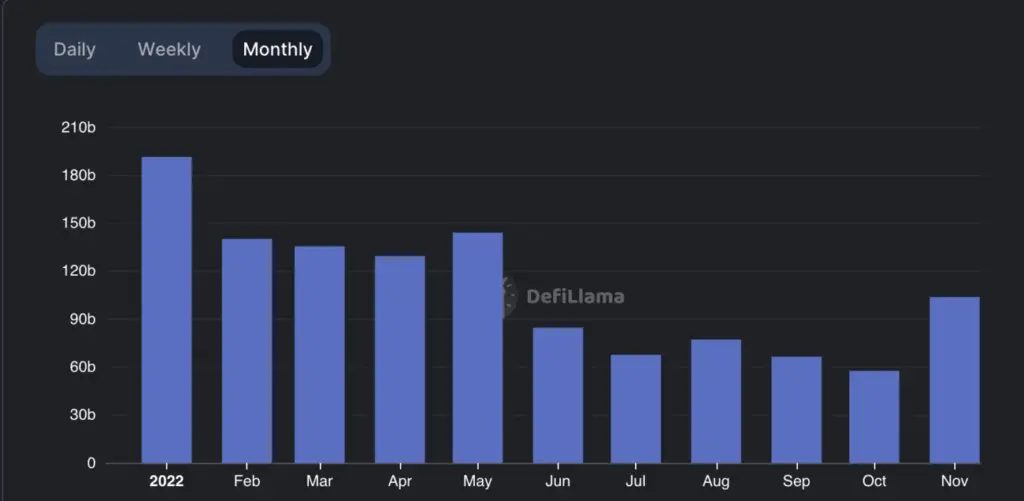
Moreover, Uniswap also surpassed Coinbase in daily ETH trading volume on November 14 ($1.1 billion vs $600 million). This is significant as CEXs have always been dominant in trading large market cap coins given their deep liquidity. It strongly indicates traders are moving away from CEXs.
This is compounded by the fact that Bitcoin (BTC) has been exiting CEX wallets at a record pace. According to on-chain data analytics Glassnode, BTC withdrawals from CEX to self-custody wallets is unfolding at a historic rate of 106k BTC monthly. This accounts for $3.7 billion worth of Bitcoins over the past week. Simultaneously, hardware wallet providers such as Ledger and Trezor reported its highest sales day. Check out some of these wallets:
Advantages of Decentralized Exchanges
Decentralized exchanges, also known as non-custodial exchanges, are decentralized finance (DeFi) protocols that allow users to trade directly with other users via smart contracts, without handing over management of their funds to an intermediary or custodian.
They are non-custodial, which means users have full and exclusive control of their wallet’s private keys. This is the opposite of putting your assets on CEXs as they hold onto the wallets and keys on your behalf. This feature makes it impossible for centralized players to siphon user funds, and is why people are doing their trading on DEXs instead.
Transactions on DEXs are facilitated through the use of smart contracts, and liquidity pools are funded by other users. As such, there is significantly reduced counterparty risk — you do not need to trust other users, only the code. There are three types of DEXs that uses different protocols: automated market makers (AMM), order book DEXs, and DEX aggregators. But they are all programmed to determine the best price for an asset, all while offering a better rate for users compared to CEXs.
Moreover, anyone can earn passive income if they provide liquidity to the protocol. On the other hand, CEXs are managed by a centralized organization such as a bank or a small handful of professional trading firms or market makers. In this case, since liquidity is concentrated in these actors, CEX maker and taker fees are much higher than DEX swap fees. Additionally, they can also choose to withdraw their assets during periods of volatility, restricting trades when users need it most.
Challenges Facing Decentralized Exchanges
Despite the many critical advantages DEXs offer, it has several downsides that hinders widespread adoption:
Relies Heavily on Centralized Exchanges
Most DEXs are dependent on price oracles (i.e. Chainlink) that source data from CEXs. As such, an attacker can manipulate the price of an asset on a particular DEX, leading to inaccurate price data being fed to all protocols which rely on that DEX as a price oracle.
A flash loan attack is a common method to trick price oracles. In such events, attackers essentially create false arbitrage opportunities by instantaneously borrowing, swapping, depositing large numbers of tokens, tricking price oracles that the target token’s price is being moved on a single exchange.
This creates a disparity which can then be arbitraged, allowing the sale or purchase of assets at above or below market price. Polygon’s Quickswap was a victim of this attack in October 2022.
DEX Transactions are Slower than CEX
Trading on DEXs are often much slower because all trades take place on the blockchain. It takes time for blocks to be validated and transactions to go through. On the other hand, CEX trades are almost instantaneous because they take place on proprietary matching engines instead of the blockchain. These engines are complex software that synchronizes and combines data from thousands of trading pairs at the same time.
Liquidity Issues and Impermanent Loss
DEXs cannot yet compete with large CEXs in size as they cannot offer as much liquidity. When they do not have enough liquidity, large orders can incur slippages in which the buyer pays above-market prices on their order. As such, a lack of liquidity can deter institutional participation as large orders are likely to suffer from slippage.
On another note, liquidity providers are exposed to a risk of impermanent loss when depositing two assets for a specific trading pair. In most cases, liquidity providers end up withdrawing more of the token that lost value and less of the one that gained value because the ratio of tokens held in the pool changes as trades occur.
Smart Contract Vulnerabilities
Although there is significantly reduced counterparty risk when using DEXs, there is still the issue of smart contract vulnerabilities that can be exploited by hackers. Smart contract codes are publicly available and anyone can review their code. Therefore, exploitable bugs can still slip past audits and other code reviews.
This is a problem inherent to all DeFi protocols. Over the past two years, we have seen numerous hacks on cross-chain bridges, hot wallets, staking platforms, and even entire blockchain infrastructures.
See also: 10 Best Smart Contract Security Auditing Firms in 2022
Future Landscape of Crypto Exchanges
In the wake of FTX’s collapse, users’ confidence in centralized exchanges are waning and the crypto community expects a shift toward decentralized platforms. However, according to JPMorgan and several other financial analysts, centralized exchanges will continue to control the majority of global digital-asset trading volumes. Although DEX trading volume has surged over the past month, it is a possibility that it reflects the automatic liquidations following the FTX collapse, and does not indicate the start of a long-term trend.
DEX users are still confined to a relatively small base of niche traders and investors, and their interfaces can be difficult to navigate. At this stage, CEXs still provide a better user experience, fiat gateways, and deeper liquidity. To date, Uniswap has a total of 4.5 million users cumulatively, whereas Coinbase has a total verified user base of 108 million.
With that being said, DeFi is still in its infancy. Development in liquidity protocols, safekeeping mechanisms, and user interfaces is needed to fully realize the potential of non-custodial trading services. As long as DEXs can compete with CEXs in terms of liquidity and speed, we may start to see widespread adoption or even a full-on switch to DEXs. After all, decentralized infrastructures are key to preventing centralized collapses, something we, as the community, has had enough of for the past year.
Frequently asked questions
Have decentralized exchanges replaced centralized exchanges?
No. DEX share has grown, but CoinGecko measured only 13.6% of spot volume and 10.2% of perpetual volume on DEXs in January 2026. CEXs remained the dominant venues.
Is a DEX safer than a CEX?
It removes some custodial and insolvency risk because users normally keep control of their wallet, but it adds smart-contract, approval, token, oracle, bridge, front-end and key-management risks. Safety depends on the protocol and how it is used.
Can a DEX freeze withdrawals?
A genuinely non-custodial pool does not have a conventional exchange account to freeze, but a protocol can still pause contracts if it has emergency controls, a front end can block access, and a congested or halted network can delay transactions.
Are DEX trades anonymous?
No. A wallet address may be pseudonymous, but trades are normally public onchain and can be linked through funding sources, reused addresses, analytics, front-end data or identity checks at other services.
Are DEX fees always lower than CEX fees?
No. Compare pool fees, gas, slippage, price impact and MEV with the CEX maker/taker fee, spread and withdrawal cost. The cheaper route varies by asset, size, network and market conditions.
Do all DEXs rely on centralized-exchange price oracles?
No. AMM spot prices usually emerge from pool balances and trades, while order-book DEXs use their own orders. Some lending, derivatives and risk systems use external oracle feeds that may aggregate CEX and DEX data.
Can a DEX list a fake token?
Permissionless pools allow anyone to create a market, so ticker and logo matches prove nothing. Verify the full contract address through the project's official channels and inspect liquidity, holder and contract risks.
Is providing DEX liquidity guaranteed passive income?
No. Fees may not offset impermanent loss, adverse selection, token price declines, exploits, incentive-token dilution and gas. An advertised APR is not a guaranteed return.
Why do traders still use centralized exchanges?
CEXs commonly provide fiat deposits, deep liquid order books, fast internal execution, advanced order types, customer support and account recovery. Those conveniences come with custody and operator risk.
Should crypto be stored on a DEX or CEX?
A DEX is a trading protocol, not a storage location; assets remain in the connected wallet except while committed to contracts. A CEX balance is custodial. Long-term storage requires a separate security decision based on the user's ability to manage keys and backups.
Sources and methodology
- CoinGecko 2026 CEX and DEX Trading Activity Report
- CoinGecko DEX-to-CEX spot and perpetual volume methodology
- CoinGecko 2026 State of Crypto Perpetuals Report
- DefiLlama DEX volume dashboard
- Bank for International Settlements comparison of DEX and CEX market structure
- BIS paper on crypto and DeFi functions and financial-stability risks
Share
Found this useful?
Share it with someone who'd want to read it.
Related

PancakeSwap ($CAKE) guide and tutorial
PancakeSwap is one of the most popular yield farming projects on Binance Smart Chain .
0x Protocol and ZRX Guide: Swap API, Settler and Governance Status
How 0x works in 2026: Swap API v2, Settler, gasless and cross-chain routing, plus the current dormant governance and retired ZRX staking status.

DinoSwap DINO Status: Is the Polygon DEX Still Active? (2026)
DinoSwap's contracts and DINO token remain on Polygon, but public development and liquidity are minimal. Check the verified contract, current activity evidence and safer recovery steps for old farm deposits.