
Trezor One vs Model T in 2026: both are discontinued but supported, with Safe 3 and Safe 5 as their successors. Compare screens, coins and backups below.
The main differences are buttons versus a touchscreen, narrower versus broader asset support, and basic versus multi-share backup. For a new purchase in 2026, compare their successors first: Trezor discontinued direct sales of both legacy models on January 8, 2026. The Safe 3 succeeds Model One; Safe 5 succeeds Model T.
Already own one? Discontinued does not mean unusable. Trezor promises critical security fixes for both until at least 2036, basic maintenance until at least 2031, and new coin support for Model T until at least 2031. See its official support commitment. This comparison was checked on October 20, 2026.
Trezor One vs Model T: side-by-side specifications
| Feature | Trezor Model One | Trezor Model T |
|---|---|---|
| Price and availability in 2026 | Discontinued in the official shop; no current direct-sale USD price | Discontinued in the official shop; no current direct-sale USD price |
| Screen | 0.96-inch monochrome OLED | 1.54-inch color touchscreen, 240 × 240 pixels |
| Input | Two buttons; host-side blind PIN matrix and passphrase entry | PIN, passphrase and recovery entry on the touchscreen |
| Size | 60 × 30 × 6 mm | 64 × 39 × 10 mm |
| Weight | 12 g | 22 g |
| Connection | Micro-USB; no Bluetooth | USB-C; no Bluetooth |
| Secure Element | None | None |
| Backup | BIP39; 24 words by default, no SLIP39 | BIP39 plus SLIP39 Single-share and Multi-share Backup |
| Asset examples | BTC, ETH and supported ERC-20 tokens; no native ADA, XRP or SOL | BTC, ETH, ADA, XRP and SOL, plus supported tokens |
| Current successor | Safe 3 | Safe 5 |
Hardware and backup specifications come from Trezor’s Model One page and Model T page. The older prices quoted in the historical comparison below are not current offers. Official resellers may have remaining stock; availability and local pricing vary.
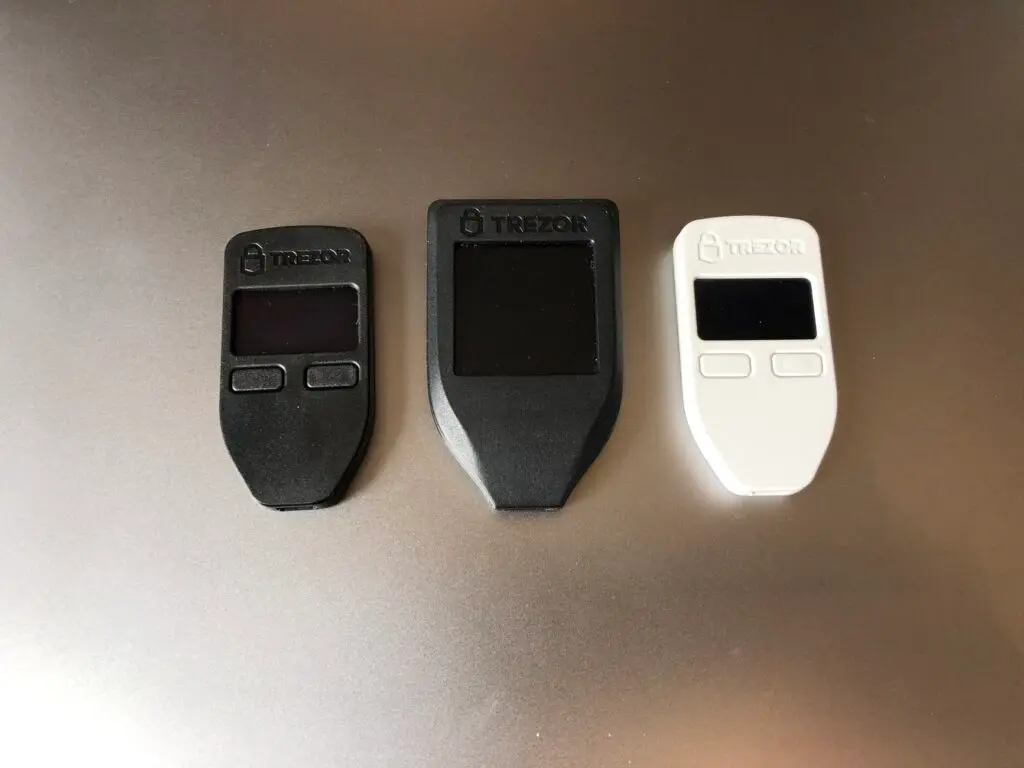
Trezor Model T size: is it much bigger than One?
Model T is 4 mm taller, 9 mm wider and 4 mm thicker, and weighs 10 g more. Both are small USB devices; the practical difference is the screen and input space rather than portability. Model T is easier to use when entering sensitive information directly on the wallet. Model One’s buttons remain adequate for checking an address and approving a transaction.
Trezor Model One coins vs Model T coins
Do not choose using an old “1,000 vs 1,400 coins” total. Those figures mix networks, tokens and app integrations. Check the exact asset, network, device and wallet app in Trezor’s supported-assets directory before transferring funds. A token on Ethereum and a token with the same ticker on Solana are different compatibility questions.
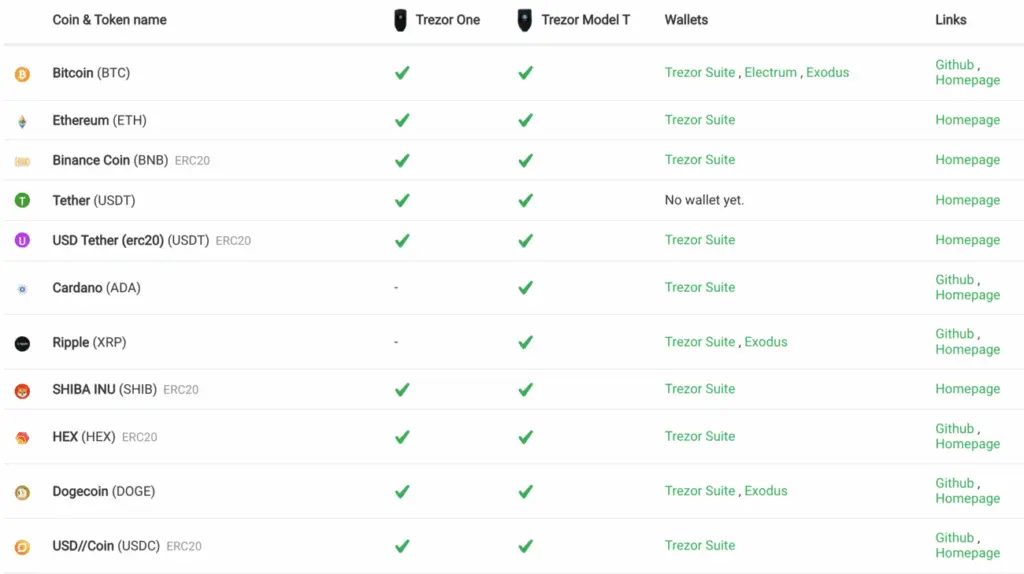
Both support Bitcoin and Ethereum. Model T adds important native-chain options that Model One lacks, including Cardano, XRP and Solana. Model One’s limitation is not simply that it cannot handle “later ERC-20 coins.” An ERC-20 token uses Ethereum; native ADA, XRP and SOL use other chains. A third-party app cannot add missing signing support to Model One’s firmware.
What coins did Trezor One lose in Trezor Suite?
Trezor Suite removed Dash, Bitcoin Gold, DigiByte, Namecoin and Vertcoin support in February 2025, with the associated backend support ending in July 2025. This affected Model T as well as Model One. Trezor says the firmware still supports those assets, so a suitable third-party application can provide access. This is an app-support change, not the coins disappearing from the blockchain. Follow the official removal and migration guidance to check your specific coin’s options.
Security and backup differences that matter today
Neither legacy model has a Secure Element. The Safe series adds that physical protection; Trezor’s PIN protection guide explains the different architectures. For an existing legacy device, keep firmware current, use a long random PIN and protect the backup. A passphrase can add protection but introduces another secret you must preserve exactly; forgetting it can make that wallet inaccessible.
Model One’s blind PIN matrix means you click positions on the computer while reading the shuffled digits on the device. Its Advanced Recovery similarly conceals recovery letters from the host. It is inaccurate to describe every Model One recovery as simply typing the phrase into a computer. Only follow recovery instructions confirmed on the physical device.
Model T supports SLIP39, often called Shamir Backup, including Single-share Backup and Multi-share Backup. Model One cannot restore a SLIP39 backup. Before using either as a spare, check backup format and asset compatibility. Multi-share means a chosen threshold of shares can recover the wallet; it does not mean arbitrarily cutting a BIP39 phrase into pieces.
Model T’s microSD slot can be used for SD card protection, binding unlocking to a secret on the card. The slot itself does not create hidden wallets: passphrases do that. Also, USB-C alone is not evidence of faster transaction signing, and no hardware wallet guarantees protection against malicious transaction approvals.
All Trezor models in 2026: which should you buy?
| Model | Official lineup status | Who should consider it? |
|---|---|---|
| Model One | Discontinued; supported legacy device | Existing owners whose assets and backup requirements still fit |
| Model T | Discontinued; supported legacy device | Existing owners who use its touchscreen and broader coin support |
| Safe 3 | Current wired, button-operated model with a Secure Element | New buyers wanting a straightforward cold-storage device; see our Safe 3 review |
| Safe 5 | Current wired touchscreen model with a Secure Element and haptic feedback | Buyers prioritizing on-device input; see our Safe 5 review |
| Safe 7 | Current wireless touchscreen model with dual Secure Elements | Buyers who need Bluetooth and full iPhone connectivity; see our Safe 7 review |
The official comparison covers the current Safe lineup. Check its store for the checkout price in your region, including tax and shipping; there is no reason to treat legacy $69 or $219 figures as today’s buying benchmark.
Both legacy models work with Trezor Suite on desktop and Android, but have limited iOS functionality. They cannot sign iPhone transactions through a direct device connection. Trezor’s Suite compatibility guide identifies Safe 7 as the model with full iOS support via Bluetooth.
Our verdict: between the two legacy devices, Model T offers the more useful interface and broader backup options. For a new purchase, start with Safe 3 or Safe 5 instead. For existing owners, end of sales alone is not a reason to migrate immediately: review supported assets, backup readiness and your need for stronger physical protection first. Our Model One review and Model T review provide device-specific context; the hardware-wallet comparison hub covers alternatives across brands.
Boxmining’s Take
Michael’s view is practical: he does not carry a hardware wallet daily. For everyday amounts, a normal up-to-date iPhone with its Secure Enclave and a good self-custody app is enough for his use. That is a personal risk judgment, not a claim that every mobile wallet has hardware-wallet isolation. A hardware wallet makes more sense for substantial long-term holdings kept in cold storage. Buy for that job, rather than assuming the most expensive model is automatically necessary.
Frequently asked questions
Is Trezor One or Model T better in 2026?
Model T has a touchscreen, broader native-chain support and SLIP39 backup. Both are discontinued in Trezor's shop. New buyers should compare Safe 3 and Safe 5; existing owners can keep using their supported devices.
Are Trezor One and Model T still supported?
Yes. Trezor commits to critical security fixes until at least 2036 and basic maintenance until at least 2031 for both. Model T also has a new-coin-support commitment until at least 2031.
What coins does Trezor Model T support that One does not?
Native Cardano, XRP and Solana are important differences. Both support Bitcoin and Ethereum. Verify the exact asset and network in Trezor's directory; a third-party wallet cannot overcome absent device firmware support.
What is the Trezor Model T size and weight?
Model T measures 64 × 39 × 10 mm and weighs 22 g. Model One measures 60 × 30 × 6 mm and weighs 12 g.
Does Trezor One support Shamir or Multi-share Backup?
No. Model One uses BIP39 backups and cannot restore SLIP39. Model T and the Safe series support SLIP39 backup options.
Can Trezor One or Model T connect to an iPhone?
They do not support direct iPhone transaction signing. Their iOS Suite functionality is limited. Safe 7 supports full iOS connectivity through Bluetooth.
Historical 2025 comparison — superseded by the verified 2026 guide above
Archive notice: The original comparison below is retained for historical context. Its buy links, prices, coin counts, 2025 recommendations and broad security assurances are not current guidance. The current guide above supersedes them. In particular, third-party apps cannot add unsupported chains, the microSD slot is not a hidden-wallet feature, and neither legacy device has a Secure Element. Do not rely on the archived claim about an absence of remote exploits as a security guarantee.
Trezor One and Trezor Model T are cryptocurrency hardware wallets released by SatoshiLabs in 2014 and 2018. As of 2025, Trezor One remains a solid choice for budget users or those with simpler portfolios. For users seeking broader coin support and a touchscreen interface, the Model T is worth the premium.
In this article, we compare both wallets and offer our updated verdict on which one fits your needs best in 2025.
For an in-depth look at each device, check out our Trezor One Review and Trezor Model T review.
Who is Trezor One for?
- Those who care about affordability. Retailing at 69 EUR, it is relatively affordable as a mainstream branded hardware wallet.
- Users who just want to trade the major coins. The Trezor One has comparatively fewer supported coins.
- Those interested in a smaller, more portable wallet. It is lighter and around 20% smaller than the Model T.
Get your Trezor One here.
Who is Trezor Model T for?
- Sophisticated traders who trade or are interested in trading numerous different altcoins. For example the Trezor One does not support Ripple (XRP), Cardano (ADA), Solana (SOL) and a number of later ERC-20 coins.
- Users who want clear and vivid displays: The Model T has an almost 2x larger colour touch screen.
Get your Trezor Model T here.
Security Features
Trezor hardware wallets continue to be among the most secure options for storing cryptocurrency. Both the Trezor One and Trezor Model T are developed by SatoshiLabs and receive regular firmware updates to address vulnerabilities and improve user protection.
Core Security Architecture
- Open-source firmware and hardware allow for independent audits and community verification.
- Trezor does not use a closed-source secure element. Instead, it relies on a hardened microcontroller and software-based security architecture.
- Devices ship with tamper-evident packaging to detect physical interference.
PIN, Passphrase, and Recovery Phrase
- PIN code can be up to 50 digits and is required to unlock the device.
- Passphrase is optional but recommended. It adds an extra layer of protection and enables hidden wallets.
- Recovery phrase consists of 12 to 24 words and is used to restore access if the device is lost or damaged.
Physical Vulnerability Disclosure
In 2020, Kraken Security Labs disclosed a hardware vulnerability affecting both models that allows PIN extraction if an attacker has physical access. This issue stems from the microcontroller design and cannot be fixed via firmware. SatoshiLabs has implemented several mitigations:
- Passphrase protection, when enabled, neutralizes the vulnerability.
- Firmware updates have hardened the software to reduce attack vectors and improve resilience.
As of 2025, no successful remote exploits have been reported for either device. Users are advised to enable passphrase protection, store recovery phrases securely offline, and keep firmware updated through Trezor Suite.
Input Method Differences
- Trezor One requires PIN, passphrase, and recovery phrase to be entered via the connected computer or mobile device.
- Trezor Model T allows all sensitive inputs to be entered directly on the device’s touchscreen, reducing exposure to malware on host devices.
Multicurrency Support
This is one of the clearest areas where the differences between the Trezor One and Model T show up—especially with the rapid evolution of the crypto space.
Trezor One
Supports over 1,000 coins and tokens, including major assets like:
- Bitcoin (BTC)
- Ethereum (ETH) and all ERC-20 tokens
- Litecoin (LTC), Bitcoin Cash (BCH), Dogecoin (DOGE), Ethereum Classic (ETC), and Chainlink (LINK)
Does not support newer or more complex assets natively, such as:
- Cardano (ADA)
- Ripple (XRP)
- Solana (SOL)
- Monero (XMR)
Some unsupported coins may be accessible via third-party wallet apps, but this requires extra setup and technical know-how.
Trezor Model T
Supports over 1,400 coins and tokens, with broader native compatibility including:
- Cardano (ADA)
- Ripple (XRP)
- Solana (SOL)
- Tezos (XTZ), EOS, BNB, and SPL tokens
Also handles ERC-20 tokens, Ethereum Layer 2 tokens (e.g., Polygon/MATIC), and NFTs on supported blockchains
Ideal for users with diverse portfolios or who want access to DeFi ecosystems and newer altcoins
Click here for a full list of the cryptocurrencies supported by the two devices.
Hardware Design
Both Trezor devices maintain a minimalist, durable design philosophy, but they differ significantly in usability and interface.
Trezor One
- Compact and lightweight: measures 60mm x 30mm x 6mm and weighs just 12 grams
- Monochrome OLED display with 128 × 64 pixel resolution
- Two physical buttons for navigation and confirmation
- Connects via USB-A (micro-B) cable
- Available in black and white
- No battery; powered via external USB connection
- Ultrasonically welded plastic casing for tamper resistance
- Supports U2F standard and includes optional password manager via Chrome extension
Trezor Model T
- Slightly larger: 64mm x 39mm x 10mm and weighs 22 grams
- Full-color LCD touchscreen with 240 × 240 pixel resolution
- Touchscreen interface allows PIN and passphrase entry directly on the device
- Uses USB-C connection for faster and more durable connectivity
- Supports Shamir Backup (SLIP-0039) for advanced recovery options
- MicroSD card slot for hidden wallets and plausible deniability
- Fully open-source firmware with customizable security settings
- Designed for enhanced usability and privacy, especially in high-risk environments
Both devices are compatible with Windows, macOS, Linux, and Android, and integrate seamlessly with the Trezor Suite app.
Verdict
Both Trezor One and Trezor Model T remain excellent choices for securing digital assets, but they cater to different types of users.
Trezor One
- Still one of the most affordable and reliable hardware wallets on the market
- Ideal for users who primarily hold major cryptocurrencies like Bitcoin and Ethereum
- Simple interface with physical buttons appeals to those who prefer tactile control
- Lacks support for newer coins and advanced features, but remains secure and effective for basic use
- Priced around $69, making it a great entry-level option
Trezor Model T
- Designed for users with diverse portfolios and advanced security needs
- Supports over 1,400 cryptocurrencies, including Cardano, Solana, and newer ERC-20 tokens
- Features a full-color touchscreen, USB-C connectivity, and MicroSD slot for hidden wallets
- Includes Shamir Backup for enhanced recovery options
- Open-source firmware and advanced privacy tools make it a favorite among security-conscious users
- Priced around $219, reflecting its premium build and broader functionality
If your crypto holdings are limited to major coins and you want a straightforward, budget-friendly device, the Trezor One is still a solid pick. But if you’re active in DeFi, hold a wide range of assets, or want the most secure and flexible experience available, the Trezor Model T is the clear winner in 2025.
Further reading
Want to know how the Trezor stacks up against other brands? Check out our comparison of the top 3 cryptocurrency hardware wallets!
Share
Found this useful?
Share it with someone who'd want to read it.
Related
Trezor Safe 5 Review (2026): Best-Balanced Trezor
Trezor Safe 5 review: is the $129 touchscreen wallet worth it in 2026? Compare Safe 3, Safe 7 and Model T, plus the iPhone limits.
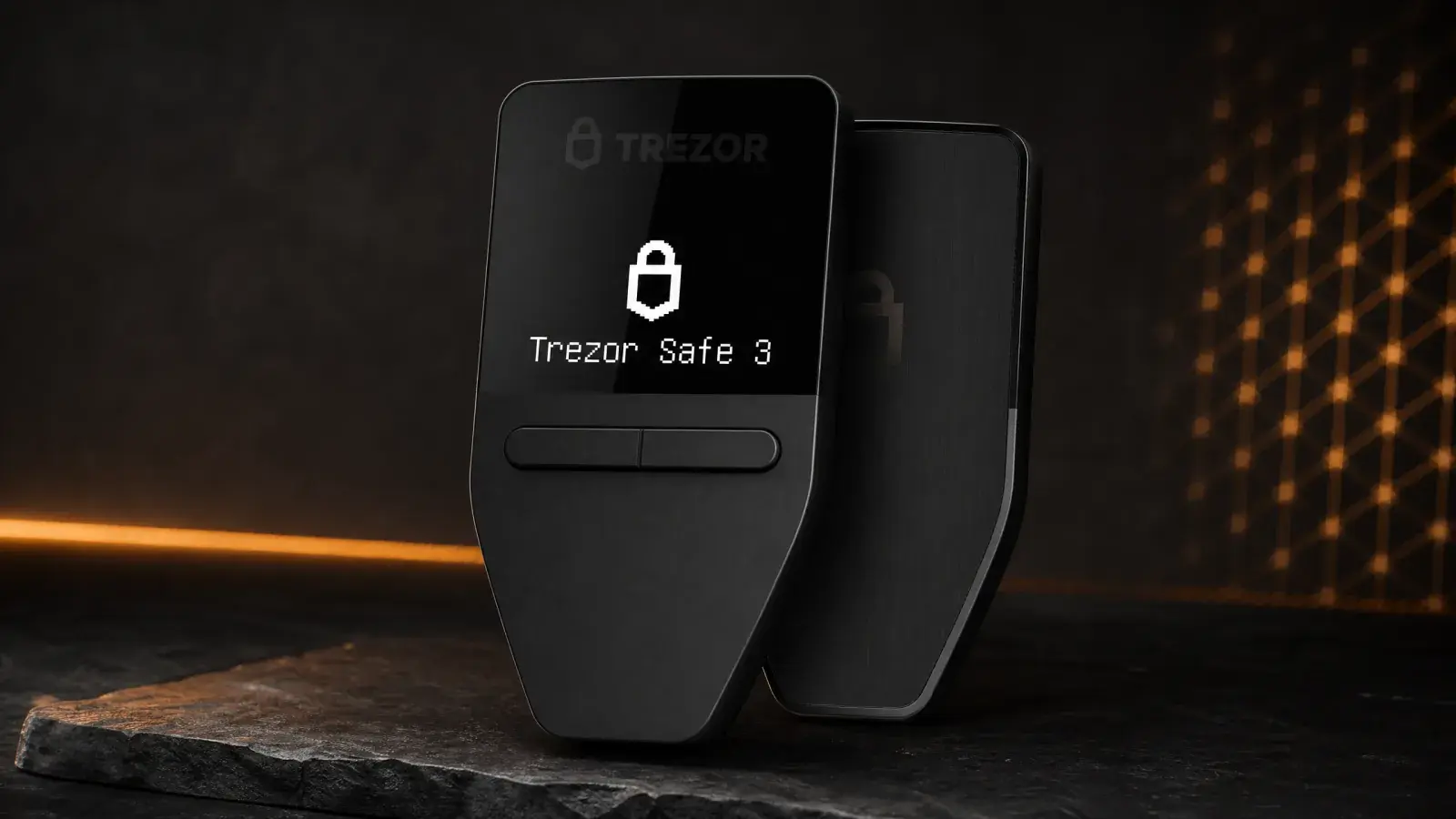
Trezor Safe 3 Review (2026): The Best US$79 Cold Wallet?
Trezor Safe 3 offers open-source cold storage and an EAL6+ Secure Element for US$79. Best for holders who accept a tiny screen and no iPhone support.
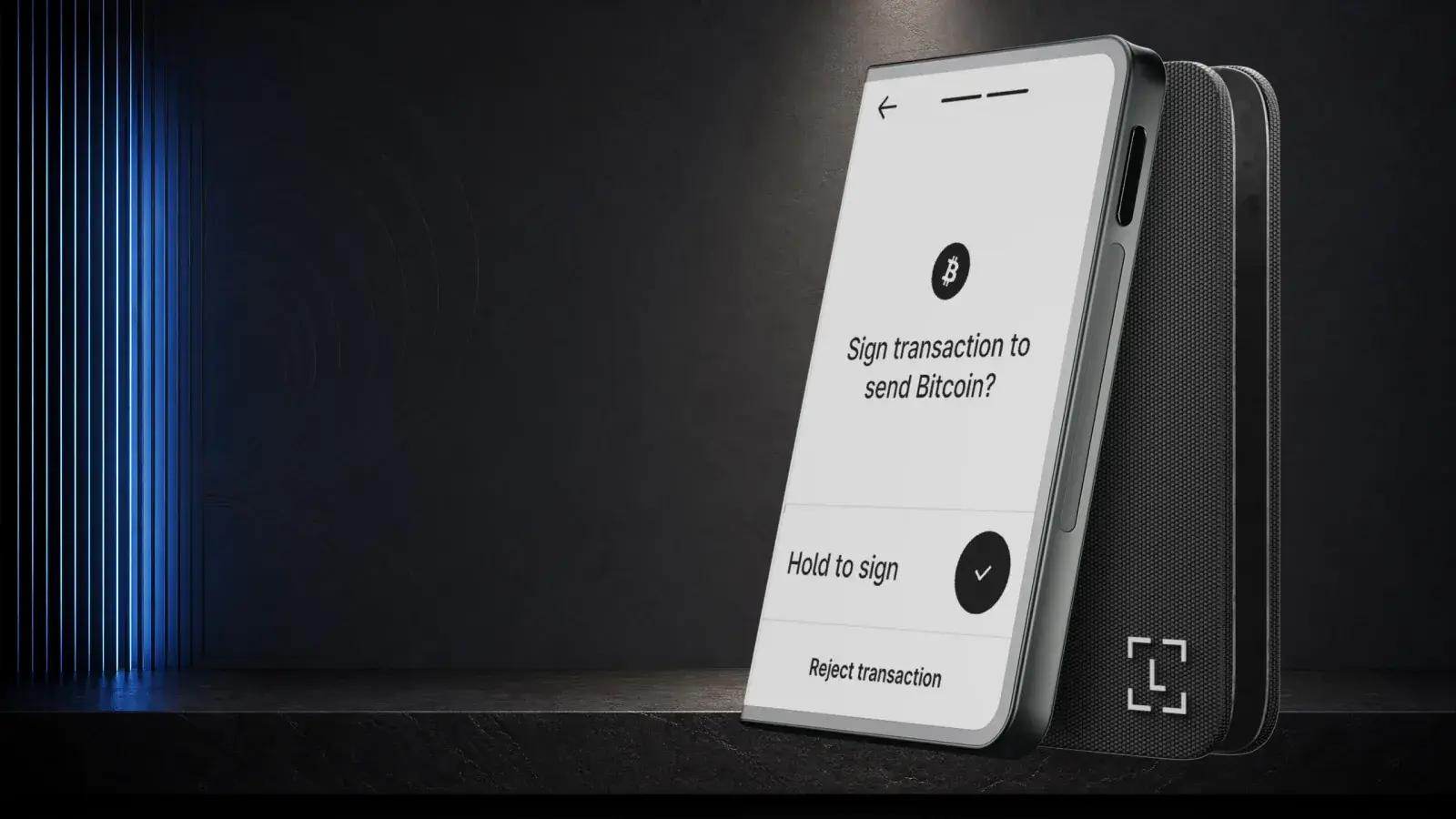
Ledger Stax Review (2026): Is the $399 Wallet Worth It?
Ledger Stax offers a curved E Ink screen and Qi charging for US$399, but not stronger key protection. It suits design-first buyers, not value seekers.