

Exchange Review
Reviewed by Michael Gu · Five-pillar methodology
The strongest crypto-native prediction-market interface we have tested, with excellent discovery and strong headline liquidity. Its biggest weakness is the fragmented regulatory and product setup between Polymarket.com and Polymarket US.
Trustworthiness
Coin Diversity
Liquidity
Regulatory Compliance
User Experience
Polymarket feels less like a betting site and more like a fast crypto exchange where the assets happen to be future outcomes. Instead of buying Bitcoin or a perpetual contract, you buy shares in answers such as “Yes” or “No.” A share priced at 64 cents implies a 64% market probability and pays $1 if that answer wins. If it loses, it pays nothing.
That simple pitch hides quite a lot of machinery. The international site uses an order book, signed crypto orders, Polygon settlement and an oracle-based resolution process. It also has geographic restrictions that rule out many large markets. US residents use a separate Polymarket US app rather than Polymarket.com.
Our verdict is positive, with a fairly large asterisk. Polymarket is the best fit for an experienced crypto user who wants broad event coverage and will read the market rules before trading. It is a worse fit for someone who wants bank funding, a single globally consistent product or the regulatory clarity of a conventional US exchange.
Polymarket review at a glance: we rate it 86/100. Makers pay no trading fee; takers pay category-dependent fees in enabled markets. The international product uses crypto funding and is unavailable or restricted in many jurisdictions. Its best features are market variety, a proper order book and non-custodial settlement; its biggest drawbacks are fragmented access, variable liquidity and resolution risk.
Scope checked 20 October 2026: This review covers the international Polymarket.com product. Its fees, collateral and resolution mechanics should not be assumed to apply to the separate US app.
Polymarket pros and cons
What we like
- The range of tradable questions is excellent. Politics, central-bank decisions, crypto, sport, technology and culture all sit in the same interface.
- Popular markets have useful charts, active order books and enough volume for proper price discovery.
- The international product is non-custodial. Orders are signed by the user and matched trades settle onchain.
- Market pages put the chart, volume, dates, related outcomes, news and trading ticket in one place.
- Limit orders give active traders control over entry price instead of forcing every trade across the spread.
What could be better
- Access is fragmented by country. Polymarket.com and Polymarket US are separate products with separate accounts.
- Funding is crypto-first on the international site. A wrong address or network can create a difficult recovery problem.
- “No platform fee” is no longer a useful blanket description. Taker fees apply in many market categories, while makers remain free and geopolitics markets are currently fee-free.
- Smaller markets can be thin. The probability shown on a card is not necessarily the price at which a large order will fill.
- A market title is only shorthand. The detailed resolution rules decide the payout.
How Polymarket trading works
Every binary market has two outcome shares. If “Yes” trades at $0.64, “No” should trade near $0.36. Together, the two sides represent the $1 that will be distributed when the market resolves. The winning share becomes redeemable for $1 and the losing share becomes worth $0.
Polymarket uses a central limit order book. Buyers and sellers post bids and asks in the same way they would on a crypto exchange. The displayed probability is generally the midpoint between the best bid and ask. If the spread is unusually wide, Polymarket may show the last traded price instead. This is why a card displaying 64% does not promise that you can buy a meaningful size at exactly 64 cents.
The platform supports orders that rest on the book as well as orders priced to execute immediately. Polymarket’s order-book documentation explains that matching happens offchain and settlement happens onchain. This keeps the interface quick while preserving signed settlement. It also means traders should check depth and slippage, especially outside the largest markets.
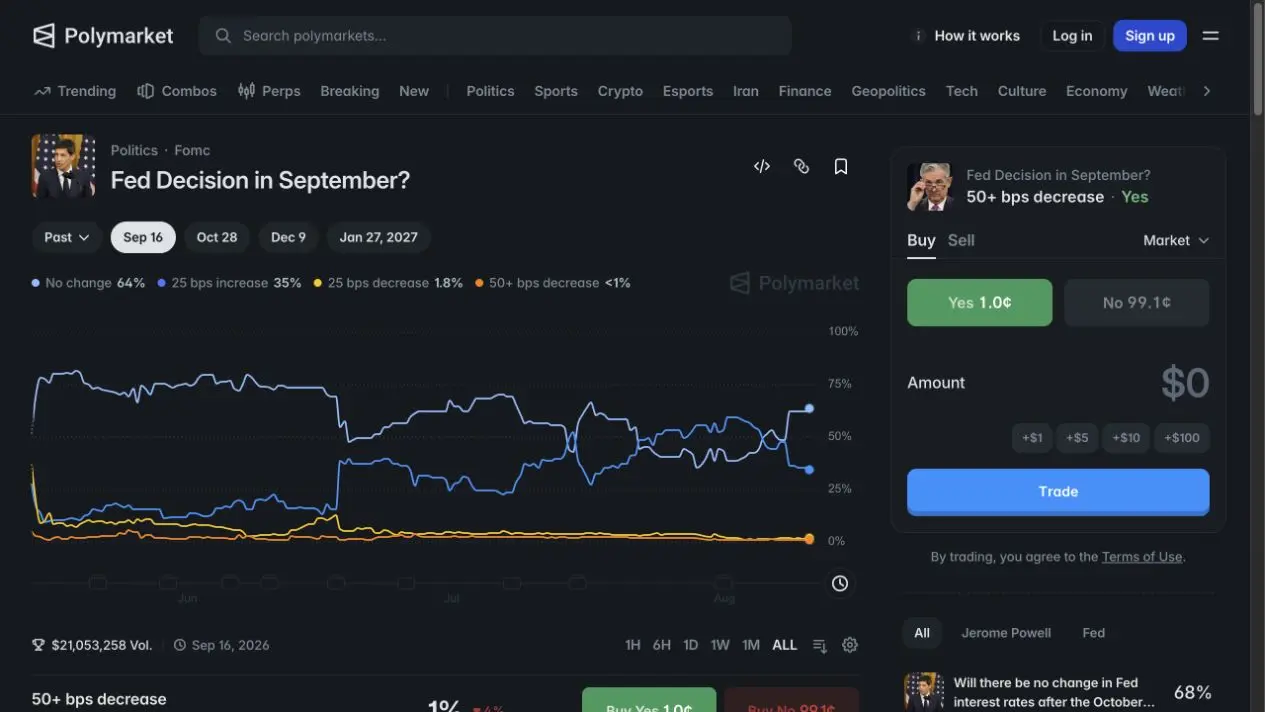
The screen above is close to what an exchange trader expects. You can inspect the historical probability, switch between dated contracts, choose an outcome and enter a dollar amount. The weak point is that the default trade panel can make a market order feel deceptively simple. Before clicking Trade, open the order book and read the rules lower on the page.
Fees
Polymarket’s current fee model depends on the market. Makers pay no trading fee. Takers pay a variable fee in enabled categories, with the dollar fee highest around a 50% probability and lower near 0% or 100%. The protocol uses those fees to fund maker rebates.
The official fee table currently lists different rates for crypto, sport, finance, politics, economics, culture, weather, mentions and technology markets. Geopolitics and world-events markets are fee-free. The trading ticket or market data should be treated as the final source for whether a specific market has fees enabled.
For scale, the official table shows that buying 100 shares at $0.50 carries a $1.75 taker fee in a crypto market, $1.25 in a sports market and $1.00 in finance, politics, mentions or technology. Those are examples, not universal flat fees: the dollar charge changes with the share price and category, and it falls as the probability moves toward 0% or 100%.
Polymarket does not add its own fee to USDC deposits or withdrawals, but that does not make moving money free. A bridge, exchange, card provider or blockchain may charge separately. The cost that catches more traders is usually the spread. Buying a thin market with an immediate order can cost much more than the displayed protocol fee.
Our practical rule is simple: use a limit order unless immediate execution is worth the spread. If you want to trade a larger amount, examine the full order book first rather than trusting the headline percentage.
Deposits and withdrawals
The international product is built around crypto funding. Each profile receives deposit addresses, and the available networks can show different addresses. Polymarket’s deposit guide recommends checking the address in the account, using the correct chain and sending a small test before a large transfer. That advice matters. Blockchain transfers are not reversible in the way a card charge can be.
Minimums also vary by network. The interface should show the applicable threshold before a transfer. Deposits below that threshold may remain pending until the cumulative amount reaches the minimum.
Withdrawals reverse the process: move the balance to a supported destination and confirm the address and network. Depending on the route, a bridge provider, receiving exchange or blockchain can introduce extra fees, delays or compliance checks. Do not send directly to a service that does not support the selected token and chain.
For users who want ACH funding, a familiar bank ledger and conventional cash withdrawals, Kalshi is much easier to understand. Polymarket earns its convenience points after money arrives, not during the journey from a bank account.
What is pUSD on Polymarket?
The deposit asset and trading collateral are different layers. Polymarket’s pUSD documentation, checked 20 October 2026, identifies Polymarket USD (pUSD) as its Polygon trading collateral backed by USDC. Supported bridge deposits can wrap into pUSD. This is a settlement token, not a promised investment return. Use the deposit and withdrawal routes shown in your account rather than assuming an exchange accepts pUSD directly.
Market selection and liquidity
Polymarket’s catalogue is its biggest advantage. The homepage behaves like a live information terminal. It groups markets by subject, surfaces breaking stories and attaches relevant news to active questions. Multiple related outcomes can be bundled into a single event page, which is much cleaner than opening a separate tab for every possible result.
Market variety is not the same as liquidity. The Fed market in our screenshot showed more than $21 million of displayed volume, while the homepage also carried markets with far less activity. A high-volume event can support narrow spreads and sizeable exits. An obscure contract may show an interesting probability but have very little depth behind it.
Check four things before entering:
- Total volume tells you whether anyone has cared about the market, but it does not show current exit liquidity.
- The bid-ask spread shows the immediate cost of getting in and out.
- Order-book depth shows how far your trade will move the price.
- Time to resolution tells you how long your capital may be tied up.
This is standard exchange discipline. Prediction markets do not remove slippage or opportunity cost just because prices are expressed as probabilities.
Can you sell before a market resolves?
You can sell outcome shares while trading remains open if there is a buyer at an acceptable price. You do not have to wait for a winning settlement to exit. But an unsold position is not cash: a limit sell can remain unfilled or fill only partly, and an immediate exit can cross several bid levels. Polymarket’s order-book guide confirms that limit orders can fill in portions and that unfilled orders can be cancelled.
For example, buying 100 shares at $0.40 costs $40 before fees. Selling all 100 at $0.55 returns $55 before fees, a $15 gross gain. If the available buyers will only pay $0.35, the same exit returns $35 and locks in a $5 gross loss. These are illustrative prices, not live quotes. For more detail, see our guide to Polymarket spread, slippage and partial fills.
Resolution and dispute risk
Polymarket uses the UMA Optimistic Oracle to resolve international markets. Anyone can propose an outcome by posting a bond, and others can dispute it during the challenge window. A disputed proposal can eventually escalate to UMA token holders.
Resolution exception, checked 20 October 2026: The UMA process above applies to UMA-resolved prediction markets. The official resolution documentation also describes up/down markets using Chainlink time-weighted average prices (TWAP), without the UMA proposal-and-dispute route. Check the specific contract’s source; a price seen on another exchange may not be its settlement input.
The important part for an ordinary trader is simpler: the market’s resolution source, deadline and edge-case language control the outcome. Polymarket’s resolution guide explicitly tells users to read those rules before trading.
This creates a type of risk that does not exist in a normal spot market. You can correctly predict the broad news event and still lose because the named source, cutoff time or measurement method differs from what you assumed. The best contracts use an objective source and tight wording. Vague or politically charged questions deserve smaller position sizes, even if the apparent odds look attractive.
A market’s end time also differs from the time you can redeem a payout. UMA proposals have a two-hour challenge window; disputes can extend settlement by days. The same official guide allows a rare unknown/50-50 outcome, where each side redeems for $0.50. The usual winning-$1/losing-$0 explanation is therefore the standard binary result, not every possible settlement.
Is Polymarket safe?
Polymarket’s international order book is non-custodial. According to its trading overview, orders are signed messages and matched trades settle atomically on Polygon. The operator cannot invent a trade that the user did not sign. That is a meaningful strength compared with leaving an unrestricted balance on an opaque offshore exchange.
Non-custodial does not mean risk-free. Users still face smart-contract risk, wallet compromise, malicious browser extensions, phishing, bridge failure and oracle disputes. A trader can also lose simply by paying too much for a valid contract. Security and investment judgment remain separate problems.
Use a unique password, enable every account protection offered, bookmark the real domain and verify links before connecting a wallet. Keep only the amount needed for active trading in the platform flow. A separate wallet for prediction-market activity can reduce the damage if a site or signature request turns out to be malicious.
Countries and regulation
Polymarket.com is the international website shown in our screenshots. It is not the US product. The official product comparison says US residents must use the separate Polymarket US iOS app, and the two account systems are not connected.
The international site also blocks or limits orders from a long list of countries. Its current geographic-restrictions page classifies the United States, United Kingdom, France, Germany, Australia and Belgium as close-only on both the website and API. Japan is close-only on the website, while the API is not restricted there. Alberta, British Columbia, Ontario and Quebec are restricted within Canada. Separately, sanctioned jurisdictions are blocked completely.
Do not use a VPN to work around these controls. Apart from the legal question, location mismatches can become a serious problem when a platform checks a withdrawal or account. Availability changes, so check the official restriction page and local law before depositing.
Who should use Polymarket?
Polymarket is a strong choice if you already understand wallets, stablecoins and limit orders. It is particularly good for traders who follow politics, macroeconomics, crypto or breaking news and want to compare a live market price with their own estimate.
It is not our first choice for a complete beginner. The interface is easy, but the funding path and resolution mechanics are not. It is also unsuitable for anyone in a restricted jurisdiction or anyone who expects a probability chart to behave like a guaranteed quote.
Prediction markets are often sold as a better news feed. That is partly true, but only in liquid markets. Prices show what traders are willing to risk at a moment in time. They can still be distorted by thin books, stale orders, incentives or one large participant.
Polymarket review verdict
Polymarket gets the product side right. Discovery is quick, live markets look good and the order-book model gives serious traders more control than a simple sportsbook-style ticket. The international platform’s non-custodial settlement is another real advantage.
The weaker side is consistency. The global website and US app are separate, geographic restrictions are extensive and the fee model now varies by category. Resolution wording also deserves the same attention that a futures trader would give a contract specification.
We score Polymarket 86/100. It is our preferred crypto-native prediction market for eligible, experienced users. Kalshi remains the cleaner option when federal US regulation, identity verification and bank funding matter more than crypto-native access.
Polymarket FAQ
What is Polymarket?
Polymarket is a prediction-market platform where eligible users trade outcome shares through an order book, with international matched trades settling on Polygon.
How does a Polymarket share pay out?
A winning binary outcome token normally redeems for $1 after resolution, while the losing token becomes worthless. Contract rules govern unusual cases.
Is Polymarket non-custodial?
The international order book uses signed orders and atomic onchain settlement, reducing conventional exchange-custody risk while retaining wallet, contract, bridge and oracle risks.
Does Polymarket charge trading fees?
Fee applicability and rates vary by market category. Check the live trading ticket or market data because a single universal fee assumption is inaccurate.
How do I fund international Polymarket?
The international product uses supported crypto deposit routes. Verify the address, token, chain and minimum in the account and test with a small transfer first.
Why does order-book liquidity matter on Polymarket?
Headline probability and total volume do not show the price available for a specific size. Spread and depth determine slippage and exit quality.
How are international Polymarket markets resolved?
They use specified contract rules and the UMA Optimistic Oracle process. The named source, deadline and edge cases control the outcome.
Can US residents use Polymarket.com?
No. Official guidance directs US residents to a separate Polymarket US product, and the international and US account systems are not connected.
Is Polymarket available in every country?
No. The international platform blocks or limits orders in many locations, and statuses change. Check the current geoblock page and local law before depositing.
Is Polymarket suitable for beginners?
It is better suited to eligible users who already understand wallets, stablecoins, limit orders, liquidity and contract resolution. Kalshi offers a more conventional funding path.
Can I cash out Polymarket before the event ends?
You can sell while trading is open if buyers are available. Your exit price depends on bids and depth, and a limit order may only partially fill. Withdrawing a cash balance is a separate step from selling shares.
Does a Polymarket limit order always avoid taker fees?
No. An order that immediately matches resting liquidity acts as a taker even if you entered a limit price. A limit controls execution price; it does not by itself guarantee maker treatment. Check the market's fee settings.
Does every Polymarket contract use UMA?
No. Official documentation distinguishes UMA-resolved prediction markets from Chainlink TWAP-resolved up/down markets. Read the named source and timing rules for the contract you are trading.
Risk warning: Event contracts can lose their full value. Market prices are not objective forecasts, and a correct view of the news does not guarantee a winning settlement. Check eligibility, fees, liquidity and the complete market rules before trading.
Final Review: Polymarket
Our comprehensive analysis
Trustworthiness
Coin Diversity
Liquidity
Regulatory Compliance
User Experience
The strongest crypto-native prediction-market interface we have tested, with excellent discovery and strong headline liquidity. Its biggest weakness is the fragmented regulatory and product setup between Polymarket.com and Polymarket US.

Share
Found this useful?
Share it with someone who'd want to read it.
Related
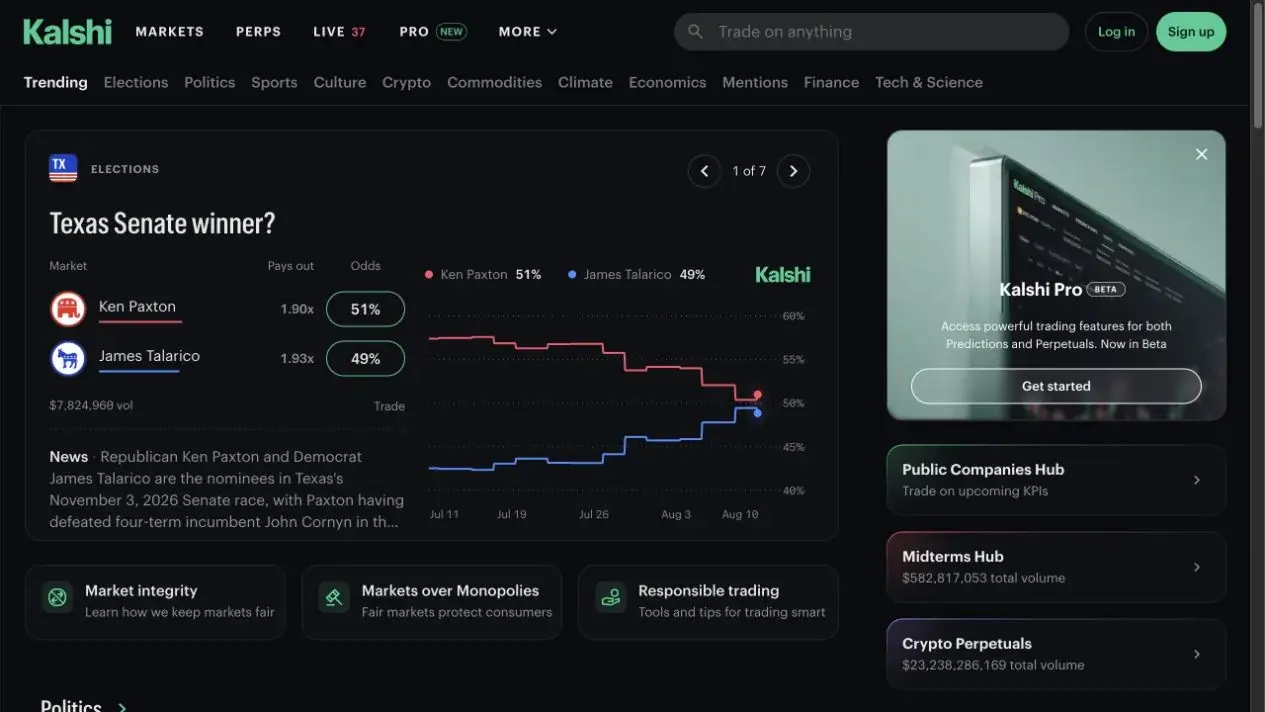
Kalshi Review (2026): Best Regulated Prediction Market?
Kalshi offers regulated event contracts with dollar funding and broad market coverage. Review its fees, liquidity, KYC, settlement rules and eligibility.
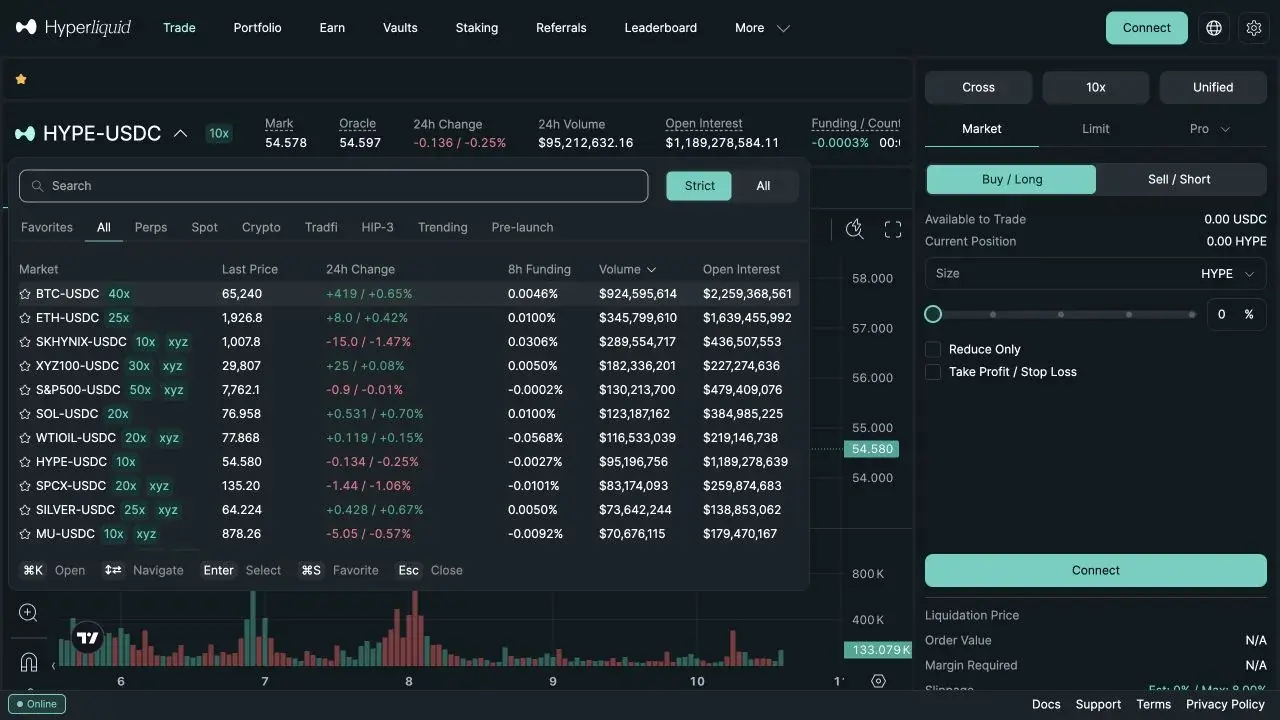
Hyperliquid Review (2026): Best Onchain Perpetual DEX?
Hyperliquid combines onchain perpetual order books, strong flagship liquidity and a polished terminal. Review its fees, leverage, bridge, safety and restrictions.

2026 Crypto Exchange Review Rating Criteria
Boxmining’s 2026 crypto exchange rating criteria cover trust, liquidity, regulation, coin access and user experience. Apply the same rubric yourself.