
Exchange Review
Reviewed by Michael Gu · Five-pillar methodology
Our top onchain perpetual exchange for experienced traders: fast execution, strong flagship liquidity and a professional terminal without handing assets to a centralized custodian. Regulatory uncertainty, validator concentration and leverage risk keep it out of beginner territory.
Trustworthiness
Coin Diversity
Liquidity
Regulatory Compliance
User Experience
Hyperliquid is the closest a decentralized perpetual exchange has come to feeling like a serious centralized derivatives venue. Charts load quickly, orders sit in a familiar price-time-priority book and the busiest markets have real depth. You can trade without depositing into a conventional exchange account, while orders, fills, positions and liquidations are recorded on Hyperliquid’s own layer-one blockchain.
That combination is the reason experienced traders pay attention. It also makes the risks easy to underestimate. Hyperliquid is not a regulated brokerage with a customer-service desk that can reset your password or reverse a withdrawal. You control the signing wallet, the validator network controls consensus, and bridged assets depend on their own technical machinery. Perpetual contracts add leverage, funding and liquidation risk on top.
Our verdict is clear: Hyperliquid is the best onchain perpetual DEX we have reviewed for active traders, but it is not the safest place to learn futures. Its execution and interface score among the best in crypto. Regulation and protocol concentration are the weaker parts of the package.
Hyperliquid pros and cons
What we like
- The trading terminal is fast, clean and immediately familiar to anyone who has used Binance, Bybit or OKX futures.
- HyperCore runs perpetual and spot order books fully onchain, with price-time-priority matching and one-block finality.
- Flagship BTC, ETH, SOL and HYPE markets have strong volume, tight displayed spreads and substantial open interest.
- Traders keep control of their wallet rather than opening a conventional custodial exchange account.
- Cross and isolated margin, limit orders, stops, take profit, TWAP and Chase orders give active traders a useful toolset.
- Trading does not require a separate gas payment on every order.
- The public API, subaccounts and API wallets make Hyperliquid practical for automated strategies.
What could be better
- The official interface is not licensed or registered by a governmental regulator, according to its own terms.
- Users in the United States, Ontario and sanctioned jurisdictions cannot use the official interface.
- The active validator set is limited to the top 24 by stake, and the main node client is distributed as a binary rather than as fully auditable source code.
- Funding, bridging and wallet security make onboarding harder than a normal exchange deposit.
- A wrong network, unsupported token or sub-minimum deposit can result in missing or permanently lost funds.
- Spot liquidity is uneven, and permissionless HIP-3 markets can carry extra oracle and deployer risk.
- There is no traditional account recovery when a self-custody wallet is compromised.
How Hyperliquid works
Hyperliquid is both a blockchain and an exchange. Its technical overview splits the system into HyperCore and HyperEVM. HyperCore contains the perpetual futures and spot order books, margin system, liquidations and native transfers. HyperEVM adds an Ethereum-compatible smart-contract environment on the same chain.
The important part for traders is that the order book is not an offchain matching service with occasional settlement. Hyperliquid says every order, cancellation, trade and liquidation reaches HyperCore state. The order-book documentation says orders match in price-time priority, much like a centralized exchange.
HyperBFT provides consensus. The active validator set consists of the top 24 validators by stake, and anyone can run a validator if they meet the technical and staking requirements. A quorum requires more than two-thirds of stake. This is more transparent than an exchange database, but it is not the same as Ethereum’s much larger validator population.
The chain architecture removes one familiar risk and introduces several new ones. Hyperliquid does not hold a conventional omnibus account that an exchange employee can move. Instead, safety depends on your wallet, the validator set, bridge contracts, oracle design and the correctness of HyperCore.
Perpetual futures and spot markets
Perpetual futures are Hyperliquid’s strongest product. These contracts track an underlying price without an expiry date. Traders post collateral, choose long or short exposure and pay or receive funding while the position remains open. They do not own the underlying coin.
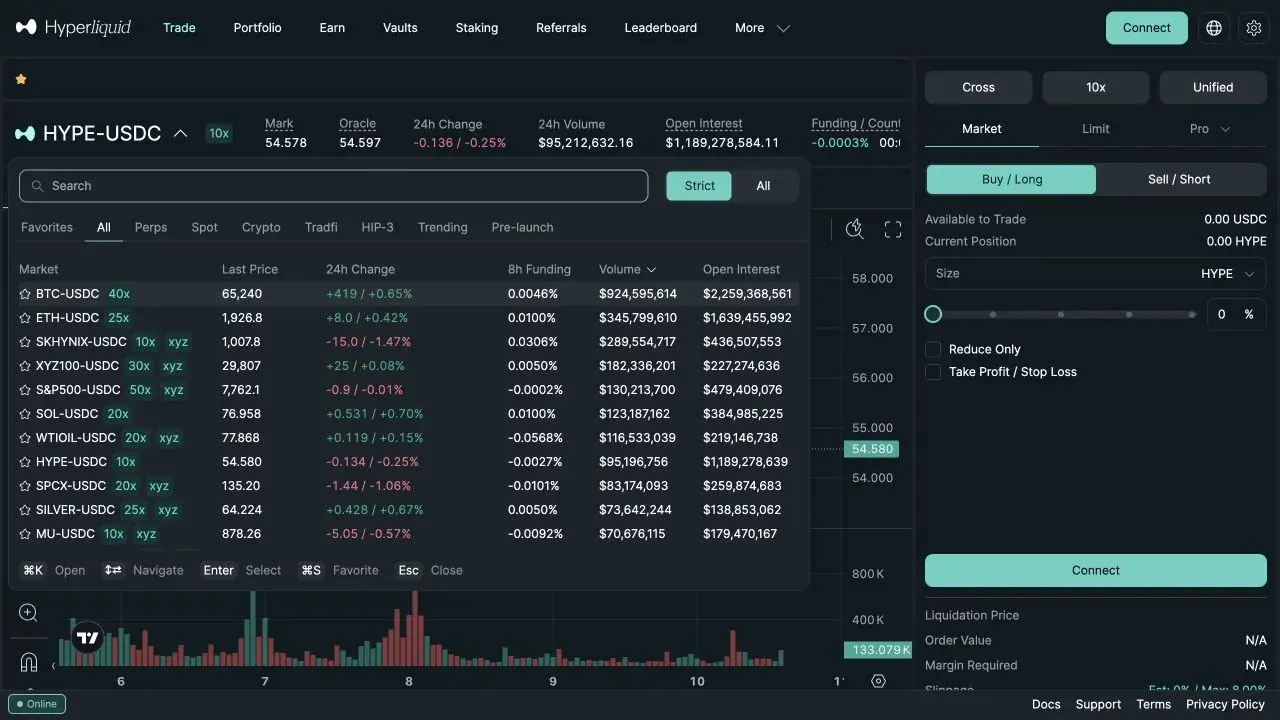
The official market metadata showed 232 validator-operated perpetual markets when we captured this review on 10 August 2026. The older perpetual-assets guide describes more than 100 assets and maximum leverage from 3x to 40x. The live interface now goes beyond standard crypto names and includes builder markets linked to equity indices, commodities and other reference prices.
HIP-3 is the reason the catalogue can expand without every listing coming from the core validator-operated market set. The HIP-3 specification lets qualified deployers create perpetual DEXs, define markets and provide oracle updates. These markets inherit HyperCore’s order books but currently use isolated margin and may charge higher fees. The deployer also becomes part of the risk analysis.
Spot trading uses HIP-1, Hyperliquid’s native token standard. The official API returned 324 spot markets and 484 spot tokens during our review. That sounds broad, but the numbers should not be read like a Coinbase listing count. Many assets are ecosystem tokens or externally bridged representations, and liquidity is concentrated in a smaller group.
Before trading any market, check whether it is a validator-operated perpetual, a builder-deployed HIP-3 contract or a spot pair. Similar ticker symbols do not create identical products. The oracle, leverage limit, collateral, fee rate and settlement authority can differ.
Fees and funding
Hyperliquid’s base perpetual fee for the lowest volume tier is currently 0.045% for takers and 0.015% for makers. The official fee schedule reduces those rates as 14-day weighted volume rises. At higher maker-share tiers, qualifying traders can receive rebates.
Spot starts higher, at 0.070% taker and 0.040% maker for the base tier. Spot volume counts double toward the weighted fee tier. HYPE staking can reduce trading fees by 5% to 40%, depending on the amount staked, although linking a separate staking address to a trading address is permanent and gives the staking address control of the trading account. That is a detail worth understanding before approving anything.
Builder fees complicate the headline rates. HIP-3 deployers may receive a fee share, and the user-facing cost can be higher than the standard validator-operated perpetual rate. The order ticket displays the applicable maker and taker rates. Check it for the exact market rather than relying on a screenshot or an old comparison table.
Funding is separate from trading fees. Hyperliquid settles funding every hour. When a perpetual trades above its underlying index, longs will usually pay shorts. When it trades below, shorts may pay longs. Funding is peer to peer, but it can turn an apparently cheap position into an expensive hold.
For a short intraday trade, execution and spread may matter more than one funding payment. For a position held for days, a persistent rate deserves a place in the profit calculation. Hyperliquid shows the current rate and countdown beside the market statistics.
Liquidity and execution
Hyperliquid earns its highest score on liquidity. In our live capture, the core perpetual API reported about $1.87 billion in 24-hour notional volume and roughly $6.95 billion of open interest. BTC accounted for close to half of that volume. These are a point-in-time snapshot, not a promise of future liquidity.
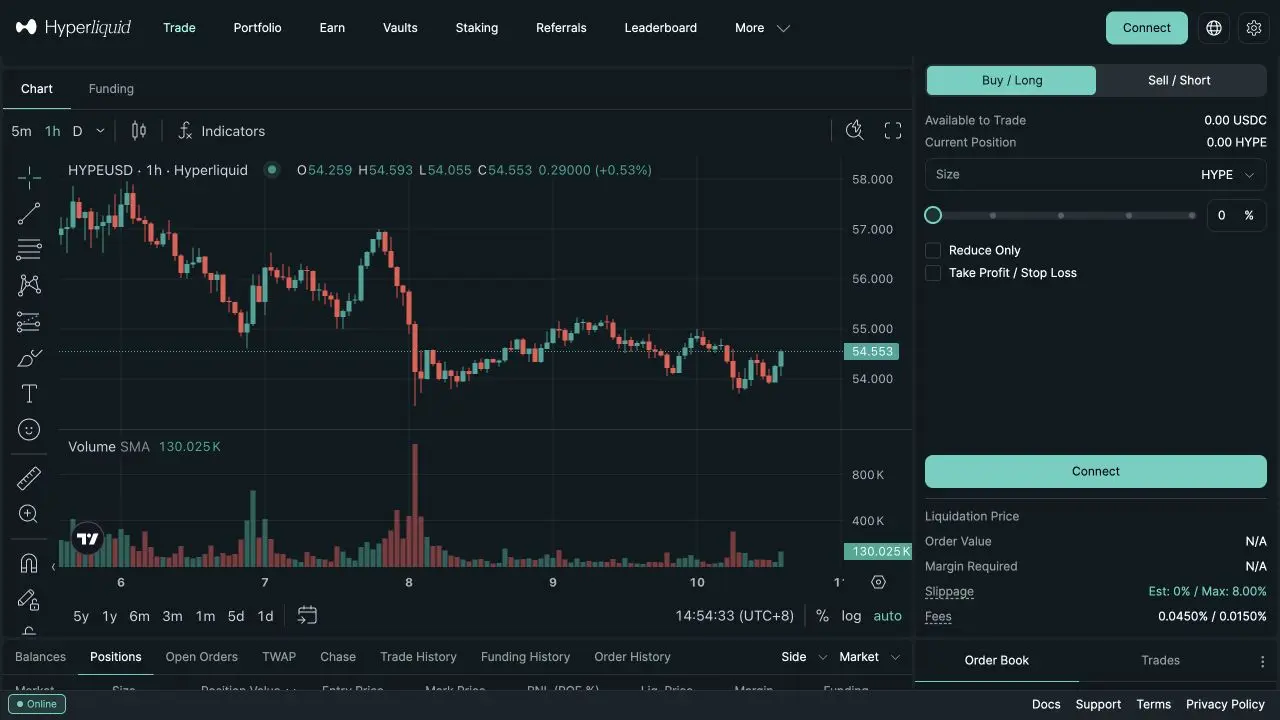
The HYPE-USDC screen in our screenshot showed a displayed spread around 0.002%, with more than $95 million in 24-hour volume and about $1.19 billion of open interest. That is a genuinely tradable market, not a decorative DeFi pool. BTC, ETH and SOL also had substantial books.
The quality drops outside the leaders. A platform-wide volume figure tells you little about the depth in a newly listed or builder-deployed contract. Inspect the number of orders around the mid-price, the size available before your expected slippage becomes unacceptable and whether open interest is concentrated in a few accounts.
Market orders deserve particular care. Hyperliquid’s ticket showed maximum slippage controls, but a control is not a substitute for checking the book. Use limit orders when the market is thin or the position is large. A good trading thesis can still lose money through a poor fill.
Order types and trading tools
The default terminal supports market and limit orders, reduce-only instructions and take-profit or stop-loss attachments. The Pro menu adds more advanced choices. TWAP orders split a larger order over time, while Chase orders update a resting order as the market moves. Hyperliquid announced that Chase is available on desktop perpetual markets.
Cross margin is the default. Collateral is shared across eligible cross positions, which makes capital use efficient but allows one losing trade to weaken the entire cross account. Isolated margin confines collateral to a specific position. If you are testing a volatile or unfamiliar market, isolated margin provides a clearer loss boundary.
Subaccounts are useful for separating strategies. The official rules allow up to 10 after an account reaches $100,000 in volume, with more becoming available at higher volume. API wallets can sign trading actions without exposing the main wallet key to a bot. Permissions still need careful review because a leaked trading key can create large losses even if it cannot withdraw directly.
Leverage and liquidations
Hyperliquid lets traders choose an integer leverage level up to each asset’s maximum. The margin documentation says the maintenance margin is half the initial margin required at maximum leverage. Max leverage currently ranges from 3x to 40x on validator-operated assets.
Liquidation starts when account equity falls below maintenance margin. Hyperliquid first sends market orders to close the position through the book. If equity falls below two-thirds of maintenance margin and the book cannot restore the account, a backstop liquidator vault takes over the position. For a cross account, that can transfer all cross positions and cross margin to the liquidator.
The estimated liquidation price can move because of funding, other cross positions and changes to account equity. The liquidation guide also explains that liquidation uses a mark price combining external exchange prices with Hyperliquid’s book state. Your screen price is not necessarily the price that determines liquidation.
This is why 40x leverage is a risk limit, not a recommendation. At high leverage, a small adverse move can erase the collateral before a stop executes. Start with low leverage, use isolated margin when appropriate and size the position from the loss you can tolerate rather than from the maximum the interface permits.
Deposits and withdrawals
The easiest wallet route is native USDC on Arbitrum. You need ETH on Arbitrum to pay the deposit transaction gas, but ordinary trades do not require separate gas. The native bridge credits deposits after validators representing more than two-thirds of staking power sign them.
There is a 5 USDC minimum for the native bridge. The bridge documentation warns that a smaller wallet deposit may not be credited and can be lost. The interface also supports selected assets from Bitcoin, Ethereum, Solana, Monad and Plasma through additional deposit systems. Those routes have their own supported-token lists, minimums and recovery procedures.
Withdrawals to Arbitrum cost 1 USDC and normally arrive after the validator signing and dispute process. Hyperliquid’s onboarding guide says the user does not need Arbitrum gas for the withdrawal itself.
Check the network, token and minimum every time. Sending USDT to the native USDC bridge, sending an Ethereum token to an unsupported deposit address or choosing the wrong chain can leave funds missing. A decentralized interface does not guarantee a recovery service.
Email login is also available. It creates a blockchain address for the user and removes the need to install a browser wallet on day one. It is more approachable, but traders should still understand how the address is secured and how to export or recover it before depositing a meaningful amount.
Is Hyperliquid safe?
Hyperliquid is non-custodial in the important sense that you authorize actions from your wallet instead of transferring ownership to a standard exchange account. The public chain makes positions, orders and liquidations easier to inspect. The native bridge code is public, and Hyperliquid publishes two Zellic bridge audits.
Those advantages do not make the system trustless. The native USDC bridge depends on stake-weighted validator signatures, and an emergency unlock also relies on two-thirds of validator stake using cold keys. The active validator set is the top 24 by stake. Validator concentration therefore matters directly to both chain consensus and bridge operations.
The node repository provides Docker configuration and instructions, but the validator software itself is downloaded as a precompiled binary. That limits independent source review of the complete production client. We view this as a meaningful trade-off: order and state transparency are strong, while implementation transparency and validator diversity still have room to improve.
Wallet compromise is the most immediate user risk. Hyperliquid’s own security FAQ says it cannot recover a compromised self-custody address. Use a hardware wallet for larger balances, create a separate trading wallet, verify the domain before signing and never give a website your seed phrase.
Vaults carry additional risk. HLP supplies liquidity, handles backstop liquidations and receives part of protocol fees. Depositors share its profit and loss and face a four-day lock after a deposit. It is an investment strategy, not an insured savings account.
Regulation and restricted countries
Hyperliquid’s official terms, updated 15 June 2026, are unusually direct. They say neither the interface nor the Hyperliquid protocol is licensed, approved, authorized, endorsed or registered by a governmental authority or regulatory body.
The interface is unavailable to people and entities in the United States and Ontario, Canada, as well as sanctioned territories and certain sanctioned citizens. The terms also prohibit using technology to disguise location or evade restrictions. Separate outcome-market restrictions can apply to additional users.
Wallet access without routine identity verification should not be confused with legal permission. The interface puts responsibility on the user to determine whether leveraged derivatives are legal in their location. Rules can also change faster than an exchange review. Check the current terms and local law before depositing.
We score regulatory compliance at 40/100. That does not mean Hyperliquid is fraudulent. It means the official product lacks the licensing, identity checks and jurisdiction-specific customer framework we would expect from a regulated derivatives exchange. Users receive transparency from the blockchain, not the protections of a licensed broker.
Hyperliquid compared with centralized exchanges
Hyperliquid’s strongest comparison is against Binance, Bybit and OKX perpetuals. It now competes on interface quality and, in flagship markets, on actual execution. The order book, funding display, leverage controls and API tools will feel familiar to an experienced futures trader.
The custody model is the largest difference. A centralized exchange records your balance in its private database and controls withdrawals. Hyperliquid records trading state onchain and lets the wallet authorize actions. That reduces conventional exchange-custody risk but adds validator, bridge and key-management risk.
Centralized exchanges remain easier for fiat deposits, password recovery, tax statements and customer support. Regulated venues may also offer formal complaints procedures and segregated-customer-asset rules. Hyperliquid is better when onchain transparency and direct wallet control matter more than those services.
Coin selection depends on the product. Hyperliquid has an impressive perpetual catalogue and hundreds of spot pairs, but a large global exchange still offers broader spot liquidity, fiat pairs, options, structured products and local payment methods. Use the venue that is strongest for the exact trade, not the one with the loudest total-volume number.
Who should use Hyperliquid?
Hyperliquid suits experienced perpetual traders who understand funding, liquidation, order-book depth and wallet security. It is especially compelling for crypto-native users who want centralized-exchange speed without putting their trading balance into a conventional custodial account.
It is also a strong platform for quantitative traders. Public APIs, websocket feeds, API wallets, subaccounts and visible onchain state create a practical environment for bots and market-making systems. Automated trading still needs independent position limits and monitoring. Fast execution can compound a software error just as quickly as it executes a good strategy.
Beginners should start elsewhere or use the testnet first. Learning wallets, bridges and perpetual futures at the same time creates too many ways to make an irreversible mistake. Anyone in a restricted jurisdiction should not attempt to bypass the interface controls.
Long-term spot investors may find the platform less useful than perpetual specialists do. Spot markets exist, but selection quality, liquidity and asset-bridge risk vary. A hardware wallet or a well-regulated spot exchange may be a simpler fit for buying and holding a major asset.
Hyperliquid review verdict
Hyperliquid has built the best onchain perpetual trading product we have tested. The terminal is excellent, the busiest books are genuinely liquid and HyperCore gives traders a level of state transparency that a normal exchange database cannot match. Its fee schedule is competitive and the order types are no longer a stripped-down DeFi imitation.
The weak points deserve equal weight. The official interface has no regulatory licence, access is restricted in major jurisdictions, the validator set is relatively small and the full production node client is not open source. Users must also manage wallets, deposit networks and liquidation risk without conventional account recovery.
We score Hyperliquid 82/100. For an eligible and experienced perpetual trader, it is our top decentralized exchange. For a beginner, a US or Ontario resident, or someone who values regulated customer protections above onchain transparency, it is the wrong venue.
Hyperliquid FAQ
What is Hyperliquid?
Hyperliquid is a layer-one blockchain and onchain exchange. HyperCore runs its perpetual and spot order books, margin and liquidations, while HyperEVM provides an Ethereum-compatible smart-contract environment.
Is Hyperliquid a decentralized exchange?
It is an onchain, wallet-authorized exchange rather than a conventional custodial platform. However, users still depend on its validator set, bridge, oracles, interface and production node software.
What are Hyperliquid's base perpetual fees?
At the review snapshot, the lowest-volume tier charged 0.045% for takers and 0.015% for makers. The official schedule changes rates by 14-day weighted volume and maker activity.
How often does Hyperliquid charge funding?
Funding settles every hour. Depending on the perpetual's relationship to its index, longs may pay shorts or shorts may pay longs.
What is the minimum Hyperliquid bridge deposit?
The native USDC bridge has a 5 USDC minimum. Hyperliquid warns that a smaller wallet deposit may not be credited and can be lost.
How much does a Hyperliquid withdrawal cost?
A standard withdrawal through the native bridge to Arbitrum costs 1 USDC at the review snapshot. Other deposit and withdrawal routes can have different requirements.
What leverage does Hyperliquid offer?
Maximum leverage varies by asset and was 3x to 40x for validator-operated perpetual markets at the review snapshot. Higher leverage increases liquidation sensitivity.
Can US residents use Hyperliquid?
The official interface's June 2026 terms exclude people and entities in the United States and also restrict Ontario and other listed jurisdictions. Users must check the current terms and local law.
Is Hyperliquid safe?
Onchain state and wallet authorization reduce some conventional exchange-custody risks, but bridge, validator, oracle, liquidation, wallet and software risks remain. A compromised self-custody wallet cannot be recovered by Hyperliquid.
Is Hyperliquid suitable for beginners?
Generally no. Beginners would need to learn wallets, bridges, order books, funding and liquidation at once. Testnet practice is safer before considering real funds.
Risk warning: Perpetual futures can liquidate your collateral, and funding can make a position more expensive over time. Smart-contract, validator, oracle, bridge, wallet and market risks remain even when trading state is onchain. Check eligibility, contract type, fees, liquidity, network and liquidation price before every trade.
Final Review: Hyperliquid
Our comprehensive analysis
Trustworthiness
Coin Diversity
Liquidity
Regulatory Compliance
User Experience
Our top onchain perpetual exchange for experienced traders: fast execution, strong flagship liquidity and a professional terminal without handing assets to a centralized custodian. Regulatory uncertainty, validator concentration and leverage risk keep it out of beginner territory.

Share
Found this useful?
Share it with someone who'd want to read it.
Related
Kalshi Review (2026): Best Regulated Prediction Market?
Kalshi offers regulated event contracts with dollar funding and broad market coverage. Review its fees, liquidity, KYC, settlement rules and eligibility.
Polymarket Review (2026): Best Crypto Prediction Market?
Polymarket combines crypto-native funding, prediction-market order books and non-custodial settlement. Review fees, liquidity, rules, safety and restrictions.

2026 Crypto Exchange Review Rating Criteria
Boxmining’s 2026 crypto exchange rating criteria cover trust, liquidity, regulation, coin access and user experience. Apply the same rubric yourself.