
Updated 15 October 2026. Ethereum 2.0 is a retired name for upgrades that already shipped. There is one Ethereum, it runs on proof-of-stake, and the ETH in your wallet is the same ETH. Mining is over. Staking is how the chain is secured. The 2026 work is about data for Layer 2 rollups and a heavier Layer 1, not a new coin.
If you hold ETH, you do not convert, wrap, or "upgrade" it for any of this. If you want protocol rewards, you stake. If you want cheaper everyday transactions, you use a Layer 2. This guide covers the current network, the staking numbers we can actually cite, and the roadmap as published by the Ethereum Foundation.
What is Ethereum 2.0?
Ethereum 2.0, often shortened to ETH2 or Eth2, was the public name for moving Ethereum from proof-of-work mining to proof-of-stake. That move happened at the Merge on 15 September 2022. The Ethereum Foundation's roadmap now lists that upgrade as Paris, and it records an energy drop of about 99.95% because miners stopped competing to produce blocks.
The name stuck in search even after the developers dropped it. People still look up "what is Ethereum 2.0" and "ETH2" years later. The useful answer is short: Ethereum 2.0 finished as a branding exercise. The network kept the same ETH, the same addresses, and the same history. A consensus layer called the Beacon Chain, which had been running beside the mining chain since 1 December 2020, took over block production.
What is ETH2?
ETH2 is the same nickname. It is not a ticker, a claim token, or a migration target. Anyone asking you to swap ETH for ETH2, or to send ETH to an "upgrade address", is running a scam. Your balance stays where it is through every later hard fork, including Pectra, Fusaka, and whatever follows.
Ethereum 2.0 vs Ethereum
They are one network. "Ethereum 2.0 vs Ethereum" made sense in 2020 and 2021, when the Beacon Chain was a separate proof-of-stake chain and the original chain was still mined. After the Merge, that split ended.
- Before 15 September 2022: miners produced blocks on the original chain. The Beacon Chain coordinated validators in parallel and did not handle your transfers yet.
- After the Merge: validators propose and attest to blocks. ETH, smart contracts, and NFTs stayed on the same chain. There was no airdrop and no replacement asset.
- What still changes: named upgrades keep altering how blocks are built, how much data rollups can post, and how staking accounts are sized. Those are forks of Ethereum, not a second Ethereum.
Our Ethereum beginner's guide covers ETH as an asset. This page is the upgrade and staking reference. The Merge explainer is the closer look at the day mining stopped.
ETH 2.0 staking
Staking replaced mining. You lock ETH as collateral, run a validator (or pay someone to run one), and the protocol pays you for proposing blocks and attesting that you saw the ones other validators proposed. Rewards are paid in ETH. They are not a bank rate, and they move when the amount of ETH staked moves.
A dated yield, not a promise
Ethereum does not publish a fixed APR. For a public snapshot, use beaconcha.in's ETH.STORE reference rate. On the reward day from 13 October 2026, 12:00:23 UTC, to 14 October 2026, 12:00:23 UTC, that rate was 2.56% annualized.
ETH.STORE is the day's consensus rewards plus transaction fees, for validators that stayed active the whole day with an unchanged effective balance, divided by that starting effective balance and multiplied by 365. In that sample the effective balance was about 41.94 million ETH. That denominator is not "all ETH staked". Validators that entered, exited, or changed balance mid-day are left out on purpose. A pool's advertised rate will differ again, because of its fee, its uptime, and how it handles block-builder payments.
Check the live rate on the day you stake. As more ETH is staked, the consensus reward per validator generally falls. A quiet fee market makes the extra execution income smaller too.
Solo staking, pools, and the 32 ETH line
- 32 ETH still activates a validator. Since Pectra on 7 May 2025, one validator's effective balance can be as high as 2048 ETH, so stake above 32 ETH can earn in the same validator. The Ethereum.org roadmap describes that change directly. You still cannot activate a brand-new validator with a smaller deposit.
- Withdrawals have been open since Shapella on 12 April 2023. Rewards can skim off, and a full exit returns the stake, subject to the exit queue that day. Our Shapella explainer covers how withdrawals were added.
- Under 32 ETH, people use a pool. Lido (stETH), Rocket Pool (rETH), and Coinbase (cbETH) are the names readers already know. You take smart-contract risk, operator risk, and the chance that the receipt token trades below ETH. Read the docs of the one you pick. A quoted APR is their number, not the protocol's.
- Penalties are real. An offline validator leaks rewards. Slashing is reserved for breaking consensus rules, such as signing two conflicting blocks, and it is uncommon. It is still a reason to keep one validator's keys on one machine.
The official starting point is the Ethereum Launchpad. Its checklist is the hardware and client list that matters. Older posts, including our Allnodes hosted-validator walkthrough, go stale on testnets and machine specs. Use them for the shape of the job, then follow the Launchpad before you deposit.
The deposit contract has been 0x00000000219ab540356cBB839Cbe05303d7705Fa since 2020, which is the address in the mainnet chain spec and the one shown below. Do not paste it into a wallet and send 32 ETH. A plain transfer will not register a validator. The Launchpad builds the deposit from keys you generated locally.

Running a validator
A solo validator runs an execution client and a consensus client, plus a validator client that holds the signing key. Plan on a dedicated machine, a large SSD, enough RAM for both clients, and an unmetered connection. Confirm the current numbers on the Launchpad rather than a screenshot from a livestream.
Practise on a current public testnet such as Hoodi before you touch mainnet. Generate deposit data only with current client tooling. Keep the withdrawal address separate from the signing key, and write down how you will recover it. Never type a seed phrase into a site that offered to "activate your ETH2 validator".
If you only want to hold and send ETH, you do not need a validator. A normal wallet is enough. Our MetaMask tutorial walks through that.
The 2026 roadmap: Pectra, Fusaka, Glamsterdam
Ethereum ships named hard forks, not the old phase numbers. Dates below are the mainnet activations on ethereum.org unless noted. Blob counts after Fusaka come from the Ethereum Foundation's Fusaka mainnet announcement and match the blob schedule in go-ethereum's mainnet chain spec, which on 15 October 2026 had no later blob-parameter time set.
| Upgrade | Mainnet | What it means in practice |
|---|---|---|
| The Merge (Paris) | 15 September 2022 | Proof-of-stake replaced mining. ETH stayed ETH. Energy use fell by about 99.95%, per ethereum.org. |
| Shapella | 12 April 2023 | Validators could withdraw rewards and exit. |
| Dencun | 13 March 2024 | Blob transactions (EIP-4844) gave rollups a cheaper, temporary place to post data. Target 3 blobs per block, maximum 6. |
| Pectra | 7 May 2025 | Blob target 6, maximum 9. Validator effective balance can reach 2048 ETH. A regular wallet can attach contract code for batching, sponsored gas, or recovery, if the wallet supports it. |
| Fusaka | 3 December 2025 | PeerDAS lets nodes store a sample of blob data instead of every blob. Clients shipped a 60 million default gas limit, with a cap of 16,777,216 gas (2^24) on a single transaction. The live gas limit can differ if validators vote it up or down. |
| BPO1 | 9 December 2025 | Blob-parameter fork only. Target 10, maximum 15. |
| BPO2 | 7 January 2026 | Blob target 14, maximum 21. This is the latest blob schedule recorded in the Foundation announcement and in go-ethereum's mainnet spec as checked on 15 October 2026. |
| Glamsterdam | Q4 2026, mainnet date not set | Headliners on ethereum.org are enshrined proposer-builder separation (EIP-7732) and block-level access lists (EIP-7928). Sepolia activated on 6 October 2026. Scope can still change before mainnet. |
| Hegotá | 2027, scope not final | ethereum.org lists fork-choice enforced inclusion lists and frame transactions so far, and says dozens more proposals exist. Treat the feature list as unfinished. |
Pectra is already live
Pectra is the fork people still describe as "upcoming" in old posts. It activated on 7 May 2025. For stakers, the practical change is the higher effective balance: you can consolidate stake into fewer validators instead of running a new 32 ETH validator for every chunk. For wallet users, the practical change is optional contract code on an existing account. Nothing in Pectra requires you to move your ETH.
Fusaka, PeerDAS, and blobs
Fusaka activated on 3 December 2025. Its headline feature, PeerDAS (EIP-7594), spreads blob data across the network so a node keeps a fraction of it, about one-eighth in the ethereum.org description, and can still be convinced the full data was published. That is what makes higher blob counts realistic without asking every home node to download every rollup blob.
Blob parameter-only forks then raise the counts without waiting for a full named upgrade. BPO1 on 9 December 2025 moved the target and maximum from 6 and 9 to 10 and 15. BPO2 on 7 January 2026 moved them to 14 and 21. A later BPO is a normal thing for client teams to discuss. It is not something to treat as active until a mainnet time is in the client configs. Full Danksharding, the longer-term design for much more blob capacity, is still on the roadmap and is not live.
Glamsterdam is next, and it has no mainnet slot yet
ethereum.org lists Glamsterdam as in development for Q4 2026. The roadmap page was current as of the site update on 13 October 2026, and it does not give a mainnet clock time. The Foundation's testnet announcement scheduled the Sepolia activation for 6 October 2026 at 13:53:36 UTC and left Hoodi and mainnet as "to be decided".
Two changes are the ones worth understanding:
- Enshrined proposer-builder separation puts the handoff between the validator who proposes a block and the builder who assembles transactions into the protocol. Today that handoff leans on external relay software. The point is safer scaling of Layer 1 data, not a new yield product.
- Block-level access lists record which accounts and storage a block will touch, so clients can read and check more of the block in parallel.
ethereum.org notes that the Glamsterdam meta EIP is still a draft and that the included set can change before mainnet. Holders do not install anything for a testnet fork. Node operators update both clients when a mainnet release is actually announced.
Hegotá is the name after that, listed for 2027. The features on the roadmap page today are about forcing inclusion of valid transactions and letting accounts define their own signature rules, including a path toward post-quantum signatures. The page says the scope is not final. Quoting a Hegotá mainnet month would be a guess.
Ethereum Layer 2 in 2026
Layer 2 is how Ethereum got cheaper for ordinary use. A rollup executes transactions on its own chain and posts the data, or a proof, back to Ethereum. Blobs are the temporary data field built for that job. They have their own fee, separate from the gas you pay for a normal Layer 1 transfer.
In 2026 that path is: Dencun created blobs, Pectra doubled the original target, Fusaka added PeerDAS, and BPO2 left the target at 14 blobs per block with room for 21. Rollup fees still move with demand. A quiet blob market is cheap. A crowded one is not. Blobs also do not make a rollup's sequencer, bridge, or upgrade keys safe. Those are the rollup's risks.
Arbitrum, OP Mainnet, Base, and zk-rollups such as zkSync are the names most wallets already show. They are not the same design. Our Layer 2 guide separates optimistic rollups, zk-rollups, and sidechains such as Polygon PoS. For live value locked and the stage of each project's proofs, use L2BEAT rather than a number frozen in an article.
If you are sending ETH from MetaMask, the network dropdown is the whole decision. Ethereum Mainnet gas is paid in ETH and is still the expensive, final settlement layer. A Layer 2 in that same dropdown is often the cheaper place to move tokens, and it is still Ethereum's security model only to the extent that rollup actually posts to Ethereum. Match the network on both sides of a transfer.
A short history of the old phases
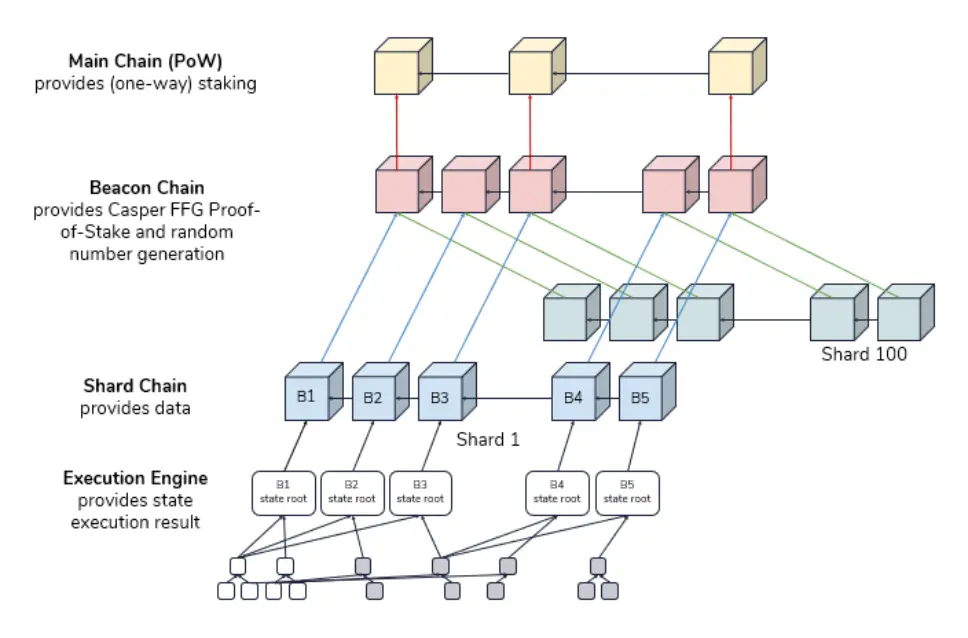
The 2020 diagrams split the work into phases. Phase 0 was the Beacon Chain, launched on 1 December 2020. The Merge, sometimes called Phase 1.5, landed on 15 September 2022 and connected that Beacon Chain to the chain everyone already used. Phase 1 and Phase 2 were shard-chain designs: first data shards, then execution on those shards. Calling the Merge "Phase 1" and sharding "Phase 2", which a lot of explainers did, scrambles that order.
Ethereum did not ship 64 execution shard chains. ethereum.org's roadmap says shard chains were dropped because rollups scaled first, and proto-Danksharding (the blobs in Dencun) took the data-availability job the shards were meant to do. The phase numbers are history. The named forks in the table above are the schedule.
One older fork still confuses search. The London hard fork on 5 August 2021 changed the fee market (EIP-1559) while Ethereum was still mined. It was not the Merge and it did not create ETH2. We keep that write-up as a historical London note. This page is the current Ethereum 2.0 article.
Ethereum 2.0 mining ended in 2022
You cannot mine Ethereum, Ethereum 2.0, or ETH2. Proof-of-work block production stopped at the Merge on 15 September 2022. A GPU, an ASIC, Claymore, or a mining pool cannot produce mainnet ETH. Buying hardware for that purpose will not earn protocol mining rewards, because those rewards do not exist anymore.
The replacement is staking, described above. Miners who left in 2022 either sold equipment, pointed it at other coins, or became validator operators. Our note from the week of the Merge is the contemporary account, and the old mining guide is archived so the setup steps are not mistaken for current advice.
A site selling an "Ethereum 2.0 miner", a cloud-mining contract for ETH, or a swap from ETH to ETH2 is not describing this protocol. Close it.
Frequently Asked Questions
What is Ethereum 2.0?
Ethereum 2.0 is the old name for Ethereum's move to proof-of-stake. The Merge completed that move on 15 September 2022. There is one Ethereum and one ETH. Later forks such as Pectra and Fusaka are upgrades to that same network.
What is ETH2?
ETH2, or Eth2, is a nickname for the same upgrade. It is not a separate coin, a contract you must migrate into, or a token you should buy. A request to swap ETH for ETH2 is a scam.
What is the difference between Ethereum 2.0 and Ethereum?
There is no remaining difference. Before the Merge, the Beacon Chain was a separate proof-of-stake chain and the original chain was mined. Those pieces are one network now. "Ethereum 2.0" on this page means that combined Ethereum.
How does ETH 2.0 staking work?
You deposit at least 32 ETH through the official Launchpad to activate a validator, or you use a pool if you have less. Validators propose and attest to blocks and earn ETH. Since Pectra, one validator's effective balance can be as high as 2048 ETH. Rewards change with total stake and with your uptime. On 13–14 October 2026, beaconcha.in's ETH.STORE reference rate was 2.56% annualized.
Can you mine Ethereum 2.0?
No. Ethereum mining ended on 15 September 2022. Ethereum 2.0 mining is not a hidden mode, a testnet trick, or a newer algorithm. The chain uses proof-of-stake. Staking is the way to earn protocol rewards.
What is Ethereum Layer 2 in 2026?
Layer 2 rollups execute transactions away from Ethereum mainnet and post data back in blobs. Blobs went live in March 2024. After Fusaka and the January 2026 blob-parameter fork, the scheduled target is 14 blobs per block and the maximum is 21. Rollup fees still depend on demand, and each rollup has its own bridge and operator risks. Full Danksharding is not live.
What is next on the Ethereum roadmap after Fusaka?
Fusaka is already live, as of 3 December 2025, and the follow-up blob-parameter forks through BPO2 are live as well. Glamsterdam is the next named upgrade. ethereum.org places it in Q4 2026 and does not confirm a mainnet date. It activated on the Sepolia testnet on 6 October 2026. Hegotá is listed for 2027 with an unfinished scope.
Is there an ETH2 coin?
No. ETH is the only native asset. Balances were not replaced at the Merge, at Shapella, at Pectra, or at Fusaka, and holders do not need to claim a new token for Glamsterdam.
Can I withdraw staked ETH?
Yes. Since Shapella on 12 April 2023, validators can withdraw rewards and exit the stake. How long an exit takes depends on the queue that day, so check a beacon-chain explorer when you leave.
Do I need 32 ETH to stake?
A new solo validator needs at least 32 ETH. Pools and exchanges accept less and add their own fees and contract risk. Pectra raised the maximum effective balance to 2048 ETH, which changes how large one validator can be, not the minimum to start.
What is a realistic Ethereum staking yield?
There is no fixed yield. beaconcha.in's ETH.STORE rate for the reward day ending 14 October 2026 was 2.56% annualized, covering consensus rewards and transaction fees for the validators in its sample. Your result moves with the amount of ETH staked, your validator's uptime, proposal luck, and any pool fee.
Is Ethereum staking risk-free?
No. Offline validators lose rewards. Serious rule-breaking can be slashed. Pools add smart-contract and operator risk, and a liquid staking token can trade below ETH. Stake only what you can leave in the exit queue.
Further reading
- Ethereum roadmap (site updated 13 October 2026 when we checked)
- Fusaka and Glamsterdam on ethereum.org
- Fusaka mainnet announcement, including the BPO1 and BPO2 schedule
- Glamsterdam Sepolia announcement
- Ethereum Launchpad for staking
- beaconcha.in ETH.STORE for the staking reference rate
- L2BEAT for current Layer 2 data
Disclaimer: Staking and trading can lose you money. Yields move, penalties exist, and a pool can fail. This page is an explanation of public protocol facts, not a recommendation to stake, buy, or use any particular service. Check the primary sources above before you lock ETH.
Share
Found this useful?
Share it with someone who'd want to read it.
Related
How To Stake Ethereum on Allnodes
Staking on Ethereum is finally live. However, the process of connecting your Ethereum (ETH) coins can be a bit tricky.
Ethereum Merge Explained: Proof of Stake and What Changed
A guide to Ethereum’s transition from proof of work to proof of stake, the terminology around Ethereum 2.0 and what the Merge changed for ETH.

Ethereum Shanghai (Shapella) Upgrade and ETH Withdrawals Explained
What Ethereum’s Shanghai-Capella upgrade changed, how validator withdrawals work now, and how later Dencun and Pectra upgrades altered the staking rules.