

Can Ethereum censor a transaction?
Ethereum is designed to resist censorship, but “censorship” can describe several different events. A stablecoin issuer can block its own token at the smart-contract layer; a website or RPC provider can refuse to serve a user; a block builder or validator can omit a transaction; and a custodian can freeze an account. These actors do not have the same powers.
An issuer's USDC or USDT freeze does not freeze the address's native ETH or unrelated tokens. Conversely, a valid ETH transaction can be delayed if builders or validators do not include it, even though no contract administrator can blacklist native ETH at the protocol level.
| Layer | Who can restrict activity? | What the restriction affects |
|---|---|---|
| Token contract | Issuer or contract administrator, if the code grants that role | Transfers, receipt or destruction of that specific token |
| dApp frontend | Website operator | Access to that interface, not necessarily the underlying public contract |
| RPC or wallet service | Infrastructure provider | Transaction submission, data access or simulation through that provider |
| Block builder or relay | Builder/relay operator | Whether its candidate blocks include a transaction |
| Validator/proposer | Validator operator | Which valid block or locally built transactions it proposes |
| Custodial account | Exchange, broker or wallet custodian | The customer's offchain account and withdrawals |
How stablecoin freezes work
ERC-20 defines a common token interface; it does not require or prohibit a blacklist. An issuer can add roles that pause a contract, block selected addresses, mint or burn tokens, or upgrade the implementation behind a proxy.
Circle's published EVM stablecoin contracts, used for USDC and related products, explicitly support pausing, upgrades, blacklisting, minting and burning. The blacklister role can prevent listed addresses from sending or receiving that token. Tether issues USDT and maintains its own contract and compliance controls. Paxos is a different issuer and does not issue USDT.
This is compatible with self-custody of the wallet key but limits control over the asset. A user may control the private key for an address while the issuer still controls the rules and redemption promise of an administered token. “Not your keys, not your coins” does not describe the full risk of an upgradeable or blacklistable token.
Are Ethereum smart contracts immutable?
Code stored at a particular contract address cannot simply be edited in place, but that does not mean every application is permanently fixed. Common control patterns include:
- Proxy upgrades: a stable proxy address delegates calls to an implementation that an authorized administrator can replace.
- Pause roles: a privileged address can stop selected operations or all transfers.
- Blacklist or denylist roles: the contract checks addresses before allowing transfers.
- Mint and burn roles: authorized accounts can change token supply under defined rules.
- Governance changes: token holders, multisigs or security councils may modify parameters or upgrade code.
Users should inspect the proxy, implementation, owner, role holders and upgrade delay—not just whether source code is verified. Renounced or immutable contracts remove some administrative risks but can also make bug fixes and incident response impossible.
How block-level censorship can happen
Ethereum validators take turns proposing blocks. Many use MEV-Boost, optional software that lets them choose bids from specialized builders through relays. Builders order transactions and submit candidate blocks; relays validate and forward bids; the proposer selects a block, commonly based on value.
A builder or relay can filter transactions. A validator can also build locally, choose other relays or decline a bid. If some participants censor but a later non-censoring proposer receives the transaction and includes it, the result is a delay rather than permanent protocol censorship. The risk becomes more serious if a large, coordinated share of block production refuses the same transactions or interferes with blocks that include them.
Ethereum does not currently guarantee that a particular valid transaction will be included within a fixed number of slots. A validator is not automatically slashed merely for omitting one transaction. Transaction fees, nonce conflicts, private order flow and network propagation can also cause delay without ideological or regulatory censorship.
What happened to Tornado Cash sanctions?
OFAC designated Tornado Cash-related entities and addresses in 2022. Circle then blocked USDC held by designated addresses under its contract controls. That event drove much of the early post-Merge debate over OFAC-filtering relays.
The legal and sanctions status later changed: on 21 March 2025, OFAC removed Tornado Cash and the listed Ethereum addresses from the Specially Designated Nationals list. Old articles that describe those addresses as currently sanctioned are therefore outdated. This change does not remove stablecoin blacklist functionality or settle every legal issue involving developers, operators or particular transactions.
OFAC administers U.S. sanctions; it does not “oversee Ethereum block validation.” U.S. persons and companies evaluate their own legal obligations, which can influence issuers, relays, builders, validators, frontends and infrastructure providers in different ways.
Ethereum's censorship-resistance roadmap
Ethereum researchers are developing protocol mechanisms that reduce reliance on a small group of builders. EIP-7805, Fork-choice enforced Inclusion Lists (FOCIL), proposes committees of validators that publish transactions a builder must include when valid and when block capacity allows. Attesters would reject blocks that ignore satisfied lists.
FOCIL remains a draft proposal and was not active on Ethereum Mainnet at this review date. Ethereum's 2026 protocol priorities continue to list FOCIL and censorship-resistance metrics as research and development work. The upcoming Glamsterdam upgrade is planned for the second half of 2026 and includes proposer-builder changes, but users should not assume draft inclusion-list protections are already live.
How to evaluate censorship risk
- Identify the asset: native ETH, an issuer-backed token, a bridged token and an exchange balance have different control points.
- Verify the contract: inspect owner, proxy admin, pauser, blacklister, minter and upgrade roles.
- Check bridge dependencies: a bridged asset may be frozen or paused by the token issuer, bridge or destination contract.
- Use resilient access: a self-hosted node or multiple reputable RPC providers can reduce dependence on one interface, but cannot bypass a token-level blacklist.
- Monitor the transaction: rule out insufficient fees, a missing nonce, replacement, revert or private-relay failure before calling a delay censorship.
- Understand redemption: a fiat-backed stablecoin is ultimately a claim governed by issuer terms and applicable law.
- Do not evade sanctions: anyone affected by a freeze or sanctions issue should preserve records and obtain qualified legal advice.
Original January 2023 Ethereum censorship article (archived)
The author-written discussion below is preserved for historical context. Issuer names and one malformed import were corrected. OFAC does not oversee validators, Tornado Cash was delisted in 2025, and smart contracts can be intentionally pauseable or upgradeable as explained above.
If you hold stablecoins on Ethereum or other EVM platforms, you must be aware of this smart contract feature…
Token Issuers on Ethereum Can Freeze Your Funds Without Notice
In order to issue tokens on EVM platforms including Ethereum and Polygon, the first step is deploying a smart contract, which is then used for transferring tokens. However, the token issuer can define support for transaction censorship and token freezing in the contract. This is how Circle, the issuer of USDC, froze 75,000 USDC in addresses connected to the 2022 Tornado Cash designation, in compliance with U.S. sanctions.
Not many users are fully aware of this feature. This can be compared to how traditional banks have the authority to freeze your funds without notice. If the stablecoin ecosystem depends on a centralized entity for issuing tokens, it could prove to be risky for all crypto users.
USDT and USDC — Regulatory Compliant Stablecoins
Tether and Circle, the issuers of USDT and USDC respectively, are required to comply with applicable rules when tokenizing US dollars on blockchain platforms. One influential U.S. sanctions administrator is the Office of Foreign Assets Control (OFAC), whose actions can affect how regulated companies approach Ethereum activity.
It is important to note that regulations for the crypto industry is not necessarily bad. They protect the interests of investors and prevent fraudulent activities. However, this is in conflict with the basic principles of decentralization, especially when user funds are on the line.
How are Transactions Censored on Ethereum?
Although a deployed smart contract can never be stopped or otherwise manipulated by a third party, token issuers, however, can write whatever they want in smart contracts, including censorship features. Here’s how:
In order to mint fungible tokens on Ethereum, developers must follow the ERC token standards including the ERC-20 (token), ERC-721 (NFT) or ERC-1155 (multi-token). These standards define a common list of rules that EVM tokens should adhere to. A customized and deployed smart contract is then used each time tokens move from address to address. However, a smart contract can define any behavior that the EVM will allow, which includes the ability to censor transactions based on a blacklist or freezing an account. As a result, any Ethereum user may lose the ability to spend or use the tokens in any way. This is what the smart contract for USDT looks like:
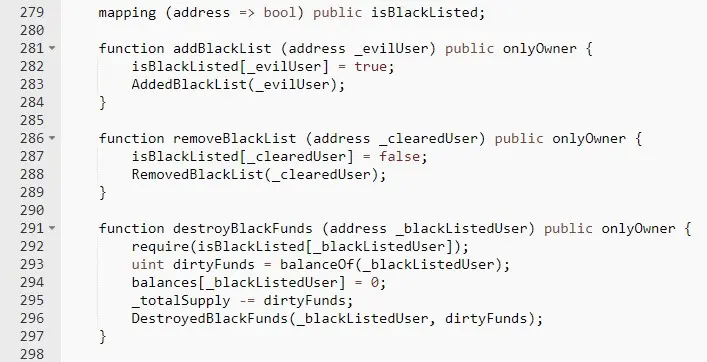
As shown in the image above, the token contract administrator has the power to blacklist token owner accounts and burn their token funds where the code permits. Of course, one could argue that this is for our safety, freezing the account of someone who has been involved in criminal activity. After all, the blockchain industry should not be a way for criminals to circumvent the law. But herein lies the dilemma: how is decentralized finance (DeFi) different from traditional finance if we still have to trust the system?
Key Takeaway
It is true that certain censorship features in place help protect investors’ interest, but the blockchain industry is meant to be different from the traditional financial world. Take the Tornado Cash incident for example, one of the developers was arrested for simply writing code, and several users who used Tornado Cash without malicious intention ended up having their funds frozen.
If we blindly accept the rules of the existing system, we will not be able to create anything innovative. It is not true self-custody if a third party can control the tokens you have in your own wallet. Nevertheless, the blockchain industry is still in its infancy, and if we are being pragmatic, a common ground must be reached between crypto users and regulators. For DeFi to move forward, we can only construct a system that remains decentralized and that regulators have no objections to.
Frequently asked questions
Can Ethereum freeze an address?
The base protocol has no general address-freeze function for native ETH. A token issuer, custodian, frontend or infrastructure provider may still restrict its own token or service.
Can USDC be frozen in a self-custody wallet?
Yes. Controlling the wallet key does not override USDC's token contract. Circle's published EVM contracts include a blacklister role that can stop listed addresses from sending or receiving USDC.
Can USDT be frozen on Ethereum?
USDT is issued by Tether and uses administered token contracts with compliance controls. Any action applies to USDT under that contract, not automatically to native ETH or unrelated tokens.
Does ERC-20 require a blacklist?
No. ERC-20 specifies a common interface and events. Blacklists, pause controls, minting roles and proxy upgrades are additional design choices made by the token developer.
Can an immutable smart contract be changed?
Stored bytecode is not edited directly, but a proxy can delegate to a replaceable implementation. Other contracts expose privileged configuration, pause or governance functions without changing bytecode.
How can Ethereum validators censor transactions?
A proposer can omit a transaction or choose a builder bid that omits it. If a later non-censoring proposer includes it, the effect is delay rather than permanent censorship.
What is MEV-Boost?
MEV-Boost is optional validator software that sources candidate blocks from specialized builders through relays. It separates proposing from block construction but adds builder and relay control points.
Is Tornado Cash still sanctioned by OFAC?
OFAC removed Tornado Cash and the listed Ethereum addresses from the SDN list on 21 March 2025. Other sanctions and legal obligations can still apply to particular people or transactions.
Are Ethereum inclusion lists live?
No. EIP-7805 FOCIL remained a draft proposal at this review date. It proposes validator committees that can require builders to include eligible transactions.
Does using another RPC bypass a stablecoin freeze?
No. Another RPC can bypass an interface-level refusal, but all nodes enforce the same token contract. A contract-level blacklist will still reject the transfer.
Sources
- Circle's USDC EVM contracts: pause, upgrade, blacklist, mint and burn roles
- Circle's official USDC contract directory
- OFAC's 21 March 2025 Tornado Cash delisting
- Flashbots: how MEV-Boost, builders, relays and validators interact
- Ethereum.org: proposer-builder separation and censorship resistance
- Draft EIP-7805: Fork-choice enforced Inclusion Lists
- Ethereum Foundation 2026 protocol priorities
- Ethereum.org: Glamsterdam status and planned H2 2026 timing
Share
Found this useful?
Share it with someone who'd want to read it.
Related

Polygon ($MATIC): can it solve Ethereum’s scaling challenges?
Ethereum remains the backbone of decentralized finance, but even after its shift to proof-of-stake, scalability issues persist.
How To Stake Ethereum on Allnodes
Staking on Ethereum is finally live. However, the process of connecting your Ethereum (ETH) coins can be a bit tricky.

Ethereum 2.0 Explained: The Merge, Staking and 2026 Roadmap
Ethereum 2.0 is now simply Ethereum. Learn what the Merge changed, how staking works, why shard chains were dropped, and what the 2026 roadmap includes.