
GameFi did not disappear. The embarrassing truth is more useful: its original thesis failed.
The 2021 pitch said that tokens and NFTs would turn players into owners, align them with developers, and make time spent in a game economically meaningful. In practice, too many projects launched a currency, sold scarce land or characters, and attracted investors before they had proved that ordinary people wanted to play the game. They found liquidity before they found fun.
When token prices went up, this looked like product-market fit. When rewards fell, much of the “community” left with them. The industry had measured wallets, transaction volume, and asset prices, then mistaken those numbers for a durable player base.
That does not mean every blockchain game was a scam or every NFT mechanic was badly designed. Axie Infinity, in particular, showed that collectible creatures, breeding, trading, and card battles could fit together. It also showed why a good crypto-native design can still collapse under its own financial success.
My view in 2026 is simple: players do not want a financial position disguised as a game. They want a good game. Ownership can support that experience, but the moment the economy starts dictating the design, the player becomes exit liquidity.
My Honest Take on Crypto Gaming
Watch on YouTubeI raised many of these questions in my January 2022 video, including why Axie worked, where its limits were, why Gods Unchained had not reached the same base, and what to avoid. Four and a half years later, we no longer have to guess. We can look at where the projects actually ended up.
GameFi’s category error: it confused users with players
A player opens a game because the next match, quest, build, or discovery is worth their time. A financial user opens it because the expected reward is worth more than the cost.
Those groups can overlap, but they are not the same. GameFi’s early dashboards made the distinction dangerously easy to ignore. A unique active wallet is a wallet that touches a smart contract. It is not necessarily one person, and it does not tell us whether that person enjoyed a game, returned without an incentive, or even played at all. DappRadar’s own documentation notes that playing Axie does not require a blockchain transaction and that its tracker sees smart-contract interactions, not all gameplay.
This matters because a reward can manufacture activity. Pay people to click, grind, mint, or move an asset and the wallet chart rises. Reduce the reward and you discover how much of that activity was rented.
The best recent reality check came in the second quarter of 2025. DappRadar reported that blockchain gaming activity fell 17% quarter over quarter to 4.8 million daily unique active wallets, more than 300 listed gaming dapps became inactive, and investment dropped 93% year over year to $73 million. Those wallet numbers still sound large, but the closures and funding collapse tell us how little economic depth sat underneath many of them.
Where the former GameFi leaders are now
Token price is not a player count, and a falling token does not prove that a game is bad. It does show how far speculative expectations ran ahead of the products. The peak-to-current figures below are approximate snapshots from CoinGecko on 12 August 2026.
| Project | What the market originally bought | Where it is now | Token versus peak |
|---|---|---|---|
| Axie Infinity | NFT creatures, breeding, battles, and play-to-earn income | Still shipping games and collection utility; far smaller than its 2021 peak | AXS about 99% below its $164.90 peak |
| STEPN | NFT sneakers that paid users to walk or run | App and ecosystem remain active; the explosive reward-led growth is gone | GMT about 99.8% below its $4.11 peak; GST almost entirely below its $8.51 peak |
| Gods Unchained | Tradable digital cards and play-to-earn rewards | Still live, with a new expansion and mode in 2026; never became a mainstream card-game rival | GODS about 99.8% below its $8.80 peak |
| Illuvium | A high-production-value interoperable RPG universe | Arena and other products remain; MMO scope was reduced for a targeted December 2026 launch | ILV about 99.8% below its $1,911.26 peak |
| The Sandbox | Scarce virtual land plus a creator-owned metaverse | Active creator platform; reported 2,000 experiences published in the year before February 2025 | SAND about 99.5% below its $8.40 peak |
| Decentraland | Token-owned virtual land and a user-governed social world | Still building desktop and mobile clients; mobile remained in public testing in 2026 | MANA about 98.9% below its $5.85 peak |
| Ember Sword | An MMORPG with NFT land and a player-owned economy | Development and servers ended in May 2025 after the studio could not secure more funding | Closed |
| Champions Tactics | Ubisoft tactical battles using collectible NFT Champions | Blockchain features ended in May 2026; servers are scheduled to close on 30 October 2026 | Being sunset |
Sources: Axie, STEPN GMT, STEPN GST, Gods Unchained, Illuvium, The Sandbox, Decentraland, Ember Sword closure reporting, and Ubisoft’s Champions Tactics FAQ.
This is not a table of eight identical failures. Some products survived. Some found small, committed communities. Some are still improving. The shared failure was valuation: the market priced possible future populations before the games had earned present ones.
Axie Infinity: the best GameFi design became too expensive to be a game
Axie deserves more credit than the lazy “ponzinomics” summary gives it. Its NFTs were not arbitrarily bolted onto an action game. The collectible creature was the playable unit. Its traits influenced battle cards. Breeding created new creatures. Trading helped players build teams. Ownership, reproduction, and combat belonged to the same system.
That is why Axie worked when so many copycats did not. Sky Mavis reported that the game grew from roughly 50,000 players before its Season 17 balancing period to more than 2.7 million by Season 19 in 2021. Axie later surpassed $4 billion in NFT transaction volume. Those were extraordinary achievements for a game that had begun as a crypto experiment.
But success broke accessibility. A 2021 CoinGecko survey estimated that a new player needed at least three Axies costing about $690 in total, and 62% of respondents saw the price as a high barrier. At other moments, usable teams cost considerably more. When playing a game requires an investment decision, normal game discovery stops. You do not casually invite a friend. You pitch them an expected return.
Scholarships appeared to solve that problem by letting asset owners lend teams to players and split the earnings. In reality, this imported a labour relationship into the game. Many “players” became workers grinding on behalf of managers. Their enjoyment mattered less than daily token output.
The economy then faced the question every play-to-earn design eventually faces: who is paying the earners? SLP was minted through play and burned mainly through breeding. Breeding demand depended heavily on growth and the need for more Axies. When fewer new players needed teams, the main source of demand weakened while existing players continued producing rewards.
Axie responded. It removed or reduced emissions, introduced free starter Axies and new game versions, capped SLP supply, and kept building. The project is not dead. Its official release feed was still announcing Terrariums V1.2 in August 2026.
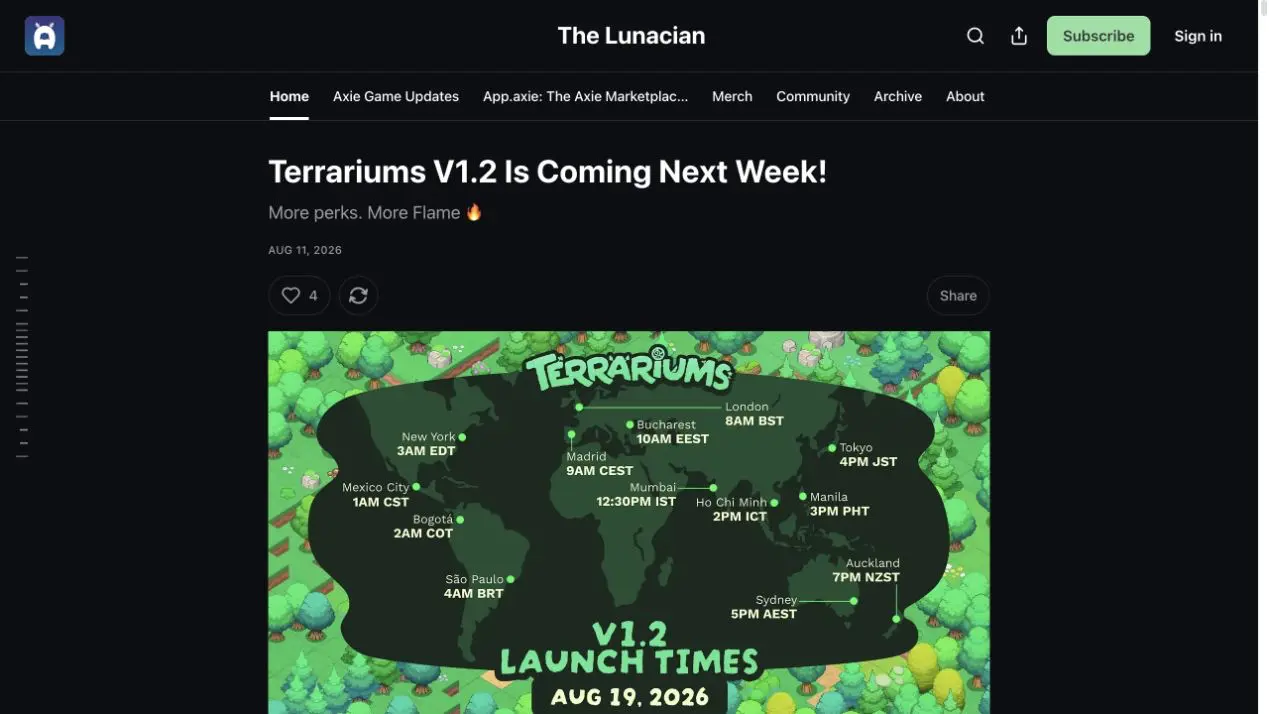
Axie’s story is therefore not “NFT games cannot work.” It is more specific: an NFT game can work mechanically and still price ordinary players out, turn play into labour, and make growth responsible for balancing the reward economy.
STEPN: a brilliant loop that revealed who was there for the loop
STEPN was arguably the cleanest GameFi product after Axie. Buy an NFT sneaker, walk or run, earn GST, then spend it on repairs, levels, gems, minting, and more sneakers. The action was easy to understand and tied to something many people already wanted to do.
The growth was spectacular. STEPN said daily active users hit one million on 2 June 2022. On-chain analysis cited by Dune found monthly active users rising from about 2,500 in January to more than 705,000 in May, then falling by roughly 90% from the second-quarter high by the middle of the fourth quarter.
The problem was visible in the pitch: people did not buy expensive virtual running shoes only because walking had become more fun. They bought because the yield made the shoe look productive. That made the NFT price an entry fee and the reward token the retention system. As returns compressed, the game discovered that financial motivation had been doing much of the product’s work.
STEPN survives as a Web3 lifestyle app and continued holding town halls and building related products in 2025. That is a meaningful outcome. It is also a much smaller claim than the one its 2022 valuation implied.
Gods Unchained: NFTs fit card games, but a market cannot create opponents
Trading card games appear almost perfect for NFTs. Cards are discrete collectibles. Players already understand rarity, deck building, trading, expansions, and secondary markets. A card does not need to leap between unrelated games to have value; it only needs to remain useful and desirable inside one good game.
Gods Unchained built around that fit. Players could earn cards, forge some into tradable NFTs, and use GODS in the game economy. Unlike projects selling a future world, it had a recognisable game loop.
Yet being a sensible NFT implementation did not make it a mainstream card game. A competitive card game needs excellent onboarding, balance, spectatorship, frequent content, a reliable client, and enough opponents at every skill level. Blockchain ownership solves none of those problems. Worse, if valuable legacy cards create a persistent competitive or psychological disadvantage for newcomers, ownership can work against growth.
The project is still alive. It launched The Waking Plague expansion in June 2026 and a Conquest mode in July. That longevity deserves respect. But with GODS roughly 99.8% below its peak, it also demonstrates the gap between keeping a niche game running and validating the financial expectations attached to it.
Why full action games are an especially poor fit
The faster and more skill-based a game becomes, the harder it is to justify putting scarce, tradable assets near competitive power.
In a card battler or creature collector, the owned object is already part of the game’s natural grammar. In a shooter, fighter, racing game, or action RPG, the player expects movement, aim, reaction, map knowledge, and team coordination to determine the result. If an NFT weapon, character, car, or stat boost materially improves performance, the game becomes pay-to-win. If it does not affect performance, it is a cosmetic with a more complicated checkout process.
That does not make tradable cosmetics impossible. Counter-Strike skins proved long ago that players value scarce digital objects. The difference is that the market grew around an excellent game and an established culture. The skin was not the reason the shooting worked, and players were not promised that routine matches would pay a salary.
This is the test GameFi repeatedly reversed. It asked, “How do we add a token economy to this combat loop?” The better question is, “Would people still play this if every asset became account-bound and worth zero?” If the answer is no, there is no game to financialize.
Ubisoft’s Champions Tactics is an unusually clear ending. It launched worldwide in October 2024 with 75,000 NFT Champions. In 2026, Ubisoft added an ordinary in-game Gold Chest, froze wallet inventories, replicated owned Champions inside the game, and closed the Forge and marketplace. The official site now says the game is coming to an end, with servers scheduled to shut down on 30 October.
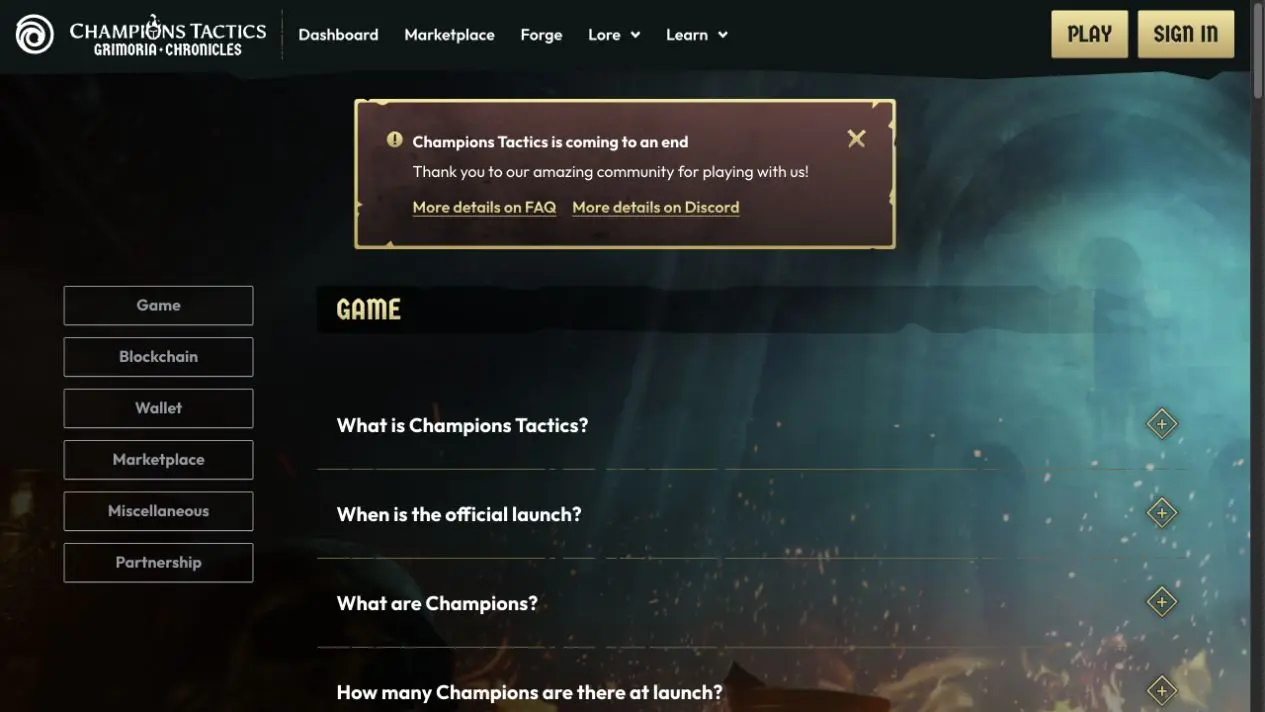
Players did not need an NFT to make turn-based tactics possible. Once the NFT layer was removed, the supposedly permanent assets survived only as database entries in a game that the publisher could still close.
Illuvium and the “AAA will save us” trap
After the first wave of simple play-to-earn games collapsed, the industry adopted a new answer: wait for higher-quality games. Teams promised AAA visuals, interoperable universes, cinematic worlds, esports, mobile companions, land systems, and player-owned economies.
Better production values were necessary, but they were not a business model. In some cases, token and land sales let projects finance an enormous scope before the audience had validated a small one. A traditional studio can cancel a weak prototype. A tokenized project has holders, public roadmaps, asset owners, governance politics, and prices reacting to every delay. It starts life carrying the obligations of a live economy.
Illuvium is the clearest surviving example. It has produced real games, strong art, an auto-battler, a city builder, collectibles, and an explorable world. It has also spent years trying to make those pieces feel like one coherent universe. In January 2026, the project shut Overworld ahead of a network migration and said it would reopen with the full MMO release. In February council minutes, the team said the MMO’s scope had been reduced, more existing assets would be reused, and PvP plus additional combat polish would come after launch.
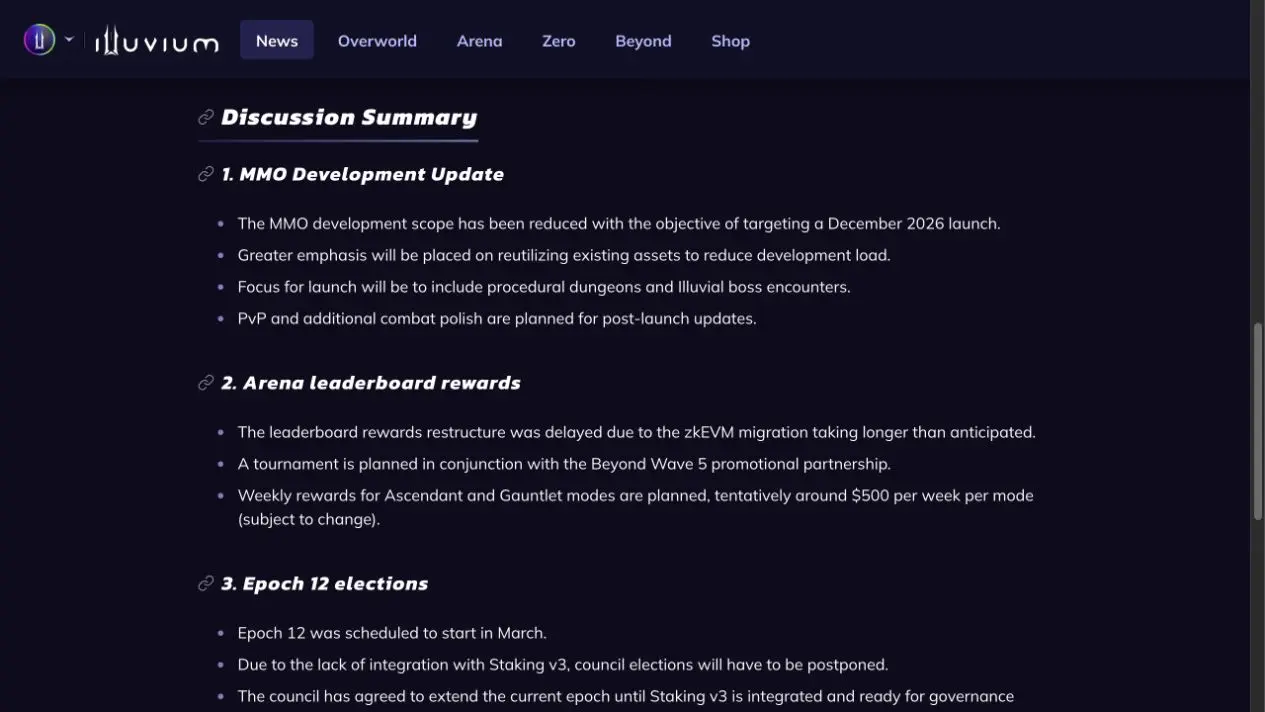
That is not proof Illuvium will fail. It is proof that a $1,900 token price in 2021 was never a sober measurement of a finished game. The market capitalised the dream years before the studio could discover the sustainable scope.
Virtual land valued scarcity before traffic
The Sandbox and Decentraland made a related mistake at a different scale. They sold location and scarcity before they had recurring foot traffic.
Land is valuable in a city because people need to be there. A plot near a busy station, shopping district, or workplace captures existing demand. In a virtual world, teleportation is easy and the supply of possible worlds is effectively unlimited. Artificially limiting parcels does not create a reason to visit them.
Both projects still exist and continue building. The Sandbox said its community published more than 2,000 experiences in the 12 months before its February 2025 Game Maker update. Decentraland rebuilt around desktop and mobile clients, with mobile in public testing during 2026. These are signs of real work, not evidence of abandonment.
But their token drawdowns show how much value had been assigned to the possibility of becoming the dominant metaverse rather than to the audience already using the products. They first made virtual land expensive, then had to make the virtual world worth visiting.
Players were never anti-monetization. They were anti-extraction
It is too convenient for crypto founders to say gamers simply “didn’t understand” NFTs. Players understand monetization extremely well. They understand paid expansions, subscriptions, cosmetics, battle passes, gacha, downloadable content, auction houses, and grey markets. They complain because they can see when a system makes the game worse.
Traditional players already distrust publishers that cut content into add-ons, sell competitive power, manufacture frustration, or shut down paid live-service games. GameFi arrived and often added more layers: wallets, seed phrases, gas, volatile entry prices, financial reporting, tax questions, scams, and the knowledge that every balance patch could move somebody’s portfolio.
The backlash was rational. Mojang rejected blockchain integration in Minecraft because NFT scarcity and exclusion conflicted with the game’s values. Steam excludes games that issue or allow exchange of cryptocurrencies or NFTs. In the 2023 GDC survey, 75% of respondents said their studios were not interested in blockchain technology.
Players were not rejecting ownership in the abstract. They were asking a practical question: what does this do for the game that a normal database cannot? Too many projects answered with benefits for investors, marketplaces, and token treasuries rather than benefits felt during play.
What remains worth building
I do not think every crypto gaming idea should be discarded. I think the order has to be reversed.
- The game must retain players with no token reward. Measure return rate, session quality, social groups, competitive depth, and voluntary spending before promoting wallet activity.
- Entry must be free or conventionally priced. No starter NFT should turn trying a game into a capital-allocation decision.
- Ownership should be optional and quiet. A player should not need to understand bridges, gas, or custody to complete the first session.
- Tradable assets should avoid competitive power. Cosmetics, creator-made objects, tournament trophies, and genuinely scarce commemorative items are safer than weapons or characters that determine wins.
- The economy needs outside consumers, not only inside investors. If everybody is earning, somebody must value the entertainment enough to spend without expecting a return.
- Assets need an honest end-of-life plan. “On-chain forever” is meaningless if the art, utility, marketplace, and game server disappear.
The strongest current experiments tend to hide the chain. Off The Grid is notable because it first presents itself as a free extraction shooter on PC and consoles, then places ownership and a marketplace behind the action. It attracted substantial wallet activity during early access. Yet even this more game-first example does not prove token economics work: GUN has fallen roughly 97% from its March 2025 high. A playable action game and a successful game token remain two separate achievements.
The likely future is not “GameFi” as a genre. It is a small number of good games using blockchain for specific back-office functions that most players can ignore. If ownership is truly useful, it will survive without being the headline.
The verdict: GameFi was finance looking for a game
The first GameFi cycle wanted to believe that players were an underpaid workforce and every game was a latent economy. That was the wrong diagnosis.
People play to master systems, spend time with friends, explore worlds, compete, collect, create, and relax. Sometimes they happily spend money doing it. Very few want every session to become a calculation of yield, floor price, emissions, and exit liquidity.
Axie proved that NFTs could form the core of a real game design. It also proved that a rapidly appreciating entry asset can exclude the audience a game needs. STEPN proved that rewards can accelerate a clean consumer loop, then showed how quickly the loop contracts when the reward weakens. Gods Unchained proved that even the most natural NFT category still has to win as a game. Illuvium proved that impressive production cannot make premature valuation rational. Ember Sword and Champions Tactics proved that “ownership” does not stop a game from ending.
So what happened to GameFi? It did not lose because gamers hate technology. It lost because crypto funded economies before studios earned communities, valued assets before players valued the worlds containing them, and treated speculation as evidence of fun.
Good games may still use NFTs. They just will not need us to care that they do.
GameFi FAQ
What is GameFi?
GameFi describes games that combine blockchain assets, tokens or financial incentives with gameplay, often promoting ownership, trading or play-to-earn economies.
Why did the first GameFi boom collapse?
Many economies depended on new buyers, token appreciation and emissions instead of retaining players who enjoyed the game without financial rewards.
Are unique active wallets the same as players?
No. A wallet interaction is not necessarily one person or a gameplay session, and some gameplay does not create an onchain transaction at all.
Is Axie Infinity dead?
No. Sky Mavis continued shipping updates in 2026, but Axie's survival is different from recovering its 2021 player and economic scale.
What did STEPN reveal about play-to-earn design?
STEPN showed that rewards can accelerate adoption of a clean consumer loop, but activity can contract sharply when token returns and speculative demand weaken.
Why do NFT card games make more sense than action games?
Cards are already discrete collectible objects, while action games need fast authoritative servers and frequent balance changes that limit the benefit of putting core gameplay onchain.
Does blockchain ownership keep a game alive?
No. Tokens may remain onchain after servers, art hosting, marketplaces and utility disappear. A shutdown plan matters more than the permanence of a ledger entry.
Why did traditional players reject many GameFi projects?
Players already understand monetization and objected when wallets, volatility, speculation and extraction made games less accessible or less enjoyable.
Can blockchain gaming still work?
Potentially, when the game retains players without rewards, entry is simple, ownership is optional, tradable assets avoid competitive power and the economy has real consumers.
What is the likely future of GameFi?
A smaller number of game-first products may use blockchain for specific ownership or marketplace functions that ordinary players can largely ignore.
Disclosure: This is an opinion and research piece, not investment advice. Token prices are volatile snapshots and should not be treated as measures of game quality or predictions of future performance.
Share
Found this useful?
Share it with someone who'd want to read it.
Related
Telegram Applies for .gram: The Web3 Domain Shift That Actually Matters
Telegram has applied for the GRAM top-level domain. If approved, it could connect websites, accounts and TON—but username rights are unclear.
Axie Infinity: A Lesson for the Future Of Play-To-Earn
Axie Infinity ($AXS) is probably the first game everyone thinks of when talking about crypto gaming or GameFi.
Common NFT Scams and How to Avoid Them
NFTs (non-fungible tokens) have become very popular amongst cryptocurrency traders and are drawing a lot of attention from several…