
This article was first published in March 2023 while Quai Network’s incentivized testnets and social-rewards campaign were active. It is now retained as a historical guide, not an opportunity to earn free tokens.
Status checked 13 August 2026: Quai Network mainnet is live. The old Dashboard social-reward tasks ended on 23 August 2023 and moved to Galxe. Quai's published token-claim event ran from 16 January until no later than 21 February 2025, subject to eligibility, KYC and its terms. Do not pay anyone, connect a wallet to an unofficial claim page or share a recovery phrase in an attempt to claim this expired campaign.
| Milestone | Status |
|---|---|
| Original social-media Dashboard tasks | Ended 23 August 2023 |
| Galxe and incentivized testnet programs | Historical; campaign-specific terms applied |
| Mainnet reward claim event | Closed by 21 February 2025 |
| Quai mainnet | Live since early February 2025 |
| Current native assets | QUAI and QI |
Historical Quai Network ($QUAI) airdrop steps
The original 2023 guide asked users to engage with Quai’s social accounts. These steps no longer qualify a reader for the closed claim event:
- Engage with Quai Network’s Twitter
- Engage with Quai Network’s Reddit
The archived details appear below to document how the campaign worked.
What is Quai Network?
Quai Network is a proof-of-work network designed around multiple interoperable chains. It includes an EVM-compatible account-based environment for QUAI and a UTXO-based environment for QI. The live network currently operates Cyprus-1 as its active zone; the multi-zone layout described in the original roadmap was not the launch configuration readers should assume today.
Quai Network provides a novel approach to blockchain scaling, different from parallel processing chains such as Aptos and Sui. It aims to maximize the energy efficiency of PoW by introducing the concept of modularity.
Proof-of-Work 2.0 and Proof-of-Entropy-Minima
Quai Network sought to improve upon the PoW consensus mechanism by addressing its environmental concerns. For the longest time, Bitcoin’s PoW algorithm has been infallible, but it also consumes massive amounts of energy. And it will continue to rise as mining difficulty increases after every Bitcoin Halving event. This is why Ethereum switched to proof-of-stake (PoS).
Quai argued that proof-of-stake can concentrate validation among large holders. The early documentation called its approach Proof-of-Work 2.0, combining merged mining and sharding so work can contribute across the hierarchy. Current Quai materials describe the consensus design as Proof-of-Entropy-Minima (PoEM). Claims about relative decentralization or energy efficiency are design arguments, not guarantees.
Merged Mining
Merged mining is the process of securing multiple blockchains with one miner, allowing miners to earn rewards in multi cryptos without having to switch between networks or use additional hardware. It was first conceived by Satoshi Nakamoto in the Bitcoin white paper, in which a completely seperate blockchain could share CPU power with Bitcoin, inheriting the same security and decentralization of Bitcoin without requiring dedicated miners.
Quai Network uses this concept, but instead of having Bitcoin as a parent chain, it has its own parent chain (the Prime Chain) which secures the many other chains beneath it by sharing hashrate. This improves throughput over monolithic chains such as Solana without the need for layer-2 solutions. Moreover, Quai Network is horizontally scalable, which means additional chains can be added to meet network demands. This is possible because of their multi-chain architecture.
Multi-Chain Architecture
Quai Network’s architecture uses sharding to divide work among chains in a hierarchy. The original roadmap described a Prime Chain, three Region Chains and nine Zone Chains. That remains useful background for the scaling design, but current network documentation says Cyprus-1 is the only active zone, so readers should not treat all nine planned zones as live.
- Prime Chain
In the original architecture, the Prime Chain sat at the core of the hierarchy and shared mining work with subordinate Region and Zone chains. It was designed to aggregate and settle state transitions across the network.
However, it has the highest mining difficulty, which means it has the slowest throughput (one block every 15 minutes). Therefore, it is not ideal for simple transactions and DApp activities. It is mostly for use in situations where the whole network is being addressed and securing the network.
- Region Chains
The roadmap named three Region Chains: Cyprus, Paxos, and Hydra. It described lower mining difficulty and higher throughput than the Prime Chain, with miners selecting one Region in addition to the Prime Chain. This paragraph describes the planned hierarchy, not the set of production zones currently active.
- Zone Chains
The original design placed three Zone Chains under each Region. Zone Chains were intended to carry regular transactions and contract interactions at higher throughput and to communicate across the hierarchy. The current mainnet documentation lists Cyprus-1 as the active zone, so old nine-zone diagrams should be read as the scalable target architecture.
- Coincident Blocks
Coincident Blocks tie the whole hierarchal structure together, linking all chains which enables cross-chain state transfers and periodic pegging of all chains to the Prime Chain’s total work. These blocks allow the entire network to inherit the same security of the Prime Chain, governed by three rules:
- All Prime blocks must contain a Region and Zone block.
- All Region blocks must contain a Zone block.
- Zone blocks can be mined asynchronously without being included in a Prime or Region coincident block.
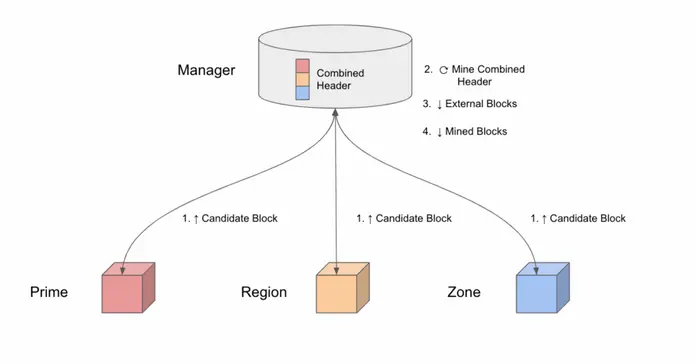
Basically, a Coincident block occurs when (1) a Prime, Region, and Zone block are confirmed at the same time OR (2) when just a Region and Zone block. Each time a Coincident block is mined, all blocks since the last coincident block are then confirmed by the Region Chain, continuing upwards until the Prime Chain — think of it as a roll call. Therefore, chains lower in the hierarchy can inherit the security of the Prime Chain while still conducting independent activities.
Who is the Team behind Quai Network?
Quai Network is developed by Dominant Strategies, a technology development company based in Austin. The company was co-founded in 2019 by Alan Orwick, Jonathan Downing, Karl Kreder, Yanni Georghiades, and Sriram Vishwanath, all of whom worked together in the Electrical and Computer Engineering department at the University of Texas. They co-wrote and published the white paper for Quai Network in December 2021.
Dominant Strategies has raised $10 million over two funding rounds — $8 million from Polychain Capital in March 2022 and $2 million from Alumni Ventures in May 2022.
Does Quai Network have a token?
Yes. The live network has two native assets: QUAI and QI. Current documentation describes QUAI as the EVM-compatible, account-based asset used for smart contracts and value storage, with mining emissions and protocol burn mechanics. QI is a UTXO-based medium-of-exchange asset whose emissions relate to mining difficulty. Users can convert between them under protocol rules.
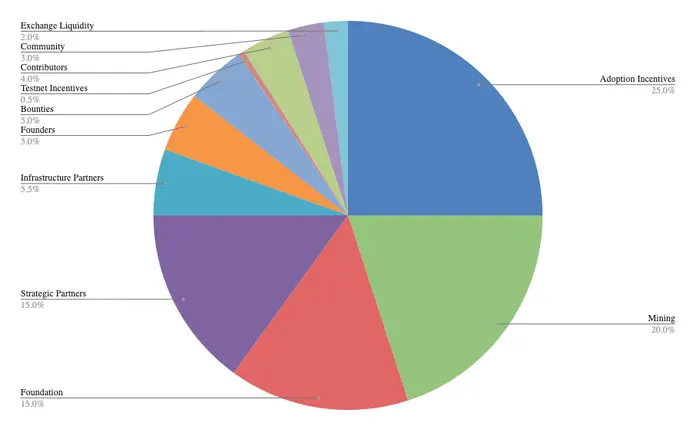
The original article's statement that QUAI was hard-capped with an undetermined total is obsolete. Quai's current emissions documentation instead describes genesis unlocks, mining emissions, the Singularity Fork's reduction in future unlocks and SOAP buybacks and burns. The old 25%, 3% and 0.5% allocation figures below belonged to a superseded tokenomics model.
How the historical Quai Network ($QUAI) rewards program worked
Quai Network ran a Social Media Rewards Program for engagement across several platforms. The Dashboard tasks described here ended in August 2023, and the program moved to Galxe with different points and terms. This section is an archive and should not be followed as a current earning guide.
In 2023, participants joined the project’s Discord, followed its Twitter account and checked recorded rewards in the Quai Dashboard. A Citizen Discord role provided a multiplier under the old rules. Those roles and links are not evidence of current claim eligibility.
At that time, Twitter and Reddit rewards were available while support for other platforms was still being developed. Quai later stated that no further rewards would be distributed through the old Dashboard after 23 August 2023.
- Follow Quai Network.
- Follow additional team accounts.
- Liking and retweeting Quai Network’s Tweets that are less than seven days old (limited to twice a day).
- Make a Tweet mentioning Quai Network. Original and insightful Tweets that are liked or replied by Quai Network will grant you additional rewards.
- Make a unique post in their channel (limited to twice a day).
- Make a post about Quai Network in another approved crypto-related Subreddit (limited to twice a day).
Under the old Reddit rules, an account needed more than 50 post/comment karma and team approval. These requirements are preserved only to explain the archived campaign.
Quai Airdrop Review
When reviewing an active airdrop, factors include whether the project has made an official commitment, the allocation, participation cost, eligibility, utility, lockups and claim security. For this campaign, the decisive factor in 2026 is simpler: it has ended.
Campaign status: Closed. The old Dashboard tasks ended in August 2023, and the official claims terms set a claim period ending no later than 21 February 2025.
Historical allocation: The percentages quoted in the 2023 article came from legacy tokenomics. Current Quai documentation labels the earlier allocation table as a legacy, pre-SOAP and pre-Singularity baseline.
Eligibility and difficulty: Participation was not simply “free.” Official terms required eligible participants to meet campaign rules and, for claims, satisfy identity and compliance requirements. Time, personal data and wallet-security exposure are costs even when no purchase is required.
Current token utility: QUAI is the EVM-compatible asset used in the account-based side of the network, while QI is a UTXO-based transactional asset. Miners choose reward denomination, and protocol conversions connect the two systems.
Historical lockup and distribution: Legacy documentation says Wave 1 and testnet rewards were available at token generation, while later Earn Program waves had different unlock schedules. Individual outcomes depend on the applicable award agreement and claim terms; this page cannot determine whether a past participant successfully claimed.
Frequently asked questions
Is the Quai Network airdrop still live?
No. The old social-media Dashboard stopped issuing rewards in August 2023. Quai's published mainnet claim event ended no later than 21 February 2025. Social engagement today does not reopen that historical claim.
When did Quai Network mainnet launch?
Quai announced a January 29, 2025 launch, while its current website describes the network as live since February 4, 2025. The important current status is that mainnet is live and the pre-mainnet campaign is over.
What are QUAI and QI?
They are the network's two native assets. QUAI is account-based and EVM-compatible for smart contracts and value storage. QI is UTXO-based and designed as a transactional medium whose emission relates to mining difficulty. Protocol rules allow conversion between them.
Are all nine Quai zones live?
No. Nine Zone Chains appeared in the original architecture and launch roadmap, but current network documentation identifies Cyprus-1 as the only active zone. The hierarchy describes how the network can scale, not the present production footprint.
What should I do if a website offers the old Quai airdrop?
Assume it is unsafe until verified through Quai's current official website and documentation. Never share a seed phrase or private key, and do not pay a fee to “unlock” an expired reward. The official claim period has closed.
Update sources
Share
Found this useful?
Share it with someone who'd want to read it.
Related
Canopy Network CNPY Airdrop Guide: Free Testnet Points
Canopy has one of the clearest free testnet campaigns in August 2026. Earn CNPY points through official quests, faucet use, testnet activity, and launching a virtual chain.
MetaMask Rewards Guide: What Is Live and Is MASK Confirmed?
MetaMask Rewards is real, but the latest official help page says there are no plans for a MASK token. Use the live campaigns for disclosed rewards, not a promised airdrop.
Polymarket Airdrop Rumor: Token Status and Real Rewards
Polymarket has real pUSD rewards, but its June 2026 help article says no token or airdrop has been announced. Here is what users can earn without relying on the rumor.