
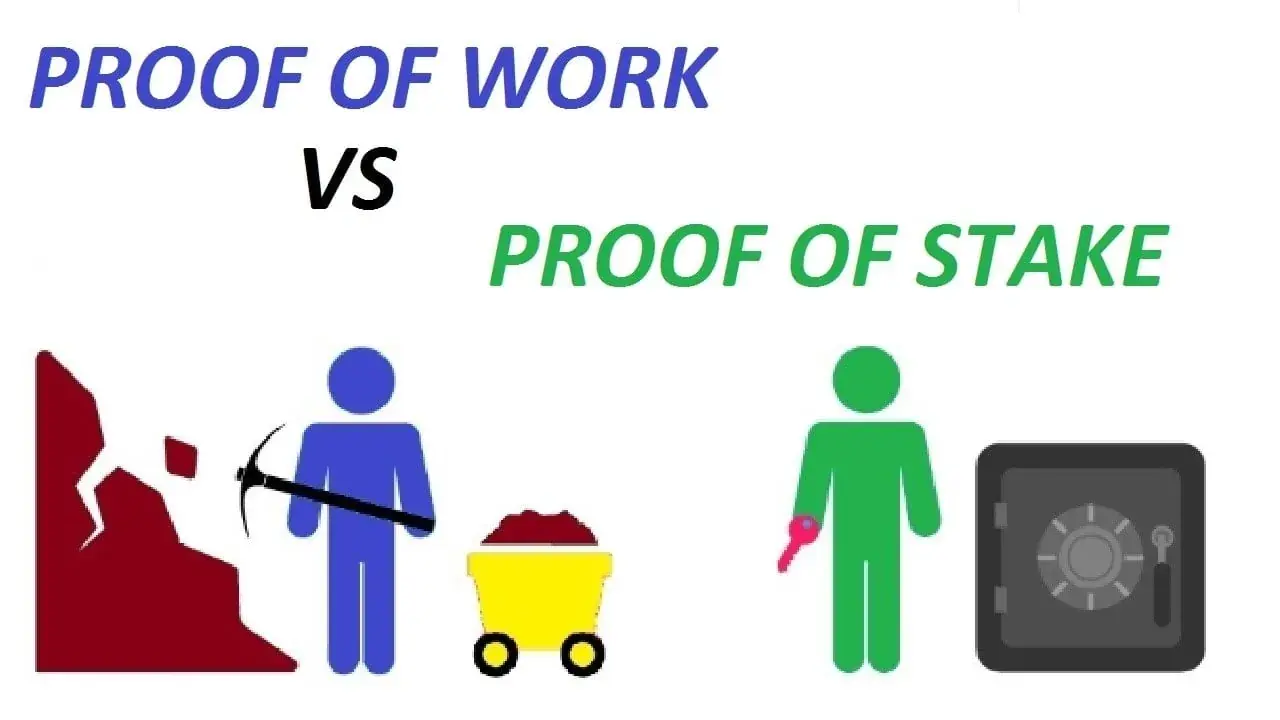
Proof of stake (PoS) is a family of consensus mechanisms in which validators put cryptocurrency at risk to help a blockchain agree on valid blocks. Honest participation can earn rewards; downtime usually causes smaller penalties, while certain conflicting signatures can lead to slashing and a forced exit.
PoS replaces proof of work’s competition to perform energy-intensive computation. It does not, by itself, guarantee cheaper transactions or higher throughput: those properties also depend on the chain’s block limits, execution design and scaling systems.
2026 update: Ethereum completed The Merge on September 15, 2022 and now uses proof of stake. Ethereum mining ended at the consensus layer. The original 2019 article is preserved below as a historical snapshot, with one accidentally duplicated paragraph removed.
Proof of stake at a glance
| Question | Proof of stake | Proof of work |
|---|---|---|
| What secures consensus? | Capital deposited as stake and protocol penalties | Specialized computation and energy expenditure |
| Who proposes blocks? | Validators selected under the protocol’s stake-weighted rules | Miners competing to find a valid proof |
| Main operating costs | Locked capital, node operation and connectivity | Mining hardware, electricity and cooling |
| Penalty for attacking | Stake can be slashed | Invalid work is rejected and its cost is unrecoverable |
| Does it guarantee scalability? | No | No |
Different PoS networks implement validator selection, delegation, rewards and governance differently. Delegated proof of stake, liquid staking and “masternodes” are not interchangeable terms for proof of stake.
How proof of stake works
At a high level, validators deposit the network’s native asset, run software that checks blocks and sign messages indicating which chain they believe is valid. The protocol chooses block proposers and weighs validator votes according to its rules. Stake makes misconduct economically punishable because the protocol can destroy part or all of a validator’s deposit.
PoS therefore does not simply reward someone for holding coins in a wallet. A validator or staking provider must perform protocol duties correctly, remain available and protect its signing keys. The precise reward rate is variable rather than guaranteed interest.
How Ethereum proof of stake works in 2026
Ethereum divides time into 12-second slots and 32-slot epochs. A validator is selected to propose a block in each slot, while committees of validators attest to blocks and checkpoints. Under normal network conditions, checkpoint finality is reached through votes representing at least two-thirds of staked ETH. Ethereum’s proof-of-stake documentation explains the proposer, attestation and finality process in detail.
Running an ordinary Ethereum node does not require ETH. Activating a solo validator requires a minimum 32 ETH deposit plus an execution client, consensus client and validator client. The Ethereum Pectra upgrade, activated in May 2025, implemented EIP-7251: validators using the newer 0x02 compounding withdrawal credentials can have an effective balance from 32 ETH up to 2,048 ETH. The minimum activation balance remains 32 ETH.
Rewards, penalties and slashing
Ethereum validators can earn protocol rewards for timely, correct attestations, block proposals and sync-committee duties. Returns change with network participation, validator performance and other factors; execution-layer priority fees and proposer revenue are separate from consensus rewards.
The risk depends on what goes wrong:
- Ordinary downtime: missed rewards and inactivity penalties, but normally not slashing.
- Extended network non-finality: inactive validators can lose progressively more through the inactivity leak.
- Slashable signatures: signing two blocks for one slot, double voting or making a surround vote can trigger slashing and forced removal. Correlated failures can produce much larger losses than an isolated slash.
Ethereum’s current rewards and penalties guide is the authoritative reference for these rules.
Can staked ETH be withdrawn?
Yes. Validator withdrawals became available with the Shanghai/Capella upgrade in 2023. A validator must have execution-layer withdrawal credentials, and a full withdrawal requires an exit first. Activation and exit queues rate-limit how quickly validators can enter or leave, so unstaking is not necessarily instant.
For 0x01 credentials, balances above 32 ETH are periodically swept to the withdrawal address. Pectra’s 0x02 credentials allow rewards to compound up to the 2,048 ETH maximum effective balance and permit withdrawal-address-initiated partial withdrawals. The Ethereum Staking Launchpad withdrawal guide documents the current process.
Ways to stake ETH
- Solo staking: run the hardware and clients yourself with at least 32 ETH. This provides direct protocol participation and control of the keys, but requires operational skill.
- Staking as a service: retain some key control while a provider operates the validator. Provider and key-handling risks remain.
- Pooled or liquid staking: stake less than 32 ETH or receive a liquid staking token. This adds smart-contract, oracle, governance, liquidity and possible token depeg risks.
- Centralized exchange staking: the exchange handles operations, but users accept custody, counterparty, withdrawal and concentration risks.
Do not compare options using headline annual percentage rates alone. Check who controls the withdrawal credentials, fees, exit terms, slashing policy, contract audits, client diversity and the concentration of stake under one operator.
Benefits and limitations of proof of stake
The clearest benefit for Ethereum was energy use: the Ethereum Foundation estimates The Merge reduced the network’s energy consumption by about 99.95%. PoS also avoids the continuous hardware race inherent to proof-of-work mining.
Trade-offs remain. Stake can concentrate in custodians or liquid-staking protocols; operators can share correlated software or infrastructure failures; governance and censorship pressure can cluster around large intermediaries; and token holders may take smart-contract or custody risk to access staking. No consensus mechanism eliminates the need to evaluate decentralization and implementation quality.
Staking also does not ensure ETH’s price will rise. Issuance, fee burning, demand, market liquidity and broader conditions all matter, and the value of rewards can fall with the asset price.
Ethereum validator safety checklist
- Use the official Staking Launchpad and verify the deposit contract rather than following an unsolicited link.
- Keep validator signing keys separate from withdrawal credentials and secure the withdrawal account carefully.
- Never run the same validator keys on two live machines; duplicate signing is a common route to slashing.
- Maintain backups, monitoring, updates and slashing-protection data, and test the setup before depositing mainnet ETH.
- Consider minority execution and consensus clients to reduce correlated client risk.
- Treat promised fixed or unusually high returns as a warning sign. Protocol rewards are variable.
Original 2019 article (historical archive)
The section below is retained substantially as originally published so readers can see the expectations before The Merge. Statements about Ethereum still using proof of work, an upcoming transition, GPU-mining profitability and staking necessarily increasing ETH’s price are outdated and should not be used as current guidance.
Proof of stake (PoS) is a consensus mechanism introduced in 2011 to improve upon the current most popular algorithm in use – Proof of Work (PoW). The main advantage of Proof of Stake two-fold it improves the speed of the Blockchain and also reduces the amount of electrical waste. Instead of consuming vasts amounts of computational power to “mine” for cryptocurrencies, Proof of Stake elects stakeholders to validate transactions. This election processes depends on the amount of cryptocurrency held by a node, hence the name Proof of Stake.
What is Proof of Stake
To truly understand PoS it is easier if we also explain the current system being used by Ethereum, and that is proof of work (Ethereum Mining). So basically when Ethereum is transferred, miners group that up into a ledger called a block chain and to do this they have to solve a puzzle. In creating this blockchain, a lot of computational power is also used. The amount of reward you get for creating a blockchain is a transaction reward. However, this depends on how much work you ie. how fast you can calculate and solve the puzzle.
So this is all going to go away once proof of stake comes along. With proof of stake, you don’t actually solve any puzzles. You remove the puzzle solving element from the system and thus change the way the reward is distributed. So instead of proving how fast you can calculate with hashrate, you need to prove how much Ethereum you own. You do this with something called a master node. When you create a master node, you have to lock up a certain amount of Ethereum to prove that you have it and rewards are distributed according to how much proof of stake you have. One can create multiple master nodes with a lot of Ethereum inside and you’ll earn more through this method.
Will Ethereum adopt Proof of Stake?
So you might have heard that Ethereum is considering changing its distributed consensus system to something called proof of stake. Here, we will try to explain what this is as well as how it may affect you.
How does this affect me?
So that’s going to be extremely interesting for everyone. We’ve seen proof of stake currencies before. Dash is one example where 50% of the rewards is done by mining and the other 50% is done by proof of stake. And there is PIVX which is 100% proof of stake. The advantage of proof of stake is huge. One benefit is that you no longer have to do the calculations which mean you save a lot of computational power. Another one is that you actually lock up Ethereum. By locking up Ethereum you effectively create more scarcity which means the price should go up.
So hopefully, it’s going to happen sometime this year. To do so, the people in charge of Ethereum have to make sure the code is ready and stable. And they also have to make sure they have the support of the miners. That’s going to be an interesting thing to see in the coming months because if the miners don’t support this move then what can happen is that it might break up Ethereum again just like last year.
But there are mechanisms to help along this process. Ethereum actually has kind of a ‘time bomb’ that would blow up if the switch is not made. The switch has always been planned and it’s in a sense been hard coded to happen sometime so that’s kind of interesting to see how this will progress.
Miners also do not need to worry they will be without a job. There are other currencies that can be mined with the current hardware. For example, if you use AMD GPUs, you can start mining Zcash which is also extremely profitable right now. So I do see this as being very exciting for everyone.
Frequently asked questions
What is proof of stake in simple terms?
Proof of stake is a way for a blockchain to agree on valid blocks using validators who put cryptocurrency at risk. Correct participation can earn rewards, while mistakes or dishonest conflicting signatures can cause losses.
Does Ethereum still use proof of work?
No. Ethereum completed The Merge on September 15, 2022 and now uses proof of stake. Proof-of-work mining is no longer part of Ethereum mainnet consensus.
How much ETH is needed to run a validator?
A solo validator needs at least 32 ETH to activate. Since Pectra, a validator with 0x02 compounding credentials can have an effective balance as high as 2,048 ETH, but the minimum remains 32 ETH.
Can I stake Ethereum with less than 32 ETH?
Yes, pooled and exchange-based services can accept smaller amounts, but they add provider, custody, smart-contract, liquidity or concentration risks. They are not equivalent to operating a solo validator.
Can a validator lose all its ETH?
Losses depend on the event. Ordinary downtime generally causes modest penalties, not slashing. Slashable behavior can force an exit, and correlated slashing events can destroy much more stake than an isolated incident.
Is staking ETH the same as earning interest?
No. Staking rewards compensate protocol participation and are variable. They are not a guaranteed bank interest rate, and returns may be reduced by penalties, provider fees, taxes or a fall in ETH's market value.
Can staked ETH be withdrawn?
Yes. Ethereum enabled withdrawals in 2023. Full withdrawals require a validator exit and are subject to protocol queues; partial-withdrawal behavior depends on the validator's withdrawal credential type.
Does proof of stake make transactions faster or cheaper?
Not automatically. Consensus is only one part of a blockchain's design. Block capacity, execution rules, demand and layer-2 systems also determine throughput and user fees.
What is the difference between a node and a validator?
A node independently verifies and relays Ethereum data and requires no ETH deposit. A validator uses signing keys and staked ETH to propose or attest to blocks, normally while relying on an execution and consensus node.
What are the biggest Ethereum staking risks?
Key risks include signing-key compromise, downtime, slashing, client bugs, delayed exits, custody failure, smart-contract exploits, liquid-staking-token depegs and concentration among large operators.
Sources and further reading
Share
Found this useful?
Share it with someone who'd want to read it.
Related
ERC 1155 Defined: What are ERC-1155 tokens?
ERC-1155 is a digital token standard created by Enjin that can used to create both fungible ( currencies ) and non-fungible ( digital…

Mithril (MITH) Overview
Mithril aims to disrupt our perceptions on social media- to decentralize and reward social media content creators fairly and openly.

x402 Explained: How AI Agents Pay for Content
x402 turns HTTP 402 Payment Required into a machine-readable checkout. It could let AI agents pay publishers per article, dataset or tool call—but payment is only one part of the creator-economy problem.