
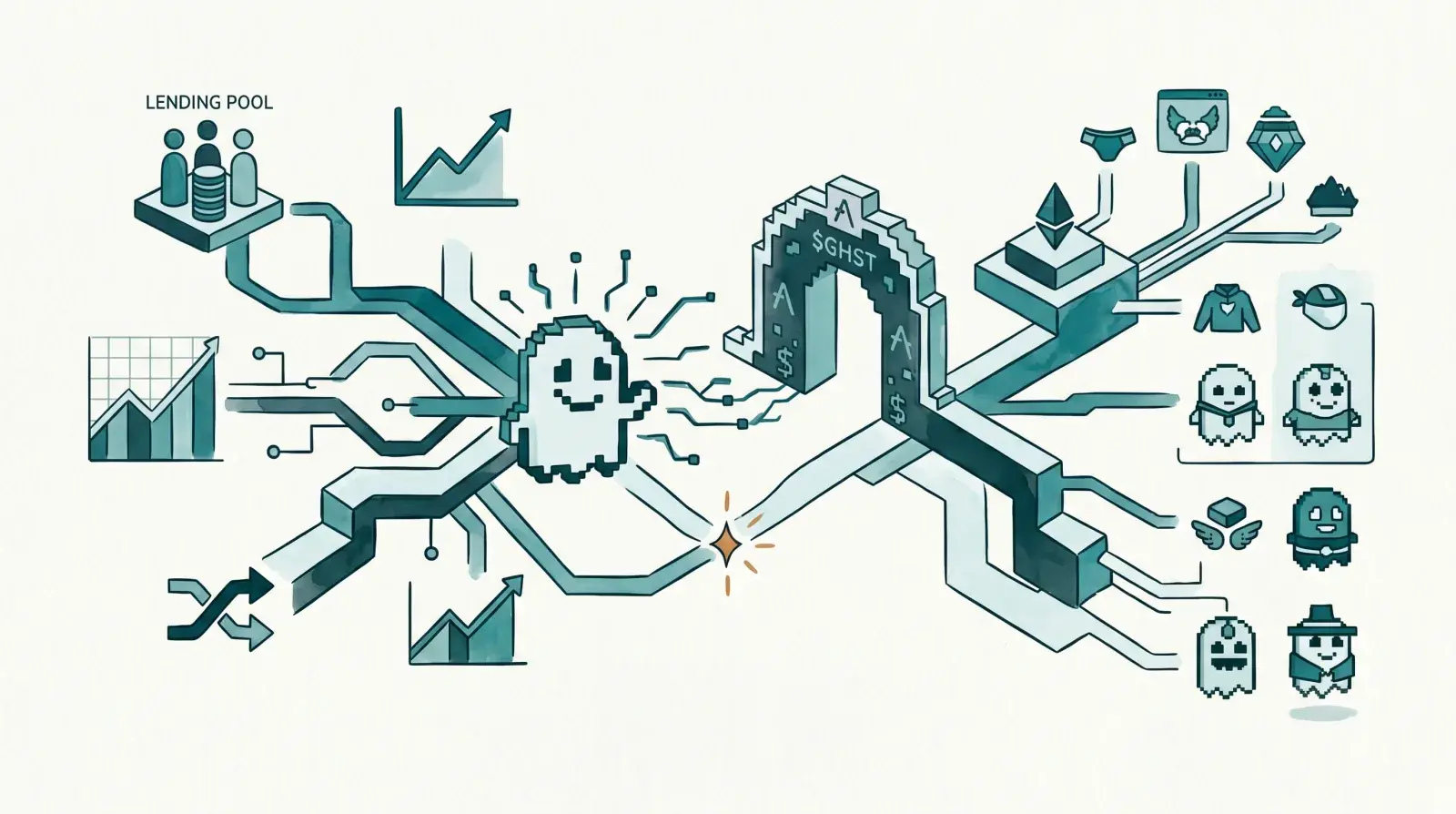
Aavegotchi is a crypto-native collectible and gaming ecosystem built around collateral-backed pixel ghosts, wearables, land and the GHST token. It was created by Pixelcraft Studios and its founders, not by Aave itself. The name and original design draw on Aave’s interest-bearing tokens, but the projects have separate teams and governance.
The ecosystem’s canonical home moved from Polygon to Base in July 2025. The official migration notice says Polygon Aavegotchi contracts were frozen, assets there became view-only and non-transferable, and equivalent NFT state was recreated on Base. Users should use current official interfaces and contract addresses rather than following the Ethereum- and Polygon-era instructions in the original article.
In May 2026, Pixelcraft announced a transition away from acting as the ecosystem’s single default studio. It described the existing one-studio model as unsustainable and began moving products and responsibilities toward DAO-led or independent stewardship. That is not the same as a blanket shutdown, but readers should not assume that Gotchiverse 3D, Gotchi Guardians or DeFi Dungeon remain under active Pixelcraft development unless a current maintainer says so.
Safety warning: Aavegotchis, GHST, wearables and REALM are speculative blockchain assets. Verify that a marketplace, migration page, token contract and network are official before connecting a wallet. Never enter a seed phrase into a migration site, and treat messages promising manual swaps or support as potential scams.
Aavegotchi status in 2026
| Topic in the 2020 article | Current status |
|---|---|
| Ethereum-based NFTs | Outdated; Base is the canonical chain after the 2025 migration |
| Aave created Aavegotchi | Incorrect; Pixelcraft created Aavegotchi, using concepts and assets associated with Aave |
| Open-ended GHST bonding curve | Closed in March 2023; the official wiki reports a fixed 52,747,802 GHST supply, subject to burns |
| Future AavegotchiDAO | The DAO and community governance are active parts of the ecosystem |
| Planned Realm metaverse | REALM and Gotchiverse assets exist, but product stewardship changed in 2026 |
| Single Pixelcraft-led roadmap | Changed; Pixelcraft began a DAO and independent-builder transition in 2026 |
How Aavegotchi NFTs work
An Aavegotchi combines a collectible NFT with attributes such as Spirit Force, traits, kinship, experience and equipped wearables. Spirit Force refers to supported collateral held with the Gotchi. Because collateral mechanics, supported assets and withdrawal routes have changed across deployments, owners should verify the live documentation before buying or modifying a Gotchi.
Portals reveal possible Aavegotchis, and a user summons one by selecting a candidate and supplying eligible Spirit Force. Wearables and traits can affect rarity and game behavior. When an Aavegotchi is transferred, its associated on-chain components may move with it; buyers should inspect the complete asset rather than valuing only the character image.
What is GHST used for?
GHST is the ecosystem’s utility and governance token. Its uses have included marketplace transactions, wearables, Portals, REALM-related assets, games and DAO participation. A use described in an older guide may no longer be active, and utility does not guarantee demand or price appreciation.
The GHST bonding curve closed in March 2023. That makes the original statement that the curve had no maximum distribution obsolete. The official wiki lists a fixed supply of 52,747,802 GHST after closure, while burns can reduce the circulating or total amount over time.
Base migration and legacy Polygon assets
The 2025 migration recreated Aavegotchi NFT state on Base and froze corresponding Polygon assets to prevent duplicate use. The official notice said NFT holders did not need to perform a general claim transaction. GHST and certain collateral handling followed separate routes, so owners of legacy Polygon balances should consult the current official migration documentation rather than improvising a bridge or accepting help through direct messages.
Contract addresses differ by chain. Base contracts are the primary current deployments, while the official contract directory labels Polygon as deprecated. Search results, old tutorials and wallet token lists can surface obsolete or counterfeit addresses.
2026 stewardship transition
Pixelcraft’s May 2026 announcement set a transition period from 1 June to 1 September 2026 for handing off products, infrastructure and knowledge. The post said it would preserve critical infrastructure during the transition and support builders, while moving away from open-ended development obligations under the former studio model.
This creates execution and continuity risk as well as opportunities for independent teams. Before spending time or money in an Aavegotchi game or asset, check who currently maintains the relevant contracts, interface, servers and roadmap. A functioning token or NFT contract does not prove that an associated game has active development.
Main Aavegotchi and GHST risks
- Project-continuity risk: responsibility for products may change during or after the stewardship transition.
- Smart-contract risk: NFT, collateral, marketplace, game and migration contracts may contain vulnerabilities.
- Liquidity risk: GHST and individual NFTs may be difficult to sell at an expected price.
- Valuation risk: rarity scores, wearables and collateral do not guarantee a buyer or a premium.
- Collateral risk: supported Spirit Force assets can depeg, lose value or become harder to withdraw.
- Migration risk: obsolete Polygon interfaces and fake Base migration sites can mislead users.
- Governance risk: DAO decisions can alter emissions, treasury use, game rules and supported products.
- Game and server risk: off-chain services can stop even when on-chain assets remain transferable.
Original October 2020 Aavegotchi guide (historical archive)
The original author-written sections below are preserved substantially intact. Its Ethereum framing, team description, planned DAO and Realm, collateral examples and open-ended bonding-curve tokenomics reflect 2020. The broken external price widget and an unrelated pharmacy link were removed during the import cleanup.
Aavegotchi ($GHST), powered by Aave, is the combination of DeFi staking and non-fungible tokens (NFT) that possesses three attributes, determining their value and rarity: collateral stake, traits, and wearables.
Aave, one of the biggest DeFi protocols today, developed NFTs that function within the DeFi framework. The project shows a promising alternative to the way many stakers perform yield farming.
Background
Launched in July 2018, the team behind Aave created Aavegotchi to offer new alternatives for yield farming. This project puts entertaining gaming mechanics on the platform to support a new type of DeFi experience for its users.
Daniel Mathieu, the lead developer for Buillionix.io, and Jesse Johnson, co-founder at Bullionix, lead the team of builders working for the Aavegotchi team. Their work centers on the main goal of “gamifying DeFi experience” through NFTs.
What is Aavegotchi?
Aavegotchis are Ethereum-based crypto-collectibles powered by NFT technology. The Aavegotchi NFTs follow a similar set-up that other blockchain-based games such as Cryptokitties implement on their own gaming economies.
What Aavegotchi offers to the blockchain gaming space are DeFi models such as collateral staking, dynamic rarity, rarity farming, decentralized autonomous organizations (DAO), and smart contract implementations. Simply put, the objective is to use DeFi and yield farming concepts in creating NFTs that can hold value and appreciate over time.
The team behind Aavegotchi sought to liken the project to the Tamagotchi. Aavegotchis can be considered as the blockchain counterpart of digital pets that we play within Tamagotchi. Aavegotchis are playable NFTs that can hold digital economic value.
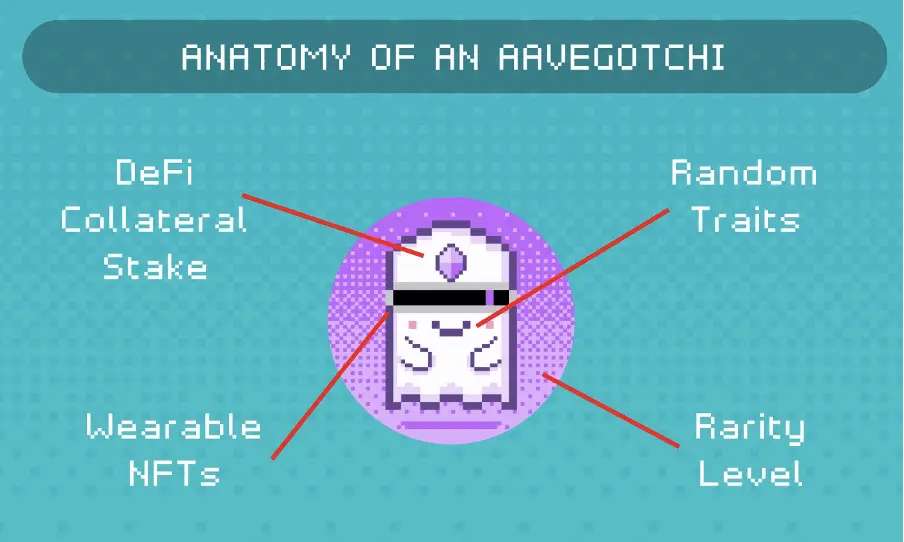
There are three elements to the Aavegotchi NFT that help define its value and rarity. They are:
- Spirit Force – Putting it in DeFi terms, this means “collateral stake.” Aavegotchi has an escrow account where every owner’s Aave-backed ERC20 tokens are held as collateral. These collateralized tokens are called “aTokens,” and are accessible to Aave’s lending pool. Since these are assets can generate yield over time, this helps increase the value of aTokens kept in Aavegotchi’s escrow account. Today, there are many aTokens supported by the platform such as aDAI, aLEND, aLINK, and aUSD, among others.
- Traits – Aavegotchis can have different attributes that make up their identity as NFTs. These traits affect their rarity, performance, and compatible wearables. While most of these traits are given to Aavegotchis randomly the moment they are created, they can be affected by user interactions that their holders make.
- Wearables – Through the ERC-998 composability standard, Aavegotchi can be used to manage child NFTs as well. These child NFTs back the wearables that users can attach to Aavegotchis. If worn on compatible Aavegotchis, they can affect their traits and value.
Where do Aavegotchis gain value?
Aavegotchis derive their value from two sources: intrinsic value and rarity value.
Intrinsic Value
Their intrinsic value originates from the amount staked by users on the NFT behind the Aavegotchi. The collateral stake, along with the interest it has accrued from Aave’s lending pool, becomes an Aavegotchi’s intrinsic value. For example, a 10 aLEND stake in an Aavegotchi will mean that it can hold that value as well, along with the interest accrued.
As of now, the only collaterals that can be staked on Aavegotchis are ERC-20 tokens listed on the Aave platform. As soon as the AavegotchiDAO is launched, the number of acceptable collaterals can be expanded.
Rarity Value
The rarity of an Aavegotchi influences its value as well. This introduces the concept of “rarity farming” on the ecosystem as well. Users get rewards for training rare Aavegotchis and trading them with other players on its platform.
Aavegotchi Ecosystem
Portals
Users can only summon or create Aavegotchis through the Portal. This is backed by a smart contract that allows for the creation of new NFTs. Portals can be bought from the Aavegotchi dapp or from an external marketplace.
In claiming Aavegotchis, users have to stake the collateral required for it. Portals can only support the summoning of one Aavegotchi.
What is $GHST Token?
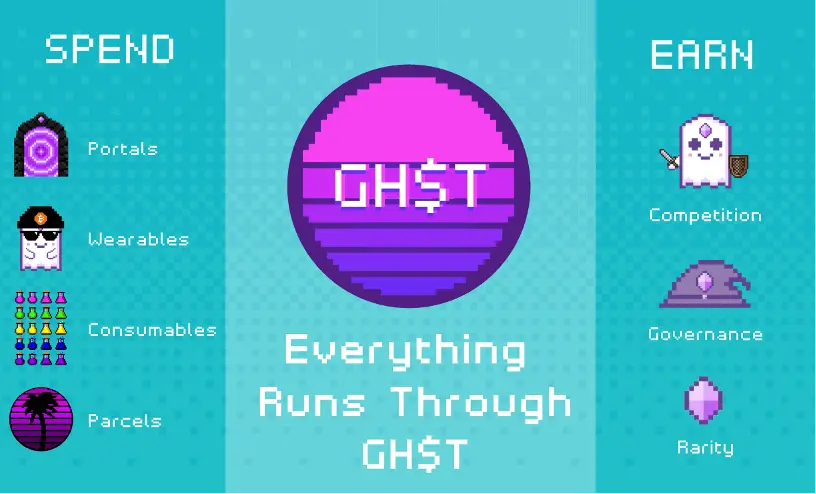
$GHST is the native utility token for the Aavegotchi platform. They can be used as a medium of exchange, fees payment for purchasing stuff like portals and wearables, voting functions, and rarity farming. $GHST is also required to mint REALM.
$GHST’s can be freely transferred to other users or swapped with supported tokens on the Aave platform.
$GHST Tokenomics
$GHST will be distributed in 3 main phases – i) Initial token distribution event, and ii) Governance rewards and iii) Rarity farming.
The Token Distribution Event is planned to begin in late Q3 2020 or early Q4 2020, split into 3 phases: Private Round, Pre Sale Round, and Token Bonding Curve.
- Private Round – 5,000,000 GHST tokens will be distributed, at a price of 0.05 DAI / GHST. Open to participants with KYC validation with a minimum of 20K DAI to be redeemed for GHST tokens. The total vesting period is 365 days, with an initial release of tokens on the 180th day after the close of the pre-sale round, followed by a release over the subsequent 185 days thereafter.
- Pre Sale Round – 500,000 GHST tokens will be distributed, at a price of 0.1 DAI / GHST. Open to participants with KYC validation with no minimum contribution. The vesting period is the same as the Private Round. Funds raised during the Pre Sale will be used as liquidity in the Token Bonding Curve reserve pool.
- Token Bonding Curve (TBC) – Open to participants with KYC validation with no minimum contribution. No maximum supply of GHST distributed via the bonding curve. No lockup or vesting period.
During the Pre Sale Round, $GHST will also be created and distributed to the Ecosystem Fund (1,000,000 GHST) and Team Fund (1,000,000 GHST). Both funds are locked according to the same schedule as the Private Round.
AavegotchiDAO
The community-governance model of the platform will be supported by the AavegotchiDAO. This protocol will allow the users to decide on the list of collaterals that can be staked in NFTs, amend gaming parameters, and even limit the number of Aavegotchis that can be created in the future. To incentivize token holders on community governance, they are rewarded with GHST.
Aavegotchi Realm
This refers to the metaverse for Aavegotchis. The Realm is the digital world where Aavegotchis can interact with each other and join games, execute smart contracts, and call for governance functions.
Users can purchase parcels of land, or REALM, in the Aavegotchi world by staking GHST tokens. Aavegotchi’s Realm is also the social layer for the AavegotchiDAO, aimed at creating a more visual experience for community voters. Within this digital experience, Aavegotchis convene in a 2D town square to discuss platform proposals and cast votes.
Conclusion
The DeFi space seems a bit too complex for many newbies. This reality can be daunting for someone who is just newly-introduced to the world of blockchain, which unfortunately presents psychological barriers to adoption. Platforms that help users ease themselves onto DeFi could be helpful additions to the crypto space in general.
Aavegotchi is a valuable concept on that end since it has a promising model in making it easier for anyone to participate in yield farming. Gamifying the DeFi space for anyone who wants to dip their toes on interest-earning products is likely to help foster adoption later on. Overall, the project shows huge potential in proving the capacity of different blockchain innovations, such as NFTs and collateral staking, to provide reliable financial products and services.
Disclaimer: Cryptocurrency trading involves significant risks and may result in the loss of your capital. You should carefully consider whether trading cryptocurrencies is right for you in light of your financial condition and ability to bear financial risks. Cryptocurrency prices are highly volatile and can fluctuate widely in a short period of time. As such, trading cryptocurrencies may not be suitable for everyone. Additionally, storing cryptocurrencies on a centralized exchange carries inherent risks, including the potential for loss due to hacking, exchange collapse, or other security breaches. We strongly advise that you seek independent professional advice before engaging in any cryptocurrency trading activities and carefully consider the security measures in place when choosing or storing your cryptocurrencies on a cryptocurrency exchange.
Frequently asked questions
What is Aavegotchi?
Aavegotchi is an NFT collectible and gaming ecosystem built around collateral-backed pixel ghosts, traits, wearables, land and community governance.
Did Aave create Aavegotchi?
No. Aavegotchi was created by Pixelcraft Studios and its founders. It adopted concepts and interest-bearing assets associated with Aave, but the projects have separate teams and governance.
Which blockchain is Aavegotchi on?
Base is Aavegotchi's canonical chain following its July 2025 migration. The official contract directory describes the earlier Polygon deployment as deprecated.
Do Aavegotchi NFT holders need to claim migrated NFTs?
The official 2025 migration notice said Polygon NFT state was snapshotted and recreated on Base without a general claim action. Legacy GHST or collateral can require different handling, so owners should follow current official instructions.
What is Spirit Force?
Spirit Force is eligible collateral held with an Aavegotchi. The supported assets and mechanics depend on the current deployment and should be verified before a purchase or withdrawal.
What is GHST used for?
GHST is used across parts of the Aavegotchi ecosystem for governance and products such as NFTs, wearables, Portals, land or games, subject to their current availability.
Is the GHST bonding curve still open?
No. The bonding curve closed in March 2023. The official wiki reports a fixed supply of 52,747,802 GHST after closure, subject to token burns.
Is Pixelcraft shutting down Aavegotchi?
Pixelcraft's May 2026 announcement described a transition away from the single-studio model, not a blanket shutdown. Products may move to DAO or independent stewardship, so their current maintainer and status must be checked individually.
Are Aavegotchi NFTs backed by collateral?
A summoned Aavegotchi can contain eligible Spirit Force collateral, but that does not guarantee its market value. Buyers should inspect the asset, collateral and current withdrawal mechanics.
What are the main risks of GHST and Aavegotchi NFTs?
Risks include price and liquidity loss, smart-contract bugs, collateral depegs, fake migration sites, obsolete contract addresses, governance changes and uncertain maintenance of individual games or services.
Sources and further reading
Share
Found this useful?
Share it with someone who'd want to read it.
Related

Aave (AAVE) Guide: V4, V3, GHO, Lending and Risks
A current guide to Aave V4 and V3, supplying, borrowing, GHO, AAVE governance, Umbrella and liquidation risk, with the original 2020 article preserved below.
Ampleforth AMPL Guide: Rebases, FORTH, SPOT and Risks
How AMPL rebases work, why token count is not profit, and the roles of FORTH governance, wrapped AMPL, SPOT and current liquidity programs.

Balancer Finance Guide: V3 Pools, BAL, Risks and V2 Status
How Balancer V3 pools, the Vault, routers, hooks and boosted liquidity work, plus BAL governance, the V2 sunset and the November 2025 exploit.