
Historical article — major update: The guide below describes the 8Hours/EHrT/VIMworld model as it existed in October 2020. It is not the current VIMworld architecture. VIMworld later became independent from 8Hours, replaced EHrT in its ecosystem, migrated participating VIMs away from VeChain, and changed its product and token model again. Do not buy EHrT or follow an old migration link based on this page.
What changed after 2020?
| Period | Verified change |
|---|---|
| 2021 | VIMworld said it was fully independent from 8Hours Foundation. It transitioned its VIM feeding system from EHrT to VEED and required a 1:1 EHrT-to-VEED swap for EHrT remaining inside VIMs after October 28, 2021. |
| 2022 | VIMworld 3.0 launched on BNB Smart Chain. Its later year-end review said the migration deadline had passed and VIMs left on VeChainThor would remain there but could not participate in new VIMworld activities. |
| 2023 | VIMworld announced an Ethereum-based personal-finance direction called VIMworld Ascendant and introduced OJEE to replace VEED. |
| 2024 | VIMworld launched a mobile app for its Ascendant experience. Current project documentation describes OJEE as the core utility token and POWA as a participation/governance token. |
| 2025–2026 review | The site and documentation remain reachable, but the latest first-party product posts we found were from 2024. Verify present app availability and support through current official channels before importing a wallet or committing funds. |
This history matters because an onchain token or NFT can continue to exist even when its official utility, supported chain or migration window changes. The original article is retained below with short status notes rather than rewritten.
8Hours Foundation ($EHrT) aimed to integrate the real world into the blockchain to create beneficial implications for the time spent with friends and family. In line with this vision, the foundation partnered with PlayTable, a proposed blockchain-enabled game console, to facilitate social gaming platforms. EHrT was presented as the native currency of the PlayTable ecosystem. Toymakers and game developers were expected to buy EHrT to register toys or assign data to their products.
Powered at the time by VeChain’s blockchain technology, VIMworld was introduced as a smart NFT platform for collectables and digital characters. VIMs, then short for Virtually Integrated Metadata, were digital collectible tokens living on VeChainThor. Each VIM was presented as a digital character with unique properties and capabilities.
Current-context note: EHrT is not the token described by VIMworld’s current token documentation. The obsolete live-price widget has been removed because it implied that the old 2020 utility model remained current.
Background
John Dempsey, the founder of the 8Hours Foundation, is both a gamer and a collector. These were exactly the same interests that allowed him to conceptualize the whole project and later be built together with his team and the community.
Dempsey felt the need to use technology to bring people together through the help of social activities, such as games.
He built the foundation to create a blockchain platform that encourages and rewards people when using it. The platform’s goal is to ensure that its participants can spend at least a minimum of eight hours per week being engaged in meaningful social interactions.
What is the 8Hours Foundation?

8Hours Foundation is an organization put together to build a real-life community even in the blockchain space. The primary purpose of the team’s efforts, as already mentioned, is to create a platform where people are rewarded for interacting with other individuals.
The foundation collaborates with PlayTable, a blockchain-based gaming platform, to spearhead a program called ‘Toy Reality’. This way, they can build a virtual social network that emulates the real world through the tokenization of real-life assets on the blockchain.
A mixture of real-world and blockchain data storage technologies power the whole platform. Furthermore, RFID technology and tagging enable the creation of their verifiable blockchain counterpart. The same set-up supports ownership tracking, asset journey recording, and asset customization.
Eight Hours Token ($EHrT)
Historical token model: The functions in this section came from the 2020 8Hours whitepaper. VIMworld later replaced EHrT with VEED for its feeding system, then introduced OJEE and POWA in its later product model. None of the use cases below should be treated as currently available EHrT utility without new confirmation from 8Hours itself.
Eight Hours Token, or the EHrT, is the native token of the platform. It can be used as a medium of exchange, fees payment, staking, and voting. EHrT also has specific functions that help run the whole platform. Mainly, these are:
- Authentic Asset Certificates (AAC) – In making blockchain representations of real-life objects, users have to spend EHrT. The process allows for the creation of AAC, which act as proof of ownership on a blockchain-counterpart of real-life assets. Additionally, these belong to the non-fungible token (NFT) classification, the same kind that allows for the tokenization of assets in the real world. For users to be able to register and join the platform, AAC’s are required.
- In-Game Currencies (IGC) – Through EHrT, users can create in-game currencies. These are tokens that developers can create to back the economy of their games. Since these currencies can work cross-platform, other gaming systems on the 8Hours Foundation ecosystem can use them as well.
- Colored Tokens – These tokens function like marks or records on an AAC that display their digital journey. This means that colored tokens can be referred to in looking for the history of an AAC’s ownership, its authenticity, progress, and wealth, among others. Furthermore, only developers can create new colored tokens and deposit them on AAC.
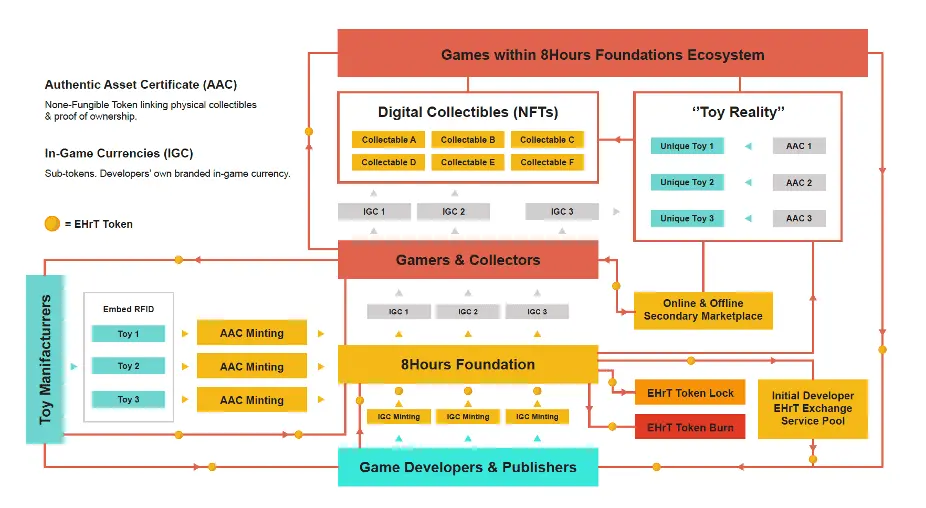
Other uses for the EHrT involve other financial services such as staking and rewards. But generally, EHrT is held by users for:
- Staking – Through a grants system, users can make investments in the projects built within the 8Hours ecosystem. This entitles stakers to receive benefits from a platform in the event that they grow.
- Reward – Through a rewards system, the platform incentivizes its users to participate in network activities, especially those that involve platform developments or updates. These users receive a proportional amount of EHrTs for their participation.
- Support – Users who want to show their support on a platform that is currently being built, that can freely use EHrTs to fund a project.
8Hours backs its transaction system with the VeChainThor chain. This allows it to support a multi-party payment protocol without requiring gas fees that platforms usually charge whenever users perform these transactions.
What is the VIMworld?
Historical VIMworld model: The following section predates VIMworld’s independence, chain migrations and shift toward gamified personal finance. It also predates the reinterpretation of VIM as “Virtual Investment Minion” in the Ascendant product.

Powered by EHrTs, the foundation has created VIMworld, a collaborative initiative between them and PlayTable, with the purpose of establishing a gaming platform built within its own ecosystem.
VIMworld refers to a virtual community that gathers a collection of all Virtually Integrated Metadata (VIM) that its participants have created on the platform. These are powered by AACs that help VIMs store and verify data, record transactional history, as well as the whole journey of virtual objects, among others.
VIM holders can then join any community activity with other users, or simply interact with them. These interactions are made possible by games that get people to perform certain tasks.
Features of VIMs
There are several features that help distinguish VIMs from the usual NFTs. These are:
- User-managed – Owners of VIMs can only grow in value if the owner attends to them by participating in VIMWorld activities. In addition, they can be customized based on their history.
- Asset-powered – VIMs require users to spend EHrTs from time to time if they want it to grow. This means that VIMs can hold actual value and grow at the same time.
- Digital Representation – It is one of the more innovative aspects of VIMs. VIMs allow real-life objects like toys and collectibles to increase in value through their blockchain representations.
At the time of the original article, the project reported more than 2,100 community members and 7,000 VIM collectibles. Those historical marketing figures are not a measure of the platform’s current users, activity or adoption.
Gaining VIMs and Growing their Value
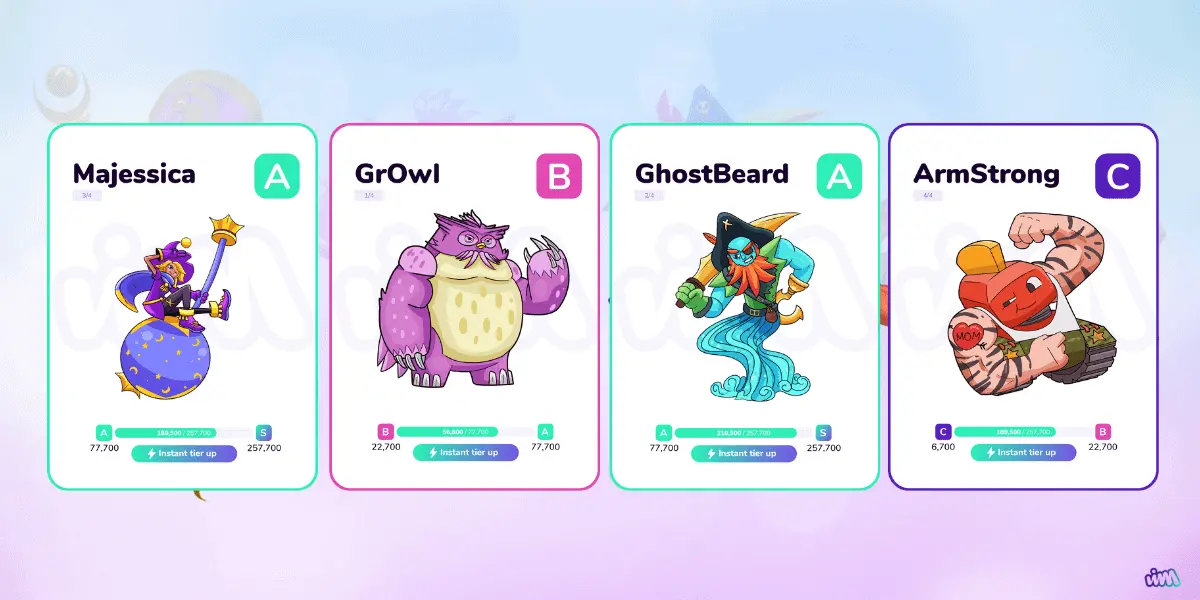
There are plenty of ways to gain VIMs, such as rewards when winning games from various platforms on the 8Hours Ecosystem, donations or incentives given out by the foundation, purchase from marketplaces, or acquisitions of toy packages.
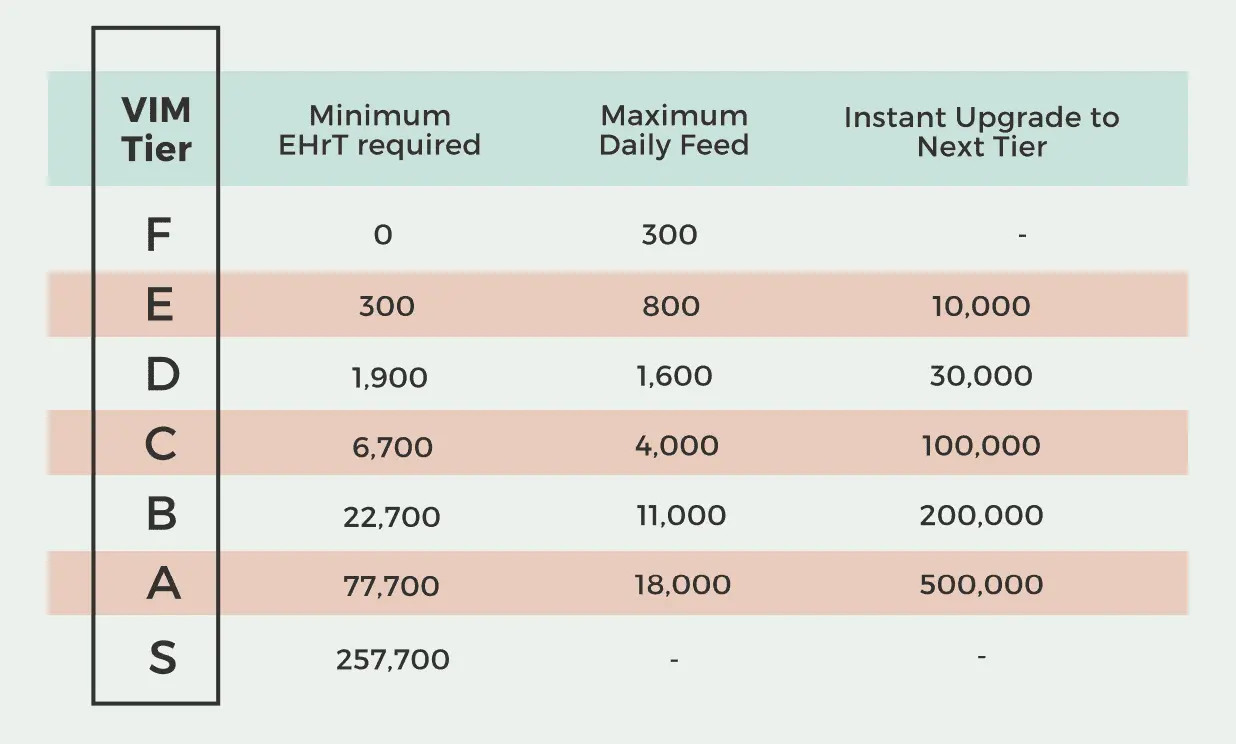
Besides representing the ownership of a user on an item or a game, VIMs are also valued based on the amount of game data and progress they hold. They are classified into a variety of rarities and tiers, but can be easily upgraded by adding more EHrT in them. Furthermore, higher-tiered VIMs accrue bigger benefits for its holders.
The original roadmap said VIMs would be traded on VIMExchange and potentially on other VeChainThor-compatible marketplaces. Later versions instead used different chains, marketplaces and tokens, making this roadmap statement obsolete.
Conclusion
Creating real-world use cases for blockchain technology is one of the biggest drivers for its adoption. And since social interactions have been reduced in this modern and digital age, having platforms that help alleviate this problem could certainly have a real use case.
The project became a case study in a different way: blockchain assets may persist while the organization, supported network, app and utility around them change. Anyone holding an old EHrT, VEED or VIM position should establish which chain and contract it uses, whether a migration window ended, and whether the current platform still supports it before taking action.
Frequently Asked Questions
Official update sources
- VIMworld: independence from 8Hours Foundation
- VIMworld: EHrT-to-VEED transition notice
- VIMworld 3.0 BNB Smart Chain launch
- VIMworld 2022 review and migration status
- VIMworld Ascendant and OJEE announcement
- Current VIMworld token ecosystem documentation
Disclaimer: Cryptocurrency trading involves significant risks and may result in the loss of your capital. You should carefully consider whether trading cryptocurrencies is right for you in light of your financial condition and ability to bear financial risks. Cryptocurrency prices are highly volatile and can fluctuate widely in a short period of time. As such, trading cryptocurrencies may not be suitable for everyone. Additionally, storing cryptocurrencies on a centralized exchange carries inherent risks, including the potential for loss due to hacking, exchange collapse, or other security breaches. We strongly advise that you seek independent professional advice before engaging in any cryptocurrency trading activities and carefully consider the security measures in place when choosing or storing your cryptocurrencies on a cryptocurrency exchange.
Share
Found this useful?
Share it with someone who'd want to read it.
Related
What Happened to Harmony ONE? Inside the 4 Billion Token Exploit
Harmony patched a cross-shard replay flaw after roughly 4 billion ONE appeared without authorization. The incident follows years of bridge losses, token inflation and failed recovery.
Alchemy Pay ACH Explained: Fiat Payments and Crypto On-Ramps
Learn how Alchemy Pay connects crypto with fiat payment rails and on-ramps, where ACH fits into the system and what users should examine before investing.
Conflux Network CFX Explained: China Links, PoW and PoS
Learn how Conflux Network combines proof of work and proof of stake, its relationship to China’s blockchain ecosystem and the role of CFX.