
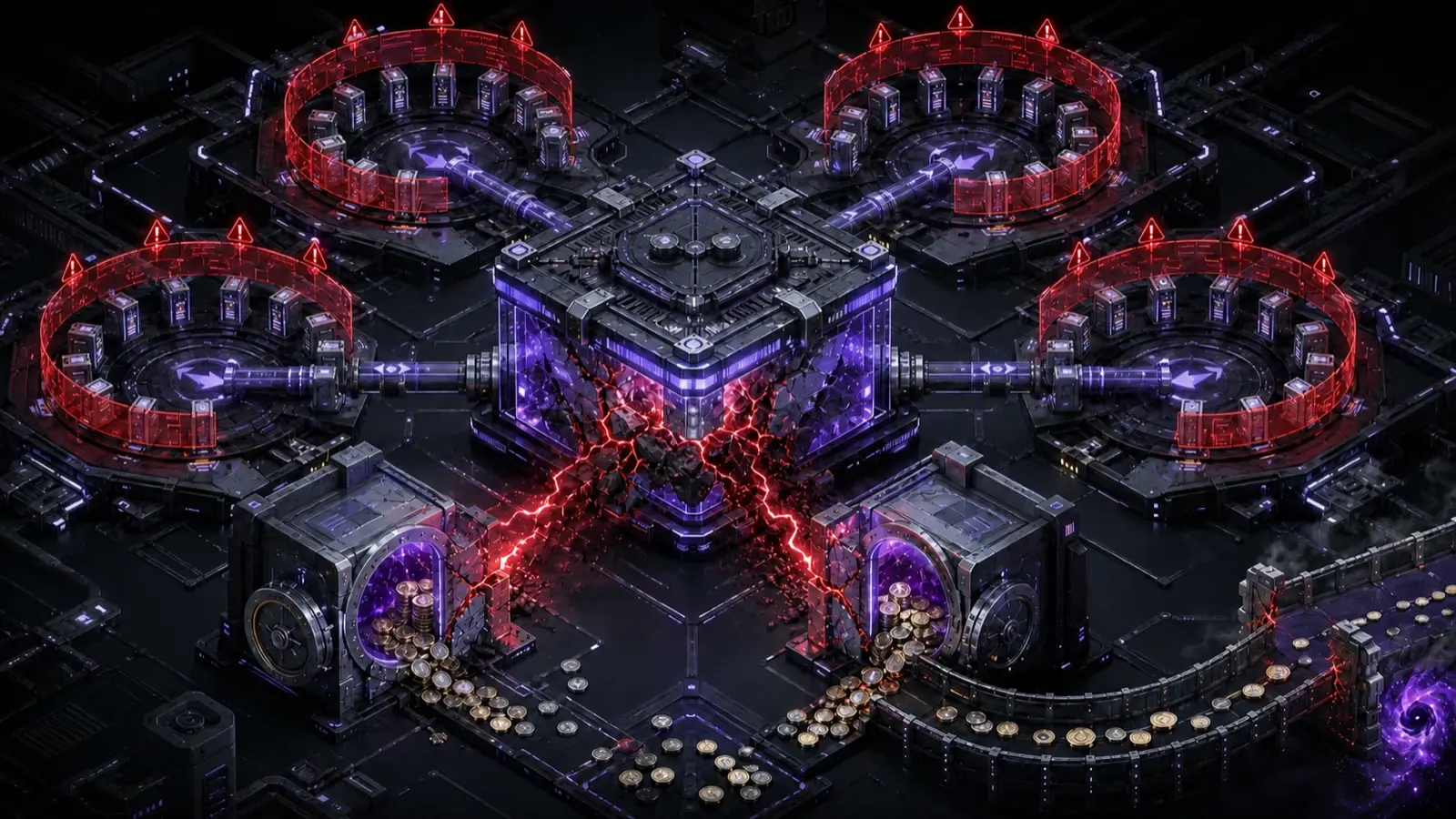
Bottom line: This was not a hack of the Cosmos Hub, the ATOM token or every chain connected through IBC. It was an exploit of Cosmos EVM, a shared software stack that lets independent Cosmos SDK chains run Ethereum-compatible applications.
Attackers used the same class of vulnerability against several networks in August 2026. KiiChain reported that 148.33 million KII was drained across 18 attacks. TAC said 2.99 billion TAC was moved from one account. MANTRA halted after two addresses were affected, but said no user funds were lost. Warden Chain also stopped, patched and restarted without a reported loss. Nesa separately disclosed malicious activity involving the vulnerability.
The immediate bug was an arithmetic underflow in the way Cosmos EVM mirrored balances after a staking operation. The larger failure was operational. A relevant fix had been visible in the public Cosmos EVM repository for months and reached patch releases on August 19. Yet multiple chains remained exposed, and the broad public recommendation to halt affected networks came only after funds had already moved.
That is why the incident matters beyond the dollar value stolen. Shared code gave Cosmos chains a faster route to EVM compatibility. It also created shared risk without an equally mature system for distributing emergency warnings, coordinating validator halts and confirming that every downstream chain had patched.
What was actually hacked?
Cosmos EVM is a reusable framework maintained by Cosmos Labs. A chain can add it to the Cosmos SDK to support Solidity contracts, Ethereum wallets, JSON-RPC and precompiles that expose native Cosmos functions to EVM applications.
A precompile is a bridge between two execution environments. In this case, it allowed a Solidity contract to call native Cosmos staking functions. That is powerful: developers can build Ethereum-style applications while accessing Cosmos-specific features. It is also a sensitive boundary because the EVM and Cosmos SDK must agree exactly on account types, balances and state changes.
The affected networks are sovereign chains. They have their own validators, tokens, applications and upgrade processes. They happened to share the vulnerable component. That means “the Cosmos hack” is useful shorthand, but technically imprecise.
There is no evidence that the Cosmos Hub consensus system was compromised or that ATOM was created or drained through this exploit.
How the Cosmos EVM exploit worked
The full upstream incident report had not been published when this article was completed on August 27. The clearest public technical account comes from KiiChain’s incident report, supported by the public Cosmos EVM patch and independent transaction analysis.
In simplified terms, the attack had four steps:
- The attacker calculated the future address of an exploit contract and first turned that address into a vesting account.
- After deploying the contract at that address, the attacker used the staking precompile to delegate slightly more than the account’s spendable balance.
- Cosmos EVM tried to subtract the delegation from the EVM-side balance. Because the subtraction was not guarded, the unsigned 256-bit number wrapped around to a value near its mathematical maximum instead of reverting.
- KiiChain says two additional, still-undisclosed defects let the attacker convert that false EVM-side balance into real transfers from victim accounts.
The public fix makes the first failure easy to see. Before the patch, SubBalance subtracted without checking whether the account had enough balance. The revised code stops execution if the amount being removed exceeds the available balance.
This was therefore a drain, not a mint. The attacker did not increase the reported token supply. The exploit broke balance accounting badly enough to move tokens that already existed.
That distinction is important but not reassuring. On TAC, independent on-chain reconstruction identified the drained account as the bonded_tokens_pool, the module account holding tokens delegated to validators. The staking records could still show tokens as bonded while the account that actually held them had been emptied.
Which chains were affected?
| Chain | Publicly reported impact | Status reported by August 27 |
|---|---|---|
| MANTRA | Two wallet addresses affected; the team said no user funds were exploited | Halted for roughly 30 hours, patched in v8.4.0 and resumed |
| TAC | 2,985,651,403 TAC drained from one account; no new supply created | Halted at block 24,671,475; post-mortem and recovery plan delayed while other chains patch |
| KiiChain | 148,326,583.15 KII drained across 18 attacks | Halted; restart plan includes fixes, recovery of on-chain funds and bridge rate limits |
| Warden Chain | Security incident reached the chain, but the team said all funds remained safe | Patched and restored after its consensus mechanism halted the network |
| Nesa | Team confirmed malicious behavior exploiting the Cosmos EVM vulnerability | Services taken offline for a software fix and remediation |
Cosmos Labs has not published a complete list of affected chains or an aggregate loss figure. Its August 26 update said many affected chains had patched and instructed operators below v0.6.2 or v0.7.2 to halt and upgrade immediately.
KiiChain: 148.33 million KII drained
KiiChain published the most detailed project report. It said an attacker repeated the technique 18 times on August 22, taking 148,326,583.15 KII before the network stopped at block 9,355,723.
Of that total, 80,728,575.06 KII, or 54.4%, remained on KiiChain in attacker-controlled addresses frozen by the halt. KiiChain plans to recover those tokens through a coordinated state migration when validators restart the network.
The other 67,597,997.87 KII crossed to BNB Smart Chain through Hyperlane. KiiChain said 64.6 million KII was sold for approximately 1.61 million BUSD, while 3 million KII reached a KuCoin deposit address. The exchange freeze request was still pending in the published report.
KiiChain also plans to cap Hyperlane outflows at 10 million KII per rolling 24 hours. A bridge limit would not repair the original bug, but it could turn a future instant drain into a slower outflow that monitoring and validators have time to stop.
TAC: the staking pool was emptied
TAC’s official update said an attacker moved 2,985,651,403 TAC from one account on August 22. It stressed that supply did not increase and that non-TAC assets remained intact.
Independent researchers traced the transaction to TAC’s bonded-token pool. Their reconstruction found that the attacker bridged most of the haul to BNB Chain within minutes, while the network did not stop until about four hours later. Those bridge timing and wallet-attribution figures are on-chain analysis, not yet a final TAC post-mortem.
TAC initially said it would publish a technical report and relaunch plan on August 25. It later delayed both documents at Cosmos Labs’ request so other affected networks could patch before more exploit detail became public.
MANTRA and Warden contained the immediate damage
MANTRA halted first, on August 20. The team said the incident affected two addresses but no user funds were exploited. It deployed a patched v8.4.0 build and resumed block production on August 22 after roughly 30 hours.
Warden said its consensus mechanism stopped the network when the vulnerability was reached. It patched and restored the chain, reporting that all funds remained safe.
The contrast is instructive. The same shared weakness produced very different outcomes depending on the target account, detection speed, bridge exposure and how quickly validators could coordinate a halt.
The patch and warning timeline
The most contentious part of the incident is not whether a patch existed. The repository history confirms that it did. The dispute is whether the risk was communicated with enough urgency before attackers reused it.
| Date (UTC) | What happened |
|---|---|
| May 15 | The balance-underflow guard was merged into the Cosmos EVM main branch in PR #1176 |
| July 27 | v0.6.1 and v0.7.1 shipped without that underflow guard |
| August 19 | v0.6.2 and v0.7.2 included the guard and advised chains to upgrade for “important security fixes” |
| August 20–22 | MANTRA halted, patched and restarted |
| August 22 | TAC and KiiChain were exploited and later halted |
| August 24 | Cosmos Labs publicly confirmed an ongoing incident and advised contacted chains to request validator halts |
| August 25–26 | Cosmos Labs named v0.6.2 and v0.7.2 as the minimum safe patch lines and said many chains had upgraded |
The v0.7.2 release did call the changes important security fixes and recommended an upgrade as soon as possible. However, the release notes did not identify the underflow, affected configurations or active exploitation. That omission can be reasonable during a silent-patch process because publishing a recipe can endanger unpatched networks.
But silent patching only works when maintainers privately reach every exposed operator first, give them time to deploy and verify completion. Cosmos Labs’ own security policy says critical fixes may be distributed privately and that premature disclosure can put unpatched networks at risk.
KiiChain alleges that it received no advance warning before the public release, that the risk was not marked as a live critical emergency when it was later communicated, and that no immediate halt was recommended until after MANTRA, TAC and KiiChain were hit. Exact private messages and timestamps have not been published, so that allegation cannot yet be independently settled.
What is independently visible is uncomfortable enough: the protective code change was public long before all downstream chains were safe, and a broad public halt recommendation arrived after multiple exploits.
Cryptocito’s view: the bug exposed an ecosystem problem
Cosmos creator Cryptocito, who has covered the ecosystem for more than five years, argued that the exploit revealed more than a software defect.
“The latest Cosmos EVM vulnerability is bad. Not only because it exposes technological- but also coordination issues.”
The latest Cosmos EVM vulnerability is bad. Not only because it exposes technological- but also coordination issues.
— Cito (@Cryptocito) August 26, 2026
His August 26 post places the incident inside a longer decline. He says projects, validators and developers have surrendered, left or migrated—often to Solana and Zcash—and argues that Cosmos Labs’ institutional focus came with a major trade-off. Those migration claims are his observation, not a comprehensive ecosystem census.
The institutional shift itself is visible. The official Cosmos Stack roadmap for 2026 emphasizes enterprise adoption, compliant financial applications and infrastructure for banking, government and critical systems. Cosmos EVM is used by projects including Ondo, MANTRA, TAC and the XRP sidechain.
That strategy is not inherently wrong. Institutional deployments can produce durable revenue and give open-source infrastructure a path beyond token incentives. Cryptocito is also right that a brutal market forces projects to earn revenue or disappear.
The trade-off is that an enterprise strategy raises the required standard. Banks and tokenized-asset issuers do not only need fast execution and regulatory features. They need predictable upgrades, a complete operator registry, emergency contact coverage, practiced validator runbooks and proof that a critical patch reached every exposed production network before its diff became public.
In that sense, the hack strengthens Cryptocito’s coordination argument. Cosmos succeeded at making a shared stack useful across sovereign chains. It had not yet made emergency response equally shared.
Our analysis: Cosmos needs a security control plane
The lesson is not that modular or open-source software is doomed. Ethereum clients, Bitcoin implementations and cloud libraries all share critical code. Shared components can be safer because more researchers inspect them and fixes benefit many users at once.
The missing piece is a security control plane around that code.
For Cosmos EVM, that should include:
- a verified inventory of every production chain, version and risky feature configuration;
- mandatory 24/7 security contacts for maintainers, validators, bridges and major exchanges;
- severity-tagged private alerts that distinguish “upgrade soon” from “halt now”;
- patch acknowledgements and readiness checks, not just a release announcement;
- pre-agreed halt and restart procedures for each validator set;
- bridge outflow limits and anomaly alerts that can contain losses while a chain stops; and
- a public post-incident report that reconciles the maintainer and affected-chain timelines.
Sovereignty complicates this. Cosmos Labs cannot press one switch to stop every independent chain, and it should not have unilateral power over them. But sovereignty does not excuse an improvised phone tree during an active exploit. Each chain can retain control while participating in a common, tested emergency protocol.
The hardest question is accountability. If projects import a v0.x stack that the repository itself says is still being audited and tested, they accept integration risk. Maintainers still have a duty to handle known critical defects responsibly. Validators must be reachable and ready to halt. Bridges need circuit breakers. No single group owns the entire failure, but every group owns part of the response.
Can Cosmos recover from this?
Yes, but recovery requires more than token prices bouncing or affected chains restarting.
Cosmos remains a widely used open-source stack with real technical value. The exploit did not invalidate appchains, IBC or the Cosmos SDK. It did show that a mature-looking ecosystem can still have immature incident coordination at the exact boundary where shared code meets sovereign operations.
Cryptocito ends with a cautious belief that there is still a path back. The practical version of that optimism is measurable: publish the full incident report, reconcile the disputed warning timeline, confirm every affected chain, audit the remaining precompile boundaries and make emergency coordination a product rather than an informal relationship.
The code bug can be patched once. Trust returns only when the next critical bug is handled before an attacker turns a public diff into a multi-chain exploit kit.
Cosmos EVM hack FAQ
Was the Cosmos Hub hacked?
No evidence shows that the Cosmos Hub, ATOM or IBC consensus was compromised. The vulnerability affected the separate Cosmos EVM software stack used by a number of independent Cosmos SDK chains.
How much was stolen in the Cosmos EVM hack?
There is no authoritative aggregate dollar figure. KiiChain reported 148.33 million KII drained and about 1.61 million BUSD realized from sales. TAC reported 2.99 billion TAC moved, but the eventual recoverable value and attacker proceeds remain subject to its delayed post-mortem. MANTRA and Warden said no user funds were lost.
What caused the Cosmos EVM exploit?
A staking-related balance subtraction could underflow instead of reverting, allowing an EVM-side balance to wrap to an enormous number. KiiChain says the attacker combined that flaw with a specially prepared vesting account and two other undisclosed defects to move real funds.
Which Cosmos EVM versions contain the patch?
Cosmos Labs told operators to upgrade to at least v0.6.2 or v0.7.2, depending on their release family. Operators on earlier versions were advised to halt until the patch could be deployed.
Why did validators halt the affected chains?
A halt stops new blocks, preventing additional exploit transactions and trapping funds that have not crossed a bridge. It also gives developers and validators time to test a patched binary and coordinate a safe restart.
Are user funds safe now?
Safety depends on the specific chain, software version and its recovery status. Users should follow only the official chain and exchange channels, avoid sending funds to halted networks and never trust unsolicited recovery messages.
Sources and evidence limits
This article used the Cosmos Labs incident notice and patch guidance; the Cosmos EVM v0.6.2 and v0.7.2 releases; PR #1176; the Cosmos Labs security policy; official disclosures from KiiChain, TAC, MANTRA, Warden and Nesa; independent transaction analysis for TAC; and Cryptocito’s attributed commentary.
Evidence limit: Cosmos Labs had not published its complete incident report, affected-chain list or aggregate loss figure by August 27. KiiChain’s description of private notifications is an allegation from an affected project, not an independently verified record of those communications. TAC’s final post-mortem and recovery plan were also pending. This article will need updating when those reports are released.
Disclosure: This article is for general information and does not constitute financial or investment advice. Do not send funds to a halted chain or act on unofficial recovery instructions.
Share
Found this useful?
Share it with someone who'd want to read it.
Related

What Happened to Harmony ONE? Inside the 4 Billion Token Exploit
Harmony patched a cross-shard replay flaw after roughly 4 billion ONE appeared without authorization. The incident follows years of bridge losses, token inflation and failed recovery.

Trump-Linked World Liberty Launches $4B USD1 on Canton
World Liberty Financial's USD1 is now natively issued on Canton, giving tokenized institutional markets another dollar settlement option.
What Is HKDAP? Standard Chartered's Hong Kong Stablecoin Plan
HKDAP is Hong Kong's first licensed HKD stablecoin. Here is what Standard Chartered is building, why it matters and how far the plan could go.