

What is Elastos? Updated overview
Elastos is a blockchain and Web3 infrastructure project designed to give users more control over identity, data and digital assets. ELA is its native token. Its architecture separates the main chain from smart-contract and identity sidechains, alongside off-chain storage and communication tools. A decentralized internet is the goal; absolute protection against copying, malware or data leaks is not a guarantee.
Reading this guide: The original 2019 explanation and videos are preserved below as historical context. Its claims about total security, automatic erasure of medical records, invisible IP addresses and Ethereum’s limitations should not be treated as current technical guarantees. The updates here take precedence over those early descriptions.
How the parts fit together
According to the Elastos architecture documentation, the main chain uses Bitcoin merged mining (AuxPoW) together with Bonded Proof of Stake (BPoS). ESC is the EVM-compatible smart-contract sidechain; EID handles decentralized identity operations. Hive supplies off-chain storage, while Carrier provides peer-to-peer communication. These are separate components, rather than a single virtual machine that makes every application safe.
Elastos’ main-chain documentation describes ELA transfers, governance, validator registration and cross-chain events as main-chain functions. General-purpose contract execution lives on sidechains. For a user, that distinction matters: selecting the right network and evaluating the transfer mechanism are part of using the ecosystem safely.
Security update: July incidents and September restart
The Elastos DAO / Elacity Labs announcement dated September 1, 2026 reports that ESC and EID resumed, with transfers to and from the main chain reopened following a full-stack review. It distinguishes a July 13 cross-chain flaw, which created ESC ELA without matching main-chain reserves, from a separate July 20 main-chain value-overflow flaw.
The same announcement said a final reserve credit was still pending and PG Chain’s ELA cross-chain transfers remained disabled. Those are statements from that dated recovery report, not confirmation that every recovery step is complete today. Check subsequent official notices and the relevant network before transferring funds.
Boxmining’s take: Bitcoin merged mining is one security mechanism. It does not certify bridge code, applications, wallets or storage permissions. The incidents make the original article’s blanket safety claims untenable. Judge each component and its failure modes, rather than relying on the “secured by Bitcoin” headline.
Original 2019 explanation
Elastos is a third generation technology that leverages blockchain technology in giving internet users complete control over their digital properties. The protection that Elastos provide is beyond cryptocurrencies or private data. It covers other intellectual properties such as books, games, movies, and business ideas.
Elastos is a new Internet technology that is revolutionizing online security and smart technology. Elastos is built on the concept of removing middleman, monetizing computing power, protecting digital assets and offering incentivised digital properties transactions with enhanced security and speed at an affordable cost.
How does Elastos work?
Current clarification: The sandbox examples below describe the original design ambition. A recipient can still photograph or otherwise capture information they can view. Do not use these examples as a promise of copy prevention, automatic deletion or suitability for medical data.
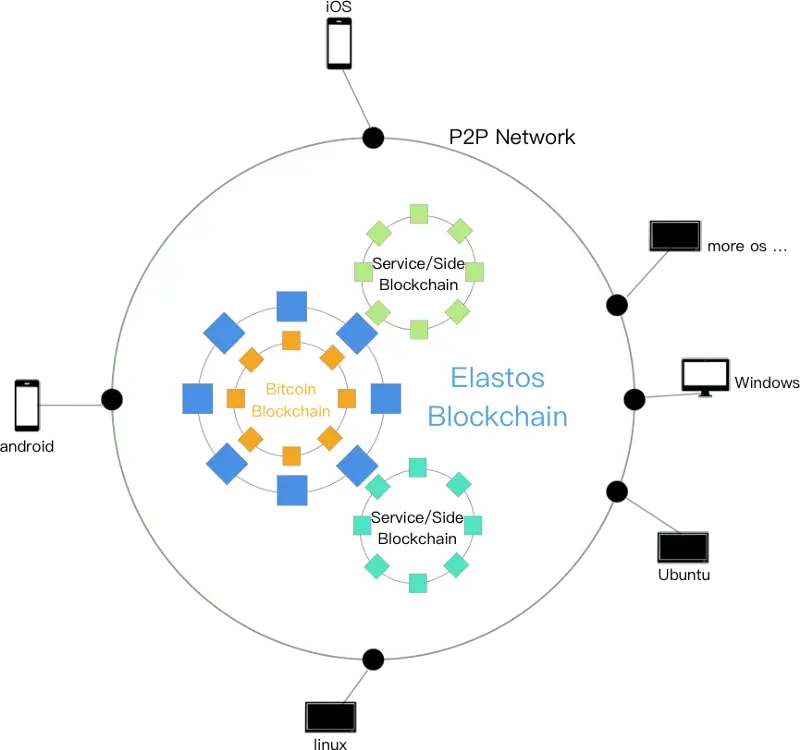
Elastos operates in an isolated environment called a virtual machine that runs on elastos runtime. Its is a lightweight operating system kept in a little box. To penetrate the system, an attacker has to create their own box and connect to the user’s data.
If hackers manage to breach the security, Elastos does not grant Internet access so the information derived cannot be sent out or uploaded to the third-party websites like YouTube, Facebook or Dropbox.
Alternatively, the hacker may try to download it to external storage, but elastos requires that the owners of the data grant permission from their end. Therefore unless the owners voluntarily share their digital assets, hackers cannot take possession of it giving owners exclusive protection over the data they secure with elastos.
In another instance, assuming the hackers try to connect another virtual machine like engineering artificial intelligence (AI) scanner, it can only scan and check the data, but it is not transferable as it is an isolated device. The information cannot be passed on to the outside world.
In another real-life instance, assuming you have a session with your doctor and he connects to your virtual machine, he can only read your medical report but will not be able to save a copy. It is also imperative to the point that the moment you close your Elastos machine, the information viewed by the doctor will be permanently erased guaranteeing you topmost security.
The Blockchain Technology Behind Elastos
Now that we know how Elastos works, it is possible for readers to conclude that Elastos does not need a blockchain technology to function in reality, the blockchain provides the secure ID to access Elastos.
In a case where a hacker tries to override the user’s security, it is the blockchain that will be responsible for the assurance that the ID is authentic, not tampered with, void of virus and malware, and perfectly matches with the one registered in the block.
Blockchain provides a layer of trust for all the virtual machines that want to connect to a system.
Real Life Application of Elastos
Business and Enterprise
It helps businesses and enterprises to protect the trade secrets, for instance, Coca-Cola can use it to store their recipe menu which will not be available to anyone without their permission
Professionals
To safeguard valuable private data and ensure that only people with permission can access the information stored on it
Content Creators
Authors, content creators, movies and game developers can leverage the use of elastos in securing the ownership of their intellectual properties. With that, they can scale up their earnings and prevent illegal distributions of their contents to unauthorized users.
Also, the content owners can use elastos to create a scarcity of their digital asset thereby increasing its value.
Developers
Elastos provides large blockchain applications in a secure environment and keeps contents intact after multiple uses
Ethereum vs. Elastos
Updated comparison: Ethereum now scales through layer-2 rollups, so the single-chain comparison below is historical. Elastos separates main-chain functions from its own sidechains; ESC’s EVM compatibility supports familiar smart-contract tooling. That does not establish that Elastos is universally faster, safer or immune to congestion or DDoS attacks.
Ethereum operates on a single main chain structure leading to speed limitation while elastos adopts main chain and side chain structure that speeds up the transaction, payment and smart contract support for several applications and services
Ethereum experiences network congestion and data redundancy while Elastos is the more secure runtime with the independent operating system, software development kit (SDK) that speed up the operating process and prevent data congestion.
Ethereum exposes data to risk as it employs a front end decentralized application (DApps) while elastos make use of a safe DApps prevented from accessing the networks thus protecting data from DDos. Also, elastos doesn’t make use of IP addresses which implies that hackers cannot track users’ activities.
Conclusion
Editorial qualification: The original conclusion below expresses the project’s early ambition. “Total protection” is not a supportable security guarantee, and the technology is not a requirement for every internet user.
In conclusion, Elastos is a disruptive third generation blockchain technology that offers total protection of data and vital confidential information for an individual or a corporate body. The innovative technology will help content owners to maximize the returns on the sale of their digital assets thus making more from their intellectual properties. Elastos is a very beneficial technology that every user of the internet should have in their possession to create a more secure internet environment for all.
Elastos FAQ
Is ELA the same as Bitcoin?
No. ELA is Elastos’ native token on its own network. Merged mining lets participating Bitcoin mining pools submit auxiliary proof of work for Elastos. It does not turn ELA into BTC or make an Elastos sidechain a Bitcoin account.
Does decentralized identity make my data private?
Not by itself. Identity, access permissions and storage are different layers. A valid identity does not prove that a device is free of malware or that an authorized recipient cannot retain what they see. Review what an application stores, who operates the storage and what permissions you grant.
What should I check before using Elastos?
Check official recovery updates, the intended chain, the wallet’s network support and the risks of any cross-chain transfer. Keep recovery phrases private. Start with our guides to Bitcoin and private keys if these distinctions are unfamiliar.
Primary sources checked October 22, 2026. Network status statements above are attributed to their dated announcements; no live yield, price or fee is promised.
Share
Found this useful?
Share it with someone who'd want to read it.
Related
Enigma ENG Status 2026: Secret Network and Token Swap
Enigma ENG is no longer supported, and its SCRT swap is closed. Learn what happened to Catalyst, the SEC settlement and Secret Network.

Monero (XMR) in a Nutshell
Monero is a rather unique member of the cryptocurrency family thanks to its focus on privacy and absence of the traditional open blockchain…

What Happened to Harmony ONE? Inside the 4 Billion Token Exploit
Harmony patched a cross-shard replay flaw after roughly 4 billion ONE appeared without authorization. The incident follows years of bridge losses, token inflation and failed recovery.