
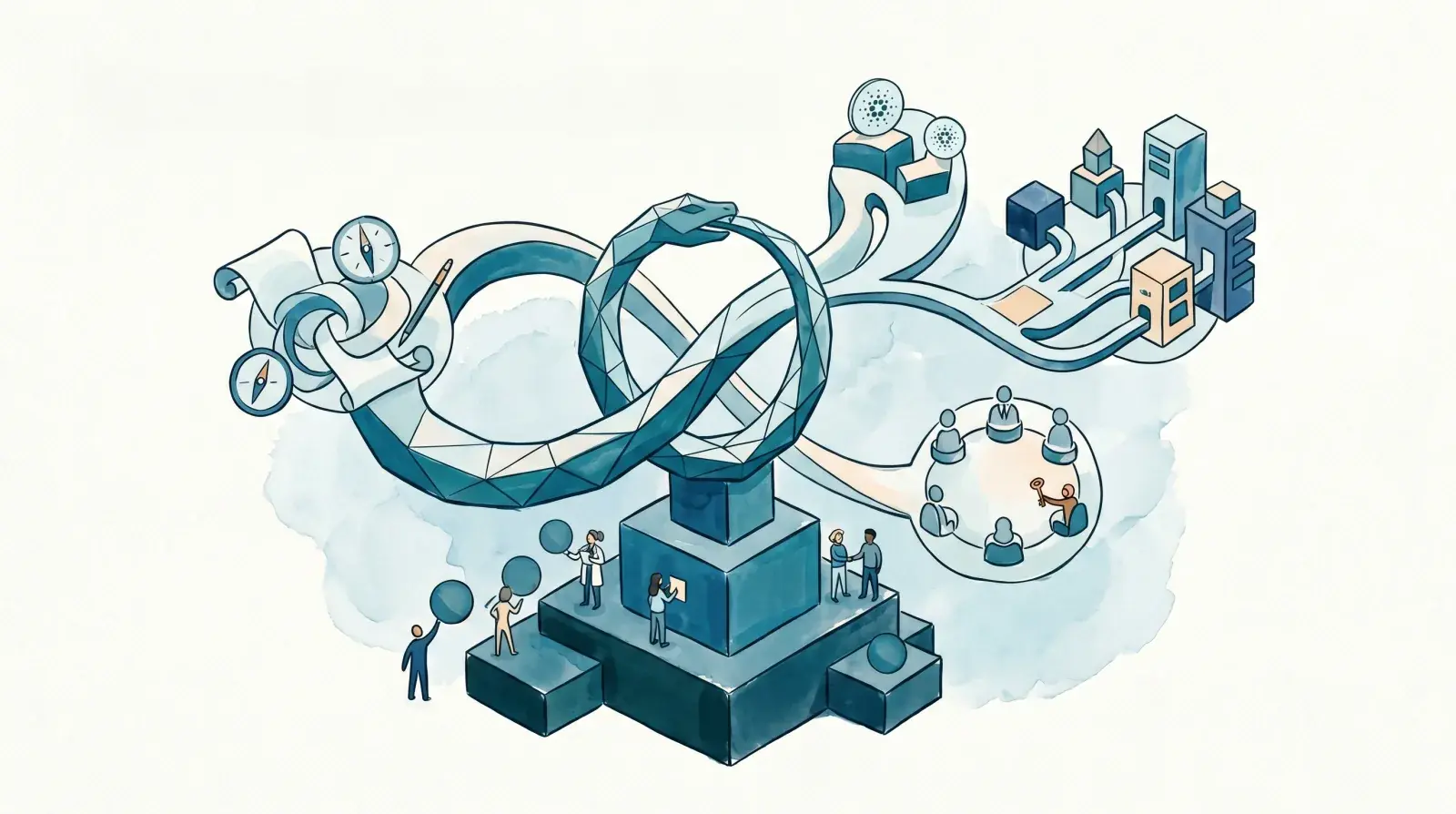
Cardano is a proof-of-stake blockchain using the Ouroboros consensus family and an extended UTXO ledger. ADA is used to pay transaction fees, delegate stake, operate stake pools and participate in on-chain governance. The network now supports native assets and Plutus smart contracts; these are no longer future roadmap items.
Cardano’s governance changed fundamentally after the Chang upgrade in 2024 and the Plomin hard fork on 29 January 2025. ADA holders can delegate voting power to delegated representatives (DReps), while DReps, stake pool operators (SPOs) and a constitutional committee have defined roles in ratifying governance actions under the Cardano constitution.
Safety warning: Delegating ADA is not the same as sending it to a pool. Use a compatible self-custody wallet, verify the pool ID and keep the recovery phrase offline. No legitimate pool operator needs your seed phrase or a transfer of custody to delegate stake.
Cardano status in 2026
| Topic in the original guide | Current status |
|---|---|
| Shelley public testing phase and future staking | Historical; delegation and stake pools have operated on mainnet since 2020 |
| Smart contracts as a future computing layer | Live since the Alonzo upgrade in September 2021 |
| ADA-only ledger | Outdated; Cardano has supported native fungible and non-fungible assets since 2021 |
| Daedalus required to use ADA | Incorrect; Daedalus is one full-node desktop wallet among multiple compatible wallets |
| Future Daedalus mobile wallet | No official Daedalus mobile app; mobile apps using its name should be treated as suspicious |
| Founding entities control upgrades | Changed; Chang and Plomin established community on-chain governance |
| Governance roles | DReps, SPOs and the constitutional committee now vote on defined action types |
How Cardano works
Cardano uses Ouroboros proof of stake. Time is divided into epochs and slots, and elected stake pools produce blocks. ADA holders can delegate staking rights to a pool while keeping control of their coins. Rewards depend on protocol parameters and pool performance and are not guaranteed.
Cardano’s extended UTXO model represents value in transaction outputs while allowing scripts to enforce spending conditions. Native tokens are tracked by the ledger without requiring an ERC-20-style transfer contract. Each native asset is identified by a policy ID and asset name, and its minting policy controls creation and burning.
Plutus validators add programmable spending rules. Smart-contract support arrived with Alonzo in 2021 and has since gained new language versions and cryptographic capabilities, including Plutus V3 with Chang. Formal methods can improve assurance, but they do not prove that every application is correct or economically safe.
ADA staking
A delegator selects a stake pool through a compatible wallet and registers delegation on-chain. The ADA remains spendable in the wallet; delegation assigns staking power rather than transferring ownership. Spending changes the live stake associated with that address without requiring a separate unstaking transaction.
Pool rewards are calculated by the protocol and distributed after the applicable epoch delay. Performance, saturation, fixed and variable fees, pledge and protocol parameters affect results. A high advertised return can be misleading, and operating multiple pools does not itself guarantee reliability or decentralization.
Cardano governance after Plomin
CIP-1694 introduced three governance bodies. DReps receive voting power delegated by ADA holders. SPOs vote on specified actions, including relevant hard-fork and security decisions. The constitutional committee checks whether governance actions comply with the constitution.
Anyone meeting the protocol requirements can submit a governance action, but ratification thresholds differ by action type. Governance delegation is separate from stake-pool delegation: a wallet can delegate block-production stake to one pool and voting power to a DRep.
The founding entities have relinquished the old genesis keys. That removes a legacy control mechanism, but decentralized governance still carries voter-participation, delegation-concentration, treasury and constitutional-interpretation risks.
Wallet choices
Daedalus is a desktop full-node wallet that downloads and validates the chain. It is not required for Cardano use and has no official mobile version. Light wallets rely on other infrastructure and trade some independent validation for convenience.
Whichever wallet is used, confirm it through an official source, make an offline recovery backup and test small transactions first. Native tokens can share similar names, so verify the policy ID rather than trusting a ticker or image.
Main Cardano risks
- Key risk: a leaked or lost recovery phrase can cause irreversible loss.
- Smart-contract risk: Plutus applications can contain logic, oracle or economic flaws.
- Native-token risk: anyone can create assets with misleading names; the policy ID is decisive.
- Staking risk: rewards vary, pools can miss blocks, and poor delegation choices can reduce returns.
- Governance risk: concentrated delegation or low participation can shape protocol and treasury decisions.
- Wallet risk: fake Daedalus mobile apps and malicious browser wallets are recurring phishing vectors.
- Market risk: ADA price can fall regardless of network usage or technical progress.
- Bridge risk: assets moved through cross-chain systems inherit risks outside Cardano’s base ledger.
Original Cardano guide (historical archive)
The original author-written sections below are preserved substantially intact. Its Shelley testnet, future staking, two-layer roadmap, Daedalus feature list and unfinished-platform discussion reflect earlier development stages.
Cardano is a decentralized smart contract platform which would be driven by peer reviewed academic research and capable of running both financial applications and decentralised applications. Established by a former co-founder of Ethereum, Cardano aims to improve on Ethereum by offering low-cost, secure and scalable transactions. To improve smart contract security, Cardano uses the programming language Haskell which has been proven to be easier to audit and formally verify. In addition, Cardano openly addresses the need for regulatory oversight whilst maintaining consumer privacy and protections through an innovative software architecture.
Check out our explainer video on Cardano ($ADA)
What is the ADA token and its uses?
ADA is Cardano’s native cryptocurrency. It was launched on 1st January 2018 through an initial coin offering as a utility token and will have 45 billion total supply. It is currently the 8th most popular cryptocurrency based on market capitalisation according to CoinGecko.
Upon the opening of the Shelley Public testnet on 9th June 2020, and any operator can set up a Cardano stake pool in anticipation for staking and delegation on the mainnet to be released in Summer 2020.
Eventually, ADA will allow users to send value between two parties, pay for goods or services, deposit funds on an exchange, or enter an application. ADA will also be used to power the transactions on the Cardano network.
Founder: Charles Hoskinson

Cardano – development of the blockchain protocol
Cardano aims to become the third generation blockchain, overcoming issues with previous generations of blockchains namely lack of scalability, interoperability and sustainability. Cardano aims to develop its platform upon these 2 guiding principles:
- Peer-review: any science guiding the solutions to these issues goes through peer review.
- High assurance code: Cardano aims to bring the same level of scientific rigour for mission critical systems such as aerospace to the development of their project.
Cardano’s platform has the following key features:
- Cardano will be built in Haskell code. Haskell uses a math based approach that results in a much more secure and reliable protocol.
- A formally verified Proof of Stake consensus called Ouroboros. It is the first provably secure blockchain protocol developed by the IOHK team and peer reviewed. It has advantages over the traditional proof of work blockchains (e.g. as used by Bitcoin) by requiring less computation resources (there will be no mining) and is thus cheaper to run, yet being just as secure as the more popular Proof of Work algorithm. It also comes with a novel reward mechanism to prevent attacks like block withholding and selfish-mining.
- Recursive InterNetwork Architecture (RINA): Cardano is looking towards building RINA in order to reduce the bandwidth which is required for communicating and disseminating data. The idea is that RINA has fewer protocols but is able to work faster, yet still providing transparency, privacy and scalability.
- The protocol is geared towards protecting users’ privacy rights while taking into account the needs of regulators. In doing so, Cardano is the first protocol to balance these requirements in a nuanced and effective way, pioneering a new approach for cryptocurrencies.
- Cardano will also be completely open source and patent-free.
Cardano’s platform is being constructed in 2 layers- a settlement layer and a computational layer. This gives the system flexibility during maintenance and allow for upgrades by way of soft forks.
After completion of the settlement layer that will run ADA, the separate computing layer will be built to handle smart contracts. Cardano will also run decentralised applications, or dapps, services not controlled by any single party but instead operate on a blockchain.
Advantages and Disadvantages of Cardano?
Advantages of Cardano
Many smart contract users believe that Cardano holds the key for long term secure development. This because of the numerous hacks and vulnerabilities in platforms such as Ethereum. Cardano founder Charles Hoskinson has criticized Ethereum as a “rushed product” with vulnerabilities which led to famous hacks such as The DAO. This could be viewed as a symptom of the flaws in Ethereum’s programming language, Solidity. Cardano improves on this by allowing for development using Haskell which can be formally verified.
Cardano’s use of the proof of stake model in itself brings lots of advantages such as less susceptibility to interference because the nodes will be responsible for throughput and thus eliminating the need for extra machines. In turn less energy will be consumed which is better for the environment.
Rewards are given out based on the number of tokens held rather than the amount of computational power contributed, which is fairer.
The platform’s 2 layered system allows for each layer to be responsible for a complete set of tasks. This means more potential for interoperability with different cryptocurrency platforms and is therefore more scalable compared to Ethereum.
Disadvantages of Cardano
Critics of Cardano have pointed to the slow development and overly ideal goals of the project. This can be risky for Cardano because it could be overtaken by more aggressive competitors, or the regulatory environment can change meanwhile.
Many features promised by the Cardano team are still not yet available. So a lot of what is said about how its cryptocurrency ADA would work is still theoretical.
What is the Daedalus wallet?
In order to store and use ADA, you must install Cardano’s Daedalus wallet. With the wallet you can send and receive ADA as well as view your transaction history.
The Daedalus wallet will also offer the following features:
- Unlimited Accounting – Manage any number of wallets with Cardano’s innovative hierarchical deterministic wallet implementation. This will give you more control over how your funds are organised. It also has powerful backup features to help recover your funds anytime.
- Advanced Security – Cardano will not hold your keys. They use the most advanced cryptography in the world to ensure safety from attack and offer spending passwords and seeds for all your accounts.
- Export to paper certificates- Wallets can be exported to paper certificates giving users the option of placing funds in cold storage.
- Built with Web Technologies – Daedalus is built on top of Electron, a battle-proven open source development platform to build cross-platform desktop apps using Javascript, HTML and CSS.
The Daedalus wallet is still a work in progress, features which are expected to be coming soon include:
- Support for Bitcoin and Ethereum Classic.
- Staking features which allow ADA holders to earn more ADA tokens.
- A mobile wallet for both iOS and Android.
What is the Goguen Era of Smart Contracts?
On 12 September 2021, Cardano’s Alonzo hard fork upgrade went live on mainnet. Therefore, users can now create and deploy smart contracts on the Cardano blockchain.
To learn more about the Goguen era and Alonzo hard fork, see the current Cardano smart-contract documentation.
Cardano enters DeFi with Occam Finance ($OCC)
Occam Finance ($OCC) is a suite of DeFi (Decentralized Finance) solutions tailored for Cardano and managed and maintained by the Occam Association, a blockchain entity based in Switzerland. Currently, Occam offers 3 major products: OccamRazer, OccamX and OccamDAO.
Resources:
Website https://cardanofoundation.org/
IOHK website https://iohk.io/
Ouroboros whitepaper https://iohk.io/research/papers/#9BKRHCSI
Blog https://cardanofoundation.org/blog/
Frequently asked questions
What is Cardano?
Cardano is a proof-of-stake blockchain using the Ouroboros consensus family, an extended UTXO ledger, native assets and Plutus smart contracts.
What is ADA used for?
ADA pays fees, represents value, delegates staking rights, supports stake-pool operation and supplies voting power in Cardano governance.
Does Cardano support smart contracts?
Yes. Smart-contract support launched with Alonzo in September 2021 and later upgrades added newer Plutus capabilities.
Can Cardano create tokens and NFTs?
Yes. Cardano tracks user-defined fungible and non-fungible assets natively. Their policy ID and asset name identify them.
Does staking ADA lock or transfer it?
Normal delegation assigns staking rights while ADA remains under the wallet owner's control and spendable. A pool operator never needs the recovery phrase.
Are Cardano staking rewards guaranteed?
No. Rewards depend on pool performance, saturation, fees, pledge and protocol parameters and can vary between epochs.
What changed with Chang and Plomin?
Chang introduced Conway-era governance in 2024, and Plomin completed the transition to full community governance on 29 January 2025.
What is a Cardano DRep?
A delegated representative receives voting power from ADA holders and votes on applicable governance actions without taking custody of their ADA.
Is Daedalus required to use Cardano?
No. Daedalus is a desktop full-node wallet. Other compatible wallets can transact, stake and participate in governance with different validation tradeoffs.
Is there an official Daedalus mobile wallet?
No. Daedalus is desktop-only. Apps claiming to be a mobile Daedalus wallet should be treated as potential phishing.
Sources and further reading
Share
Found this useful?
Share it with someone who'd want to read it.
Related
Harmony ONE Explained: Sharding, Staking and Network Design
Learn how Harmony uses proof of stake, sharding and optimized network communication to pursue scalable blockchain infrastructure.
Kusama ($KSM): How is it Polkadot’s wild cousin?
Kusama is Polkadot’s faster-moving canary network. Learn how KSM, parachains, governance and experimentation differ from the main Polkadot ecosystem.
Algorand (ALGO) Guide
Algorand is a high-performance next-generation blockchain whose goal is to create a transparent system in which everyone can achieve…